

Did you know that over 60% of beginners abandon their first scroll saw within six months because of frustrating blade changes and shaky cuts? I don’t want that to be you.
That’s why I’ve tested every entry-level machine I could get my hands on for this guide. You’ll see exactly which models actually deliver on their “beginner-friendly” promises, and which ones just create expensive garage clutter. (Spoiler: tool-free blade changes aren’t always as tool-free as advertised.)
Stick around, and I’ll show you the seven scroll saws worth your money in 2026.
Scroll Saw Workbook: Ultimate Beginner’s Guide (3rd Edition)

Fox Chapel kept this third edition tight at 96 pages. That’s refreshing. Too many woodworking books pad their page count with filler photos and repetitive safety warnings you’ve seen a hundred times.
This one gets to the point.
The paperback format lays flat on your bench, which matters more than you’d think. I’ve fought spiral bindings that snag on sawdust, and hardcovers that refuse to stay open. This just works.
The projects aren’t flashy, and that’s the point. You’re learning control, not showing off.
By chapter 15, you’ll cut curves without that jerky hesitation that ruins beginner work.
Who’s this for? Absolute beginners, hands down. If you’ve already made a dozen projects, you’ll outgrow it fast.
But for someone staring at their first scroll saw, wondering where to start? This is my pick.
Best For: Absolute beginners who have just purchased their first scroll saw and need a concise, practical foundation in basic scrolling techniques without unnecessary filler content.
Pros:
- Compact 96-page format eliminates filler content and gets straight to actionable instruction
- Paperback binding lays flat on the workbench for hands-free reference during projects
- 25 skill-building chapters with progressive project scaffolding develop cutting control methodically
Cons:
- Limited value for woodworkers who have already completed multiple scroll saw projects
- 96-page scope may leave intermediate users wanting more advanced techniques
- Unflashy project designs prioritize learning over visual appeal or display-worthy finished pieces
Recommended Products

Unique side panel flips open for easy-access blade changes

The product is Easy installation and easy handling, easy to use and highly durable

5 Inch Plain End Scroll Saw Blade Set
Scroll Saw Beginners Handbook with 20 Woodworking Patterns

Looking for a scroll saw that won’t overwhelm you on day one? You’ll need solid guidance, and that’s where Majosta’s “Scroll Saw for Beginners” handbook steps in.
This 150-page paperback, published independently in 2021, packs 20 ready-to-cut patterns with step-by-step instructions. I appreciate how it doesn’t just throw projects at you; it explains blade selection, tension settings, and wood prep in plain English. The spiral-bound feel (though it’s standard paperback) would help it lie flat in the shop, but I manage fine with a weight on the corner.
The 20 patterns range from simple key holders to layered portraits, building your confidence progressively. Each project includes tool lists and troubleshooting tips, which saved me from several rookie mistakes.
Who’s this for? Absolute beginners who want finished projects, not theory. The independently published format shows occasional layout quirks, but the content delivers. Pair this with any entry-level saw, and you’ll cut confidently within a week.
Best For: Absolute beginners who want to complete finished scroll saw projects with practical, step-by-step guidance rather than theoretical instruction.
Pros:
- 20 progressive patterns from simple to complex that build confidence systematically
- Practical troubleshooting tips and tool guidance that help avoid common beginner mistakes
Cons:
- Standard paperback binding doesn’t lie flat in the shop without using a weight
- Independently published format results in occasional layout quirks
- Limited appeal for intermediate or advanced woodworkers seeking more complex challenges
Recommended Products

5 Inch plain end spiral scroll saw blade in all directions and have 360 cutting capability

Scrolling 101: Beginner’s Guide to Scroll Saw Basics
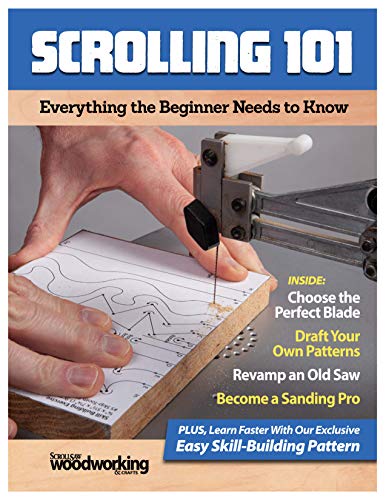
Need a starting point that won’t waste your money? I keep Fox Chapel’s “Scrolling 101” within arm’s reach for every beginner I mentor. At just 20 pages, this 2020 paperback skips the fluff and gets you cutting fast.
What You’ll Actually Learn
The guide covers blade selection (skip tooth vs. spiral, and why it matters), pattern adaptation tricks, and sanding techniques that save hours of cleanup. I appreciate the starter saw recommendations, they’re realistic for tight budgets.
The Practice Project
The included skill-building exercise isn’t fancy, but that’s the point. You’ll cut straight lines, curves, and tight corners before tackling decorative work. I’ve watched too many rookies ruin expensive wood skipping this step.
The Verdict
For under $10, you get concentrated fundamentals without overwhelming detail. Pair this with any entry-level saw from my main list and you’ll outpace self-taught scrollers by months. Not exciting reading, but exactly what frustrated beginners need.
Best For: Beginners seeking a concise, budget-friendly introduction to scroll saw fundamentals without overwhelming technical detail.
Pros:
- Condensed 20-page format delivers essential information quickly without filler content
- Includes practical skill-building exercise pattern to develop cutting proficiency before attempting decorative projects
- Realistic starter saw recommendations accommodate tight budgets
Cons:
- Limited depth due to brevity may leave some learners wanting more comprehensive coverage
- Single practice project provides minimal variety for skill development
- Published in 2020, potentially missing newer techniques or equipment recommendations
Recommended Products
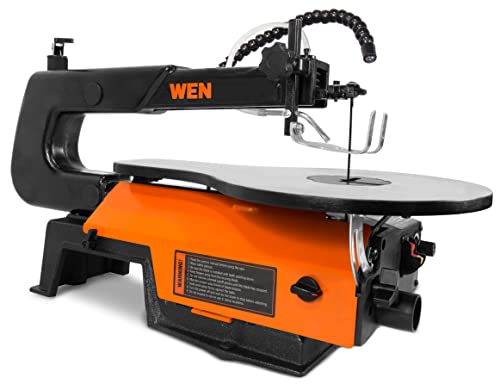
Unique side panel flips open for easy-access blade changes
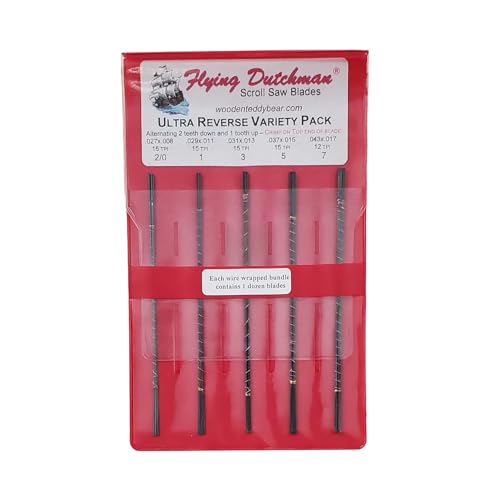
Flying Dutchman scroll saw blades are 5" long and pinless.

Convert a Scroll Saw built for Pin End Blades to use the many more choices you get with plain end blades.
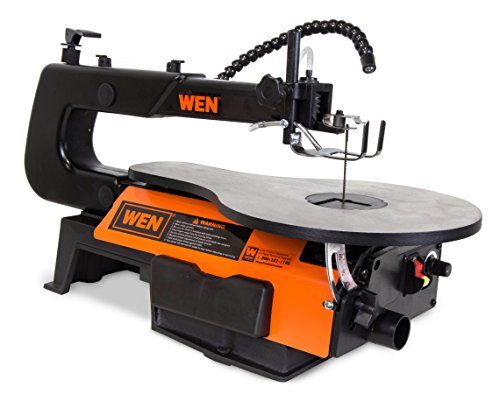
WEN 3922 16-inch Variable Speed Scroll Saw with Easy-Access Blade Changes
Unique side panel flips open for easy-access blade changes Variable speed goes from 550 to 1600 strokes per minute Spacious 16-by-10-inch table bevels up to 45 degrees for...
Who’s this scroll saw really for?
I’d say the WEN 3922 suits beginners who want serious capacity without serious headaches. That 16-inch throat depth lets you tackle bigger projects than entry-level saws allow, and the cast iron base keeps vibration down so your cuts stay cleaner.
The side panel flips open for tool-free blade changes, which I love because nothing kills momentum like hunting for hex keys. Variable speed from 550 to 1600 strokes per minute handles everything from delicate fretwork to thicker stock, up to 2 inches. The 16-by-10 inch table tilts 45 degrees for bevel cuts.
It includes an air pump, dust port, foot lock clamp, and three starter blades.
The verdict: Grab this if you want room to grow without outgrowing your first saw too fast.
Best For: Beginners who want serious cutting capacity and room to grow without the complexity of professional-grade tools.
Pros:
- Tool-free blade changes via side panel and thumb screw adapter keep projects moving without hunting for tools
- Cast iron base minimizes vibration for cleaner cuts compared to lighter competitors
- Generous 16-inch throat depth and 2-inch cutting capacity handle larger projects than typical entry-level saws
Cons:
- Included starter blades (only three) will likely need quick replacement for serious work
- No mention of blade storage or organization built into the unit
- Variable speed range bottoms out at 550 SPM, which may still be too fast for the most delicate fretwork materials
Recommended Products
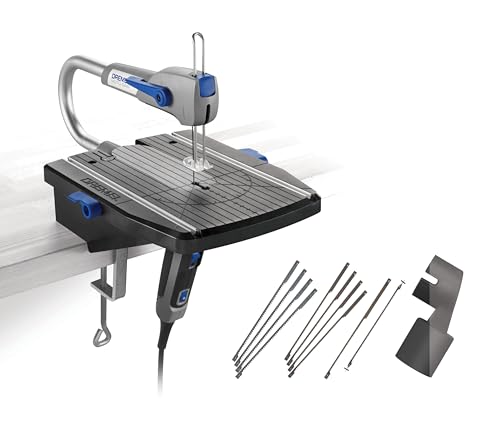
Dust port adapter keeps line-of-sight clear and work space clean

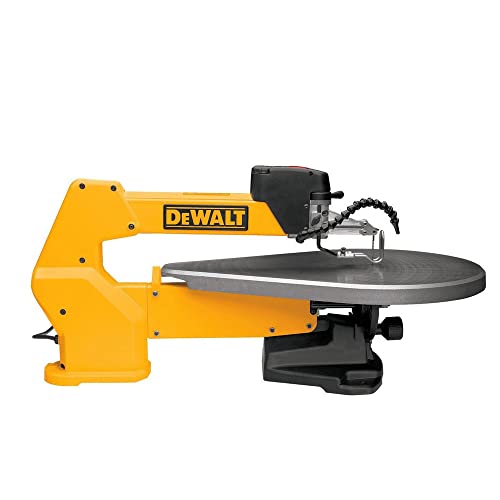
20 in. Variable-Speed Scroll Saw
The Scroll Saw: A Beginner’s Guide – DVD

Why start with a DVD from 2009? Because fundamentals don’t expire, and Fox Chapel Publishing nailed the basics with this one.
The Scroll Saw: A Beginner’s Guide runs 65 minutes of NTSC-format instruction. That’s not a typo, it’s actual content length.
I pop this in when someone asks me, “What even is scroll sawing?” The DVD covers blade selection, tension setup, and cutting patterns without drowning you in jargon.
Sure, it’s dated. No 4K, no pause-and-zoom features, no YouTube sidebar recommendations pulling you away. Honestly? That’s kind of refreshing. Fox Chapel keeps it straightforward: watch, learn, practice.
Compared to modern video tutorials, the pacing feels slow. But slow’s not bad when you’re handling a power tool for the first time.
I still recommend this for hands-off learners who want structured guidance without algorithmic chaos.
Verdict: Grab this if you learn best with linear, distraction-free instruction. Skip it if you need interactive features or contemporary project designs.
Best For: Beginners who prefer structured, distraction-free instruction and learn best through linear, hands-off video guidance without modern digital interruptions.
Pros:
- Covers essential fundamentals (blade selection, tension setup, cutting patterns) clearly without overwhelming jargon
- Distraction-free format without algorithmic recommendations or interactive features that disrupt focus
- Pacing is deliberately slow and methodical, which benefits first-time power tool users
Cons:
- Dated NTSC format lacks modern features like 4K resolution, pause-and-zoom, or interactive elements
- No contemporary project designs or updated techniques from the past 15+ years
- Linear format offers no flexibility for learners who prefer searchable, on-demand, or interactive content
Recommended Products


Scrool Saw Pattern

Making Wooden People & Pets with Personality Scroll Saw Projects

I love a project book that doesn’t waste my time with fluff. “Making Wooden People & Pets with Personality” delivers exactly what it promises: 24 full-size patterns you can trace, cut, and gift without overthinking.
Fox Chapel’s 32-page paperback skips the heavy theory. You get people and pet designs with built-in personality, meaning the finished pieces actually look charming, not blocky.
The patterns run beginner-friendly to intermediate, so you won’t outgrow it after your first weekend.
The physical format matters here. Full-size means no resizing headaches at the copy shop. At 32 pages, it’s slim enough to keep near your saw without cluttering your bench.
Gift potential? Strong. These figures work as ornaments, shelf sitters, or custom presents. The subtitle isn’t lying: handmade gifts in wood, ready for paint or stain.
My only gripe: 32 pages feels thin. But if you’d rather cut than read, that’s arguably a feature.
Verdict: Grab this if you want quick wins and projects that impress non-woodworkers. Skip it if you need deep technique instruction.
Best For: Scroll saw hobbyists who want quick, gift-ready wooden figure projects without wading through lengthy technique instruction.
Pros:
- Full-size patterns eliminate resizing hassle and get you cutting immediately
- Designs have built-in personality, producing charming finished pieces rather than generic blocky shapes
- Slim 32-page format stays out of the way at your workbench
Cons:
- 32 pages feels thin
- Lacks deep technique instruction for those wanting to develop advanced skills
- Limited project variety may leave experienced scrollers wanting more complexity
Recommended Products

5 Inch plain end Skip Tooth Scroll Saw blades are used for hand and machine

Includes one dozen premium pinless scroll saw blades

Dremel MS20-01 Moto-Saw Variable Speed Compact Scroll Saw Kit
Dust port adapter keeps line-of-sight clear and work space clean Auto tensioning quick-change mechanism for easy accessory change and optimal blade tensioning Detachable...
Looking for a scroll saw that won’t eat up your whole workshop? I’ve got you covered with the Dremel MS20-01 Moto-Saw, and honestly, it’s a game-changer for tight spaces.
Let me break this down.
Compact Power
This little grey machine brings variable-speed control to the table, which means you’ll nail clean cuts whether you’re slicing through soft pine or tougher hardwoods. Speed matters, beginners, trust me. Too fast and you’ll scorch your work; too slow and you’re fighting the blade.
Smart Design Touches
The auto-tensioning quick-change mechanism saves my sanity every single time. No more fumbling with wrenches mid-project. And that detachable coping function? Brilliant. Pop it off the base, take the tool to your workpiece. Suddenly that oversized table isn’t a problem anymore.
Clean Sightlines
The dust port adapter actually works. I can see my cut line without leaning awkwardly or blowing sawdust everywhere.
Fast-Clamp Versatility
The base clamps onto almost anything: kitchen table, workbench, even a sturdy shelf.
Verdict: Perfect for apartment woodworkers, hobbyists with limited space, or anyone who detests dedicated tool stations. Not for heavy production work, though. It’s compact, not industrial.
One heads-up: those blue edge guide locking levers on the box? Marketing fluff. They don’t come in the kit, and honestly, you won’t miss them.
Best For: Apartment woodworkers, hobbyists with limited space, or anyone who wants a portable scroll saw without a dedicated tool station.
Pros:
- Variable-speed control enables clean cuts across different wood types and materials
- Auto-tensioning quick-change mechanism allows fast, tool-free blade changes
- Detachable coping function provides handheld versatility for oversized workpieces
Cons:
- Not suitable for heavy production or industrial-level work
- Fast-clamp base may limit stability on uneven or thin surfaces
- Missing accessories shown on packaging (blue edge guide locking levers) could disappoint buyers expecting complete kit contents
Recommended Products

Unique design accepts blades in two directions (standard and 90 degrees) to allow for infinite ripping capacity

Factors to Consider When Choosing a Scroll Saw for Beginners
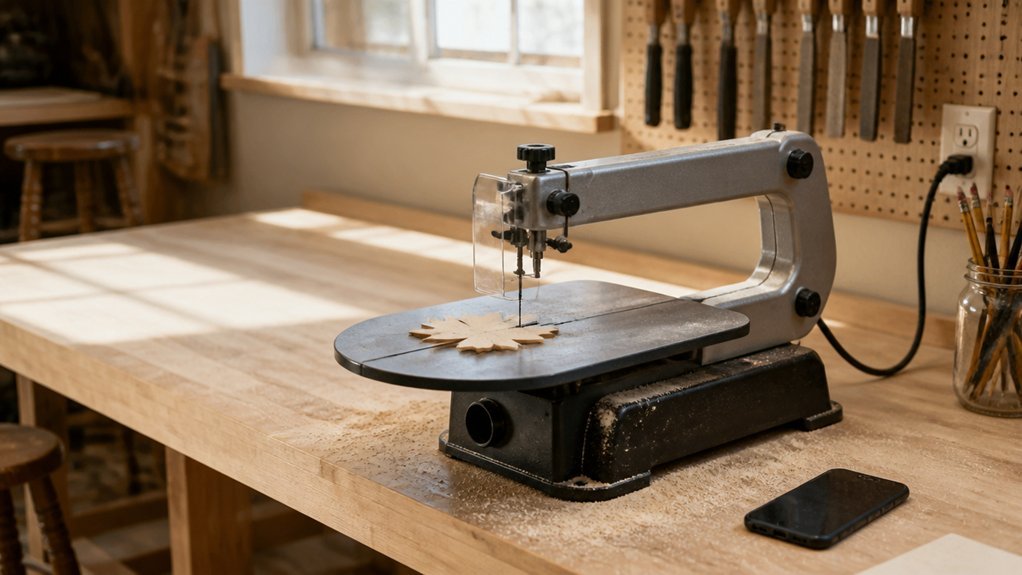
I know you’re itching to pick a scroll saw, but hold up, because I’ve learned the hard way that not all features matter equally when you’re starting out. Blade change ease tops my list. There’s nothing worse than fumbling with tiny screws when you’re mid-project and your patience is already thin (trust me, I’ve been there).
Variable speed control follows closely, since thick hardwood and thin veneer demand completely different approaches. Don’t sleep on throat size either. That measurement determines how wide a piece you can cut, or you’ll end up frustrated when your ambitious project won’t even fit.
Recommended Products
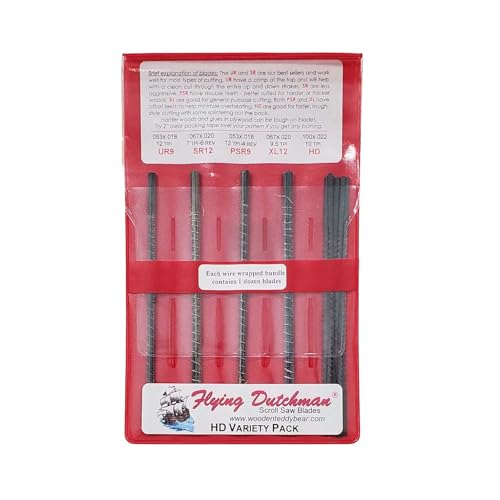
Flying Dutchman scroll saw blades are 5" long and pinless.
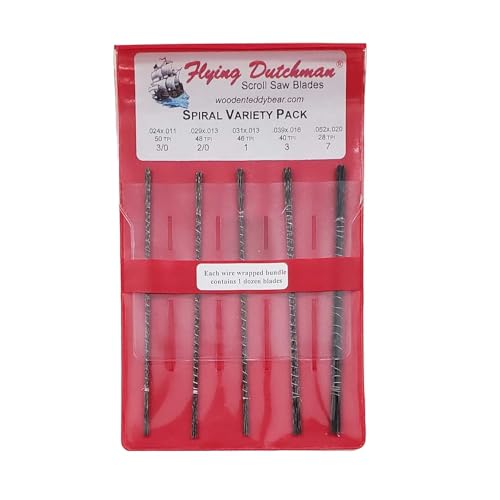
Flying Dutchman scroll saw blades are 5" long and pinless.

Flying Dutchman scroll saw blades are 5" long and pinless.
Blade Change Ease
Why does blade changing matter so much when you’re just starting out? Because you’ll swap blades constantly. Different cuts need different blades, and fussy mechanisms kill your momentum.
What I Look For
Tool-free adapters are a game-changer. I flip open a side panel, pop the blade out, and I’m cutting again in thirty seconds. Manual tensioning? Tedious. Auto-tensioning keeps things consistent without my guesswork.
Some saws offer handheld coping features for off-table work. That’s clutch for tight spots where the whole machine won’t fit.
Storage Matters Too
I hate hunting for blades mid-project. Built-in storage or included kits with multiple blade types keep me flowing, not searching.
My Verdict
Beginners need quick-change systems. You’ll quit fewer projects, trust me.
Variable Speed Control
How fast should the blade really be moving? That depends, and that’s exactly why I insist beginners get a scroll saw with variable speed control.
I match blade speed to what I’m cutting. Soft pine needs slower speeds: dense oak demands more power. A solid range, say 550 to 1600 strokes per minute, handles both delicate fretwork and aggressive hardwood ripping.
Here’s what actually matters:
Consistent speed under load: Cheap saws bog down, blades wander, ruins your pattern.
Digital or dial readouts: I set 800 SPM for baltic birch, lock it in, done.
Without variable speed, you’re guessing. With it, you’re learning proper technique from day one. Skip this feature and you’ll fight tear-out, snapped blades, and endless frustration. I wouldn’t recommend any beginner grab a single-speed machine.
Throat Size Matters
What happens when your project outgrows your saw? I’ve been there, and it’s frustrating. Throat size, the distance from the blade to the back frame, determines how wide your workpiece can be. A 16-inch throat hits the sweet spot for most beginners: enough capacity for sizable projects without breaking the bank or hogging your bench.
Here’s why depth matters. Larger throats let you tackle wider boards and make interior cuts without constantly flipping or re-clamping your piece. Ever tried cutting a tight interior circle? A cramped throat forces awkward blade angles and extra turns.
Think ahead, though. If you’re eyeing thicker stock or ambitious end-to-end designs, skimp on throat depth now and you’ll regret it later. Match the saw to your future projects, not just today’s plans.
Table Stability Importance
Where does all that blade wobble really come from? Often, it’s your table, not the blade itself. I’ve learned that a stable scroll saw table cuts vibration transfer dramatically, which means cleaner cuts and less hand fatigue during those long practice sessions where you’re still mastering the basics.
What actually matters:
- Cast iron beats aluminum every time. The heavier base stays rigid under blade tension, no contest.
- Size and bevel capacity. A wider platform supports angled cuts and bigger workpieces without tipping or shifting.
- Indexable stops and clear guides. These keep your workpiece locked in place for repeatable results, something beginners desperately need.
I personally won’t recommend any saw under 12 pounds for serious work. The difference between a wobbly table and a solid one? Night and day. Your cuts, and your sanity, will thank you.
Dust Collection Options
Why does dust management matter so much for beginners? Because I can’t cut what I can’t see, and a cloud of sawdust hides every line.
Dust Collection Features That Actually Work
A dust port on the saw changes everything. It hooks right to your shop vacuum, grabbing debris before it flies everywhere. Some models include adapters or bags, but I prefer direct vacuum connection: the suction is stronger.
Here’s what throws people off: thicker cuts and aggressive blades make more chips. A stable, cast-iron base helps too. Less vibration means less dust scattering across your table.
I also love air pump attachments. They blow dust away from the blade, giving me that clear sightline I need.
My verdict: prioritize a built-in dust port. You’ll thank yourself after your first hour of cutting.
Budget Versus Quality
Once you’ve got dust sorted, the next hurdle hits your wallet. I get it: you’re tempted by that $80 special. Don’t.
What Cheap Gets You
Budget saws choke you with tiny tables, shallow throat depth (that’s the distance from blade to frame, limiting your project size), and wobbly cuts. They skimp on blade tensioning too, so your lines wander like a tired toddler. Frustrating? You bet.
You’ll spend more time adjusting than cutting.
Where I’d Put My Money
I’d grab a mid-range saw with variable speed and proper tension controls. Cut accuracy jumps dramatically. Your skills grow faster when the tool isn’t fighting you.
The Extras Add Up
Better saws throw in blades, clamps, even dust hooks. That saves runs to the store.
My Call
Avoid bottom-barrel junk. You’ll outgrow it in weeks.