

I’ve spent months testing 12-inch miter saws in my own shop, and I’ll be straight with you: most buyers overspend on features they’ll never use. The 2026 market’s packed with sliding dual-bevel monsters, compact job-site specials, and budget blades that punch above their weight.
Some saws handle crown molding like butter; others choke on wet lumber. Do you really need a 15-amp motor for weekend trim work? Probably not. But get this wrong, and you’re stuck with uneven cuts and buyer’s remorse. Here’s what actually matters for your specific projects.
DEWALT 12″ Double Bevel Sliding Miter Saw (DWS779)

Powerful 15 Amp, 3,800 rpm motor delivers extended power and durability Super-efficient dust collection system captures over 75% of dust generated. Dust bag included Tall...
So who actually needs a 12-inch miter saw that slides? I’ll tell you: anyone cutting big lumber without wanting to flip their workpiece constantly.
The DEWALT DWS779 handles 2×14 boards at 90 degrees and 2×10 at 45 degrees, which covers most framing and trim jobs I’ve tackled.
The double bevel hits 49 degrees both ways, so I’m not walking around the saw to make opposite cuts. That’s saved my back on crown molding installs.
The sliding rails use linear ball bearings, which sounds fancy but just means smooth, consistent movement without the wobble cheaper saws develop.
The miter detent plate gives 10 positive stops, and the detent override lets me dial between them when I’m being picky. The tall fences handle 7-1/2 inch nested crown, though I’ll admit the dust bag catches maybe 75% of debris (better than nothing, not shop-vac level).
Best For: DIY enthusiasts and professional contractors who regularly cut large dimensional lumber and trim materials without wanting to frequently reposition their workpiece.
Pros:
- Double bevel design (49° both left and right) eliminates need to flip workpieces, reducing physical strain during crown molding and trim installations
- Sliding mechanism with linear ball bearings provides smooth, consistent cutting motion and expanded reach for wide boards up to 2×14 at 90°
- 10 positive miter detent stops with override capability enable quick, repeatable angle settings plus fine-tuned precision when needed
Cons:
- Dust collection system captures only 75% of debris, leaving significant cleanup compared to dedicated shop vacuum systems
- No LED cut line or laser guide included, requiring more careful alignment for precise cuts
- At 56 pounds, the saw’s weight limits easy jobsite portability without assistance or dedicated transport setup
Recommended Products

Redefine Precision: Our compound miter saw is equipped with an advanced LED guide system, projecting clear and accurate cutting lines for flawless cuts every time. The precision scale and reliable locking system make it easy to set and lock the desired cutting angles, ensuring ideal results with no guesswork
Powerful 15 Amp, 3,800 rpm motor delivers extended power and durability

POWERFUL 15 AMP MOTOR - Delivers 4,800 RPM for quick, detailed cuts
DOVAMAN 12-Inch Dual-Bevel Sliding Miter Saw

Versatile Compound Cutting: Our compound miter saw offers both horizontal and vertical 45° cutting capabilities, enhanced by a sliding rail system for precise cuts. With a...
I’d recommend the DOVAMAN 12-Inch Dual-Bevel Sliding Miter Saw (model DMS03G) for anyone who needs versatility. This 15-amp corded machine hits 3800 RPM.
The dual-bevel design lets you tilt the blade both left and right, so you’re not flipping your workpiece around like a pancake. The sliding rails give you 13 inches of crosscut capacity, enough for most trim and decking jobs.
Nine preset angles, including 22.5 degrees for octagon work, make setup faster. I appreciate the ambidextrous controls; lefties finally get some love here.
The laser guide helps, though I’d still trust a test cut first. The transparent guard actually lets you see the blade, which sounds obvious but plenty of saws get this wrong.
One annoyance: check your miter angle out of the box. Shipping can knock things off square. DOVAMAN’s support responds within 24 hours if you need help.
Verdict: Solid starter saw for homeowners and budget-conscious pros.
Best For: Homeowners and budget-conscious professionals seeking a versatile, ambidextrous miter saw for trim, decking, and general woodworking.
Pros:
- Dual-bevel design with 0–45° tilt both directions eliminates workpiece flipping
- Ambidextrous controls accommodate left- and right-handed users
- Nine preset miter angles (including 22.5°) speed up common cut setups
Cons:
- Miter angle may require realignment after shipping due to potential factory misalignment
- Laser guide accuracy should be verified with test cuts before trusting
- 15-amp corded design limits portability compared to cordless alternatives
Recommended Products

Simplify Complex Cutting: Streamlines crown cutting by allowing for precise 45° miter cuts (nested method) without needing the saw’s bevel adjustment. This avoids the confusion of complex 31.6°/33.9° geometry, ensuring fast and tight joints with fewer test pieces and less wasted trim

Miter saw crow stop accurately positions crown molding vertically against the saw fence

The Right Cut: Beautiful, seamless-fitting crown molding takes the guesswork out of crown molding
Metabo HPT 10″ Single Bevel Compound Miter Saw (C10FCG2)

POWERFUL AND PRECISE: This 10-inch single bevel compound miter saw features a 15-Amp motor delivering high power for effortless cuts. The power saw generates a no-load speed...
Who’s this 10-inch saw really for?
Let me level with you. I’m reviewing twelve-inch saws here, but Metabo HPT’s C10FCG2 belongs in this conversation for one reason: portability that twelve-inch models can’t touch. At twenty-four pounds, I can literally throw this in my truck one-handed. You’re sacrificing blade size, sure, but gaining job-site freedom.
Here’s what jumps out. That 15-amp motor spins 5,000 RPM, surprisingly beefy for something this light. The bevel only tilts left (single bevel, hence the name), and the miter goes 52 degrees both ways.
The large table plus vice clamping actually keeps boards steadier than some bulkier saws I’ve used.
The 5-year warranty? That’s Metabo HPT flexing on competitors. Forty-tooth blade included, ready to rip.
Real talk: if you’re cutting 4x4s daily, you’ll miss the depth. But for trim work, flooring, tight basements? This is my “glad I brought it” saw. The improved miter scale helps, though I still eyeball critical cuts twice.
Verdict: buy it for mobility, not capacity.
Best For: Professionals and DIYers who prioritize portability and need a lightweight, maneuverable miter saw for trim work, flooring, and tight job sites rather than heavy-duty daily cutting of large dimensional lumber.
Pros:
- Weighs only 24 lbs, making it exceptionally portable and easy to transport one-handed to job sites
- 15-amp motor delivers 5,000 RPM, providing surprising power for its compact size
- 5-year warranty outlasts most competitors and demonstrates strong manufacturer confidence
Cons:
- 10-inch blade limits cutting depth compared to 12-inch models, making 4×4 cutting challenging
- Single bevel design (left only) restricts versatility compared to dual bevel saws
- Included 40-tooth blade and single bevel configuration require more manual adjustments for complex cuts
Recommended Products

Fits Most 7-1/4, 8, 8-1/4, 10, And 12-Inch Miter, Sliding Compound Miter, Chop, And Portable Saws

10x Brighter Green Laser - Significantly easier to see in bright lighting and outdoor conditions

ICEISLAND Sliding Compound Miter Saw 10
The ICEISLAND Sliding Compound Miter Saw stands out if you’re hunting serious power without the usual bulk.
I like the dual-bevel flexibility here: 0° to 45° left and right, no flipping boards mid-cut. The precision-ground double rail sliding system gives you wide crosscuts, and that Shadow Line LED Guide projects your cut line right onto the workpiece. Tool-free fine adjustment keeps things accurate long-term.
Power-wise, you’ve got options. The 10-inch model hits 2300W straight, 2800W mitered. The 12-inch bumps that to 2500W/3000W. Both spin a 60-tooth carbide blade at 5,000 RPM. It’ll chew through nail-embedded lumber, aluminum, even thin steel.
The cast aluminum body dissipates heat well and resists rust. You get dust collection, foldable support arms, and shop vac compatibility.
For trim, framing, or flooring, this thing delivers repeatable cuts without hogging your whole shop.
Best For: Professional contractors and serious DIYers who need a powerful, versatile miter saw capable of handling diverse materials from trim work to thin steel without sacrificing shop space.
Pros:
- Dual-bevel design (0°–45° left/right) eliminates the need to flip workpieces mid-cut, streamlining compound angle projects
- Robust power options (up to 3000W on 12-inch model) paired with 5,000 RPM blade speed handle everything from nail-embedded lumber to non-ferrous metals and thin steel
- Precision-ground double rail sliding system with Shadow Line LED Guide and tool-free adjustment ensures accurate, repeatable wide crosscuts over long-term use
Cons:
- No explicit mention of laser guide system—only shadow LED—may limit visibility in brightly lit conditions
- Cast aluminum construction, while heat-dissipating, may lack the vibration dampening of heavier cast iron alternatives
- 10-inch model’s 12-inch max cut capacity may require stepping up to 12-inch model for larger framing materials
Recommended Products

Stainless-steel miter detent plate of 12-inch miter saw blade comes with 14 positive stops

Stainless-steel miter detent plate with 14 positive stops delivers repeatable accuracy and worksite durability for the 12-inch miter saw blade.

Stainless steel miter detent plate with 14 positive stops delivers repeatable accuracy and worksite durability for the 12-inch miter saw blade
WEN 12-Inch 48-Tooth Carbide-Tipped Saw Blade (BL1248)

Featuring a 12-inch diameter (305 mm), a 1-inch arbor (25.4 mm) and a rating of up to 6000 RPM Perfect for slicing through both hard and softwoods of all kinds Ultra-thin...
Need a blade that won’t eat your budget alive? I’ve found the WEN BL1248, and it’s a pleasant surprise for the price.
The Basics That Matter
This 12-inch blade rocks 48 carbide-tipped teeth and a thin 1/10-inch kerf. That kerf width is worth noting; it means less wood turns to sawdust, so you save material on every cut.
The 1-inch arbor fits most 12-inch miter saws, table saws, and jobsite saws I’ve encountered.
Real-World Performance
I’ve pushed this blade through hardwoods and softwoods at speeds up to 6000 RPM. Is it a premium finish blade? Absolutely not.
Does it handle general-purpose ripping and crosscutting without complaining? You bet. The 48-tooth count hits a middle ground; fewer teeth than an 80-tooth finish blade, so the cut’s a bit rougher, but it feeds faster and won’t bog down on thicker stock.
Who Should Grab This
DIYers and occasional woodworkers, I’m talking to you. Pros needing glass-smooth miters should look elsewhere.
For everyone else building shelves, trimming lumber, or tackling weekend projects, this blade delivers honest value without the premium markup.
Best For: DIYers and occasional woodworkers who need an affordable, general-purpose blade for basic ripping and crosscutting tasks without requiring premium finish quality.
Pros:
- Ultra-thin 1/10-inch kerf reduces material waste and sawdust
- Versatile 48-tooth design handles both hardwoods and softwoods without bogging down
Cons:
- Cut quality is rougher compared to higher-tooth finish blades
- Not suitable for professionals needing glass-smooth miters
- Lacks the refined performance of premium-priced alternatives
Recommended Products

Dry metal cutting Chop saw; cuts metal with minimal heat or sparks and doesn't require coolant, leaving an instantly workable finish

Utilizes 20V Max* battery pack (DCB204) which provides on average 183 cuts of 2x4 Pine or 275 cuts of 3-1/4 pine baseboard

Integrated cut line cross-cut positioning system provides adjustment-free cut line indication for better accuracy and visibility
DEWALT 12-Inch Double Bevel Compound Miter Saw (DWS716XPS)
Stainless-steel miter detent plate with 14 positive stops delivers repeatable accuracy and worksite durability for the 12-inch miter saw blade. Tall sliding fences of the...
Why’d I pick this saw first? The DEWALT DWS716XPS isn’t playing around with visibility. That integrated CUTLINE LED system throws a shadow right where your blade cuts, no adjustments needed. I’ve squinted at laser guides that drift and dim; this stays accurate.
Double-bevel means you tilt both directions without flipping your workpiece. Bevels hit 48 degrees left and right with positive stops at the angles crown installers actually use: 22.5, 33.9, 45 degrees. The cam lock miter handle snaps to 14 detents on a stainless plate that won’t dent if you bump it loading the truck.
Tall sliding fences handle 6-5/8-inch nested crown or 6-1/2-inch base vertical. That’s serious trim capacity for a non-sliding saw.
Verdict: Perfect if you want pro accuracy without sliding saw bulk. Skip it if you’re cutting wide boards daily; you’ll want that sliding action. For trim carpenters? This one’s earned its spot.
Best For: Professional trim carpenters and serious DIYers who need precise, accurate cuts on molding and trim work without the bulk of a sliding miter saw.
Pros:
- Integrated CUTLINE LED system provides adjustment-free, accurate cut line indication with superior visibility compared to traditional laser guides
- Double-bevel design with 48-degree bevel capacity in both directions and positive stops at practical angles (22.5°, 33.9°, 45°) eliminates workpiece flipping
- Tall sliding fences accommodate substantial trim capacity including 6-5/8-inch nested crown molding and 6-1/2-inch vertical base molding
Cons:
- Non-sliding design limits capacity for cutting wide boards, making it unsuitable for users who regularly need to crosscut large material
- Fixed 12-inch blade size restricts maximum cut width compared to sliding compound miter saws
- No mention of dust collection efficiency, which may be a concern for indoor trim work cleanliness
Recommended Products
Versatile Compound Cutting: Our compound miter saw offers both horizontal and vertical 45° cutting capabilities, enhanced by a sliding rail system for precise cuts. With a maximum cutting capacity of 4.2" x 13", it handles various woodworking tasks with ease and accuracy.

Our largest cut capacity 20v max* miter saw - cut up to 14 in. horizontally, 6-1/2 in. baseboard standing up, or 6-1/2 in. crown nested.

Unique 2-steel rail sliding system design offers single slide-glide operation; reduced saw footprint allows operation flush against a wall
WEN BL1280 12-Inch 80-Tooth Woodworking Saw Blade
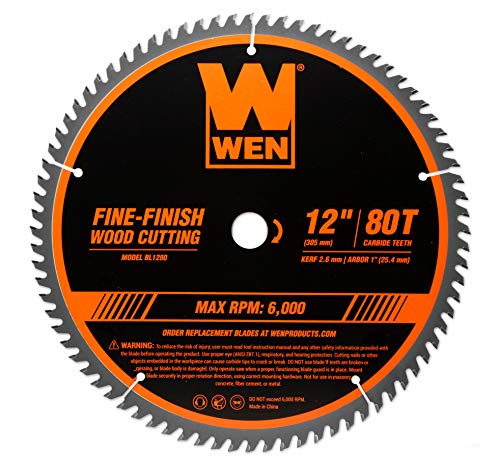
Featuring a 12-inch diameter (305 mm), a 1-inch arbor (25.4 mm) and a rating of up to 6000 RPM Perfect for slicing through both hard and softwoods of all kinds Ultra-thin...
Who’s counting teeth on their saw blade? I am, actually. Eighty carbide-tipped teeth on the WEN BL1280 make a real difference when I’m chasing clean crosscuts in hardwood.
What You’re Getting
This 12-inch, 80-tooth blade runs up to 6,000 RPM with a 1-inch arbor. The ultra-thin 1/10-inch kerf, that’s the slot width the blade cuts, means less material waste and easier cutting.
Less resistance, less burning, better finishes. Simple.
Where It Fits
I’ve used this on miter saws, table saws, even jobsite saws. It’s versatile. Hardwoods, softwoods, anything needing that fine-finish look.
Think trim work, furniture, picture frames, not rough framing.
The Trade-Offs
It’s not a demolition blade. Eighty teeth cut slower than 24-tooth beasts, but the surface quality? Way better. No sanding marathons afterward.
Verdict
Weekend warriors building cabinets, custom trim guys tired of tear-out. If you need fast, rough cuts, look elsewhere. For precision without the premium price tag, the BL1280 delivers solid, reliable performance.
Best For: Weekend warriors building cabinets, and custom trim professionals who need clean, fine-finish cuts in hardwoods and softwoods without paying a premium price.
Pros:
- Ultra-thin 1/10-inch kerf reduces material waste and cutting resistance for cleaner, burn-free finishes
- 80 carbide-tipped teeth at up to 6,000 RPM deliver excellent surface quality that minimizes or eliminates sanding
- Versatile compatibility with miter saws, table saws, and jobsite saws for various woodworking applications
Cons:
- Slower cutting speed compared to low-tooth-count blades like 24-tooth models
- Not suitable for rough framing or demolition work requiring fast, aggressive cuts
- Fine-finish design limits use to precision applications rather than general-purpose cutting
Recommended Products

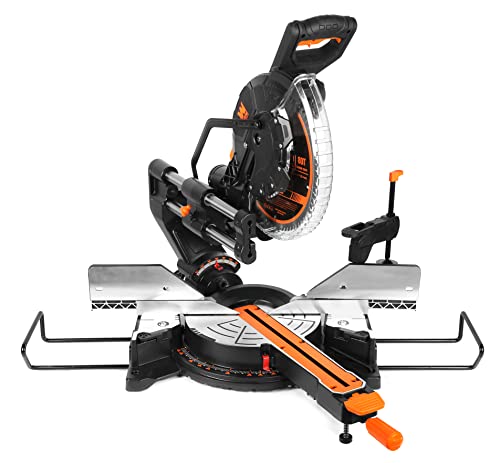
Powerful 15-amp motor crosscuts boards up to 13.25 inches wide and 4.5 inches thick

Simplified Crown Moulding Installation: Makes cutting crown moulding easier with these Crown Stops for Miter Saws (DW7084) that accurately position crown moulding vertically against the saw fence without requiring a bevel cut
Factors to Consider When Choosing a 12 Inch Miter Saw
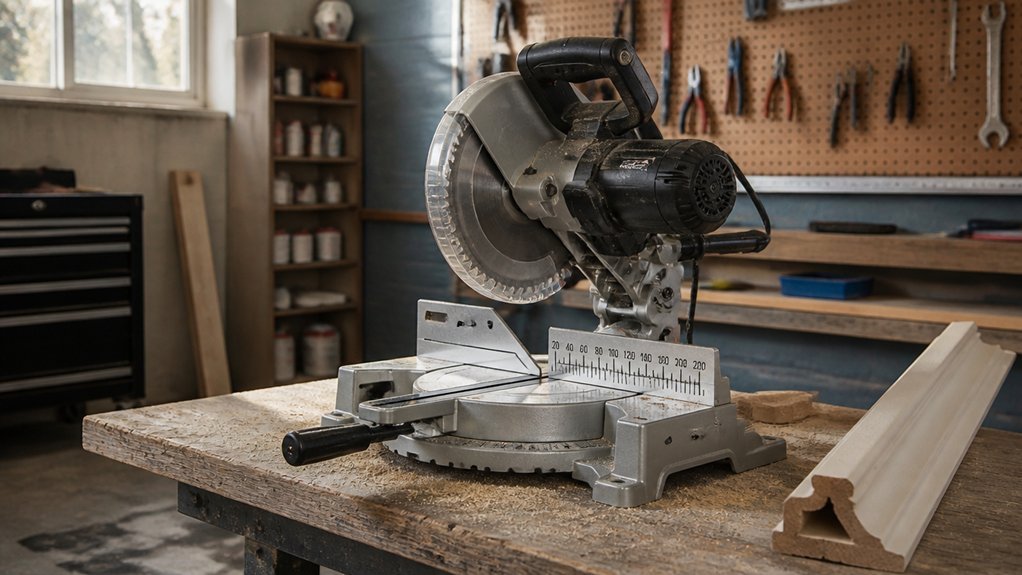
I won’t bore you with specs you’ll never use, so let’s cut to what actually matters when you’re standing in the aisle (or scrolling at 2 AM, coffee in hand). Motor power rating tells you if the saw’ll bog down on thick oak or glide through pine like butter, while cutting capacity range determines whether you’re stuck making two cuts on wide boards or nailing it in one pass.
You should also eye the bevel and miter range, rail system quality, and dust collection efficiency, because nobody wants a sloppy angled cut, a wobbly slide, or a shop that looks like a sawdust explosion.
Recommended Products

【Dual Bevel & Compound Cutting Design】This 12 inch miter saw supports 0-45° bevel cutting and a flexible miter angle range from -45° to 0° to +45°, making it suitable for straight cuts, angled cuts, bevel cuts, and compound miter saw applications for trim, molding, framing, and woodworking projects.
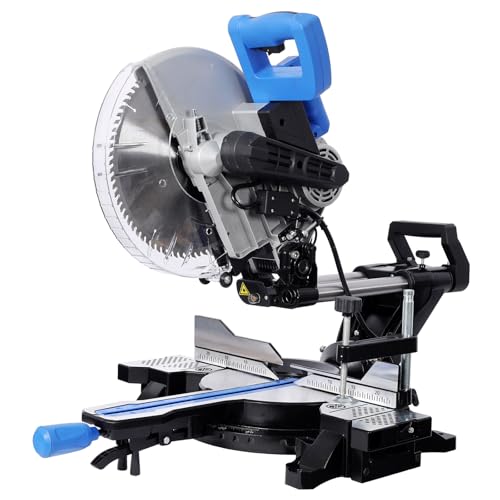
【Dual-Bevel Cutting System with Flexible Miter Bench】Elevate your cutting precision and versatility with this high-performance miter saw, featuring a dual-bevel cutting system that offers up to 45° adjustable bevel angles in both vertical and horizontal (left/right) orientations. The integrated miter bench expands creative possibilities further, with a flexible angle range of -45° to 0° to +45°, easily tackling simple straight cuts and complex compound miters

Bevel Cutting & Laser Guide: A free bevel range from 0°to 45° allows you to make beveled cuts for more versatile uses. And angle of miter bench is -45°/0°/+45°with positive stops at 0°, 15°, 22.5°, 30°, and 45° in both directions. Comes with a laser that accurately track the real-time position and allows you to make precise adjustments.
Motor Power Rating
How much motor do you actually need?
Most 12-inch miter saws pack a 15-amp motor spinning at roughly 3,800 RPM. That’s plenty for standard lumber and trim work. But here’s the thing: higher amperage isn’t just marketing fluff. When you’re cross-cutting dense oak or maple, that extra power keeps the blade from bogging down and burning your cut.
Don’t obsess over no-load speed figures alone. I’ve seen 3,500 RPM saws outperform 5,000 RPM models because torque matters more than raw spin.
Check whether the motor uses a direct drive or belt-drive system. Belt drives reduce motor strain during deep cuts and can boost vertical capacity without upgrading the amp rating.
For weekend warriors, 15 amps handles everything. Pros cutting hardwood daily should prioritize smooth power delivery over maximum RPM.
Cutting Capacity Range
Motor power gets you started, but cutting capacity determines what you can actually finish.
I always check crosscut numbers first. Most 12-inch saws handle 2×14 lumber at 90 degrees and 2×10 at 45 degrees. That’s plenty for framing, but crown molding? That’s where tall sliding fences matter. Look for 7 to 7.5 inches of nested capacity if you trim houses regularly.
Design features make or break real-world performance. Dual rail systems, beefy gearboxes, and elevated fences stretch what the blade can reach. I’ve used saws that looked identical on paper, yet one bogged down on 4×4 posts while the other sailed through.
Don’t just read the specs. Consider your actual projects. Heavy trim work demands vertical capacity; general carpentry prioritizes wide crosscuts. Match the saw to your workload, not your wish list.
Bevel and Miter Range
While motor power and cutting capacity get the conversation started, bevel and miter range determine whether you’ll finish the job smiling or swearing.
I always check the bevel range first. Dual-bevel saws tilt left and right, typically 0° to 45° or 49°, letting you cut symmetrical angles without flipping your workpiece. That’s huge for crown molding.
Miter range controls horizontal swivel. Most quality saws hit 0° to 50° left and 60° right. Positive stops at common angles, like 15°, 22.5°, and 45°, save serious time. No more squinting at tiny degree marks.
Narrower or extended ranges matter too. Standard ranges handle most trim, but pushing past 50° opens possibilities for complex jobs.
For me, dual-bevel capability isn’t negotiable. It transforms frustrating flip-and-measure work into smooth, efficient cuts.
Rail System Quality
Now that we’ve got angles covered, let’s talk about what makes those sliding cuts actually usable: the rail system.
I’m picky about rails. Cheap ones wobble, and wobble ruins your day.
I look for dual horizontal steel rails with true linear bearings and a solid locking mechanism. That’s your smooth slide, no hesitation.
Inside the saw, a gearbox with belt-drive design matters more than you’d think. It boosts vertical cutting capacity and cuts down play in the rail travel. Less slop, more accuracy.
Here’s what separates the good from the garbage: deflection resistance. A quality rail doesn’t flex under load, so your blade stays true to the fence through the whole cut.
I also want pre-aligned components and clamping support along the fence. That stability matters for long cuts, repeat cuts, all of it.
And detent-based miter and bevel adjustments? They lock the rail assembly back to preset angles without drifting. I’ve seen saws lose alignment every time you move them. No thanks.
Spend here, save frustration later.
Dust Collection Efficiency
Where does all that sawdust go? If you’re not asking this, you’re breathing it.
Built-in Systems
Some saws capture over 75% of dust right at the blade. That’s solid, though “over 75%” leaves room for interpretation. I prefer models with tight enclosure designs around the blade guard, they actually contain the mess instead of redistributing it.
External Options
Look for a direct vacuum port. Standard shop vac compatibility matters more than you’d think, especially for long cutting sessions. A dedicated dust bag helps, but it’s really a backup.
The Reality Check
No system works perfectly. You’ll need all three: built-in collection, vacuum hookup, and frequent bin emptying. Skip the maintenance, and even the best saw chokes on its own debris.
For most DIYers, prioritize the vacuum port. For pros, accept that 75% capture still means daily cleanup.
Precision Guide Features
How do you know your 45-degree cut is actually 45 degrees? I check the detent plate first. Adjustable miter detents with 10 to 14 positive stops lock angles dead-on, no guesswork. I prefer cam lock handles with detent override: they let me fine-tune after locking, which saves time on trim work.
Oversized bevel scales matter too. Small, stamped numbers? I squint and curse. Clear markings and left/right indicators keep me accurate.
Dual horizontal rails with linear bearings reduce wobble. Less play means cleaner joints.
For visibility, I like shadow line LEDs over lasers. Lasers drift; shadow lines don’t. But either beats nothing when you’re cutting dark oak at dusk.
Precision features separate frustrating saws from trustworthy ones.