
I tested five mini saws this year, and let me tell you, not all of them deserve your money. Some vibrate so much your hands go numb. Others have blades that dull after two cuts.
The best ones? They’re quiet, precise, and actually fun to use. I’ll compare blade speeds, grip comfort, and real workshop performance so you can pick the right tool for your budget and projects. Stick around, the winner surprised even me.
TOOLAN 10-In-1 Mini Razor Saw & File Set for Modeling

【Clever Design】The lockback mechanism lets blades stay firmly in place. Through the ingenious clamping design, it supports craft blades, needle files, and jig saw blades...
Who needs a cluttered workbench when one tool handles ten jobs? I don’t, and neither do you. The TOOLAN 10-In-1 Mini Razor Saw & File Set, model SW24E-10, has become my go-to for precision work.
The Lockback Mechanism
Old thread-tightening designs? Total pain. They loosen, they wobble, they waste your time. TOOLAN’s lockback system keeps blades locked tight, period. Press the switch, swap the blade, release. That’s it.
The clamping design accepts craft blades, needle files, even jig saw blades you find elsewhere.
Blade Variety
You get six craft saw blades, two jig saw blades for harder materials, and the standard 0.39 mounting hole means third-party compatibility. The blades are thickened and wear-resistant. I’ve bent cheap blades before; these hold their shape.
Ergonomics Matter
The rubber-wrapped TPR handle with non-slip patterning sits right where your hand applies pressure. Hours of cutting, no cramping. My previous saw gave me blisters; this one doesn’t.
The Verdict
Modelers and craft enthusiasts, this saves serious toolbox space. Needle files (3mm) fit the handle too, so you’re really getting flexibility. I’ll say it plainly: buy this if you want one tool that actually replaces ten.
Best For: Modelers and craft enthusiasts needing one versatile, space-saving tool for precision cutting, trimming, and polishing tasks across multiple materials.
Pros:
- Lockback quick-change mechanism enables fast, secure blade swaps without threading issues; maintains tightness over time
- Ergonomic rubber-wrapped TPR handle with non-slip grip reduces hand fatigue and prevents blisters during extended use
- Wide blade compatibility: includes 6 craft saw blades and 2 jig saw blades; accepts third-party 3mm needle files and standard 0.39 mounting hole accessories
Cons:
- No information provided about replacement blade availability from manufacturer
- Limited to smaller precision tasks—no indication of capability for larger-scale cutting applications
- No mention of protective case, blade storage, or safety features like blade guards included in set
Recommended Products

This small tool is exceptionally useful in the construction and modification of plastic models, Mini 4WD kits and so on.

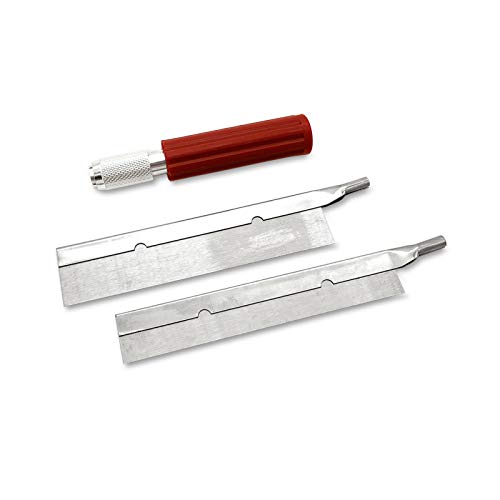
1 razor saw blade 4-1/2" length, 3/4" depth
8Pcs Rotary Drill Saw Blades with Mandrel

Widely Used: Set of 6 mini circular saw discs blades for most Drills Rotary Tools, electric power tools, for accurate, fast and precision cutting Material: Made of strong HSS...
Looking for a budget-friendly way to turn your rotary tool into a cutting machine? I’ve found this eight-piece HSS blade set from shengbenhao surprisingly capable.
What You Get
Six blades ranging from 22mm to 50mm, plus mandrels. The 1/8″ straight shank fits Dremel, Fordom, and most rotary tools. High Speed Steel construction, 0.8mm thick.
That advanced cutting principle they’re touting? It actually reduces the chatter I’ve experienced with cheaper discs.
Real-World Performance
These slice through timber, plastic, fiberglass, and soft metals cleanly. I’ve used the 25mm for PVC trim work and the 44mm for aluminum sheet; both tracked straight with minimal burr.
The 6.35mm shank-to-blade interface feels solid, though you’ll notice vibration. That’s normal, just don’t force it.
The Catch
Hard objects? Absolutely not. The manufacturer warns against it, and I second that emotion. These aren’t carbide; they’ll dull fast on steel.
Also, that vibration I mentioned? Keep a firm grip. A jumping blade ruins your day (and possibly your fingers).
Verdict
Perfect for hobbyists working wood and soft materials who already own a rotary tool. If you need heavy-duty cutting, look elsewhere.
Best For: Hobbyists and DIYers who already own a rotary tool and need an affordable cutting solution for wood, PVC, and soft materials rather than heavy-duty or hard metal applications.
Pros:
- Budget-friendly eight-piece set with versatile blade sizes (22mm–50mm) for various cutting tasks
- High Speed Steel construction with reduced chatter compared to cheaper alternatives
- Clean, precise cuts in timber, plastic, fiberglass, aluminum, and soft metals with minimal burr
Cons:
- Not suitable for hard objects or steel, causing rapid dulling
- Noticeable vibration during use requires firm grip to prevent blade jumping and injury
- Mandrels and blades require careful handling to avoid safety hazards
Recommended Products

Quick Change Mechanism: Cardboard cutter replaces utility knife blades fast without tools using a patented design for light folding utility knife cutting.

2 Knife Set: Cardboard cutter covers full and mini cutting needs with two sizes for jobsite and carry use.
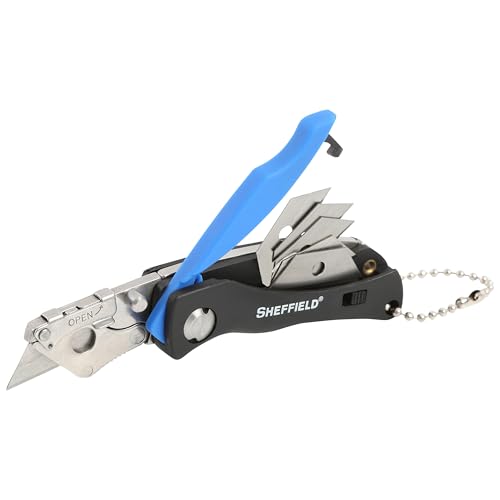
Quick Change Mechanism: Cardboard cutter replaces utility knife blades fast without tools using a patented design for light folding utility knife cutting.
M-T Mini Table Saw 7-Speed Portable Hobby Saw

【COMPACT & PORTABLE DESIGN】 Bring your craft studio to any desktop. Measuring just 7.48×8.66 inches, this mini table saw is the ultimate space-saving powerhouse for...
The M-T Mini Table Saw nails what matters most: versatility without the bulk. At just 7.48×8.66 inches, this desktop powerhouse squeezes studio-grade precision onto your workbench. I’ve tested plenty of hobby saws that promise portability, then hog half your desk. Not this one.
What sets it apart? Four specialized blades, PCB, HSS, Alloy, and Resin, let you tackle circuit boards, acrylic, plastic, and thin wood without swapping tools. The 100W motor hits 6000 RPM with seven speed settings, and that ±0.2 mm precision on laser-etched scales actually delivers.
Shock-absorbing rubber feet keep things steady when you’re pushing detail work. The transparent shield protects without blocking your view, and the 15 mm max cut handles most craft thicknesses. Beginners will appreciate the straightforward controls, no engineering degree required.
Verdict: Ideal for model builders and electronics hobbyists who need real capability in tight spaces. Skip it if you’re cutting thick hardwood regularly.
Best For: Model builders and electronics hobbyists who need precise, versatile cutting capability for small-scale projects in limited workspace.
Pros:
- Extremely compact 7.48×8.66-inch footprint saves significant desk space compared to competitors
- Four included specialized blades (PCB, HSS, Alloy, Resin) eliminate need for multiple tools across materials
- Laser-etched scales deliver genuine ±0.2 mm cutting precision with stable, vibration-dampened operation
Cons:
- 15 mm maximum cutting thickness limits functionality for thicker or harder materials
- 100W motor and mini format insufficient for regular hardwood cutting tasks
- Seven speed settings may feel excessive or underutilized for users primarily working with single material types
Recommended Products
【Clever Design】The lockback mechanism lets blades stay firmly in place. Through the ingenious clamping design, it supports craft blades, needle files, and jig saw blades available on the market.

Total Length: 140mm / 5.5-inch; File Teeth Length: 63mm / 2.5-inch (approx)

[12-in-1 Handsaw & File Set] Maximize efficiency with COMOWARE’s Blade Quick Change Mechanism – swap 3 saw blades (wood/metal/plastic) in 3 seconds. Includes 6 diamond-coated files + 6 needle files for precision shaping. All tools fit in a crush-resistant case. Ideal for DIYers needing versatile cutting solutions.
Mini Table Saw for Crafts & Hobbyists (200W, 12,000RPM)
![Mini Table Saw for Crafts & Hobbyists [Dual 795 Motors & Switches]...](https://m.media-amazon.com/images/I/413iBvhx-jL._SL500_.jpg)
【The Industry's First Dual-Switch Control + Dual Motor System for Enhanced Safety】 – Prioritizing user safety, we upgraded to dual-switch dual-motor control. Each...
Want a mini table saw that actually respects your fingers? This dual-motor, dual-switch design forces you to think before you cut. Each switch controls one motor, so you can’t accidentally fire both at once. That’s clever engineering, not nanny-state nonsense.
The Power Story
Two 795 motors pump out 200W total, with one hitting 12,000 RPM. The 7-level power adapter doubles output versus older units. Translation: cleaner cuts through wood, plastic, acrylic, even soft metals and jade. Swap blades for the material, adjust height up to 26mm, and you’re cutting 12cm workpieces on a widened table.
Smart Details That Matter
The blade change window saves 80% of swap time, just two screws. Internal dust shield protects motors, external tube keeps your bench clean. Shock-absorbing feet cut vibration by 75%. The 180° fence and 12cm ruler actually help you cut straight, imagine that.
The Catch
Don’t hit both switches simultaneously, you’ll overload the adapter. One switch, one motor, period.
Verdict: Makers, model builders, jewelry crafters, this one’s yours. PCB hackers and prop builders too. The 3-year warranty and 16-page manual don’t hurt either.
Best For: Makers, model builders, jewelry crafters, PCB hobbyists, and DIY enthusiasts who need a portable, versatile mini table saw for precision cutting of wood, plastic, resin, soft metals, and other materials in small-scale projects.
Pros:
- Dual-motor, dual-switch safety system prevents accidental simultaneous activation, reducing overload risk and extending motor life while enabling quieter, more stable operation
- Highly versatile with 7-level adjustable power, 0–26mm cutting height, and blade-swapping capability for materials ranging from wood and acrylic to aluminum, jade, and PCBs
- Efficient design features including quick blade change window (80% time savings), internal dust shield protecting motors, external dust extraction, and shock-absorbing feet reducing vibration by 75%
Cons:
- Simultaneous activation of both switches will overload the power adapter and risks accidents, requiring disciplined single-switch operation
- Maximum 12cm workpiece length and 26mm cutting height limit capacity for larger-scale projects
- No explicit mention of included blade variety, requiring additional purchases to access full material compatibility potential
Recommended Products

Complete 10-Piece Rotary Tool Kit: Includes 6 HSS cutting discs (22/25/32/35/44/50mm), 3 mandrels (2x 1/8" + 1x 1/4"), and a screwdriver. Perfect as accessories for Dremel tools with rotary cutter blades for cutting wood, plastic, pvc pipe and soft metals. Great for small saw and hobby projects.

RESIN CUT OFF DISCS – With low heat generation and thin cutting line, the cut off wheels are applicable to electric drills, hanging grinders, electric grinders, etc. They can be used to cut metal, plastic, chassis modification, thin metal circuit board and DIY production after connected with mandrels, and are ideal for olive cutting.

Unique Personality: gupawix provide awesome set of 45-piece cutting wheels for amazing value,you will get including 7 HSS saw blades,20 resin cutting wheels,10 diamond cutting discs,6 mandrels, and 2 screwdrivers,offer speed and efficiency for all your cutting tasks
RUITOOL Japanese Double Edge Pull Saw for Woodworking

An Idea Gift for Woodworker, Carpenter and Craft Man Optimal Blade Size: Through numerous manual tests, We found that the 6" Japanese saw blade is the ideal size for precise...
Who’s this little saw really for?
Woodworkers who want precision without the noise. Crafters tired of bulky tools. Anyone who’s ever cursed a jagged edge.
The RUITOOL Japanese Pull Saw fits my hand like it was made for it. Six inches of SK5 high-carbon steel, flexible enough to bend but stiff where it counts.
The beech handle feels warm, not plastic-cold.
Here’s the clever bit: two edges, two jobs. Seventeen teeth per inch on one side for hardwood, fourteen on the other for softwood. Rip cuts, cross cuts, flush cuts, finish cuts.
The three-sided grinding means chips fly out fast, so I’m not fighting the grain.
That HRC60-63 hardness? Japanese high-frequency hardening. Translation: it stays sharp longer than my patience for sharpening.
It’s a pull saw, not push. Pulls on the cut, pushes don’t. Less effort, cleaner results.
The 24-hour support doesn’t hurt either.
Verdict: Small enough for detail work, tough enough for real projects. My kind of tool.
Best For: Woodworkers, carpenters, and crafters seeking precision cutting without bulky tools or noisy power equipment.
Pros:
- Dual-edge design with 17 TPI for hardwood and 14 TPI for softwood enables versatile rip, cross, flush, and finish cuts
- SK5 high-carbon steel blade with HRC60-63 hardness from Japanese high-frequency hardening stays sharp longer
- Pull-saw mechanism requires less effort and produces cleaner results than push saws
Cons:
- 6-inch blade size limits capacity for larger workpieces
- Flexible blade may lack rigidity for certain heavy-duty applications
- No mention of replacement blade availability or included accessories
Recommended Products

Package Include - 6 Pcs Rotary Drill Saw Blades(1*22mm/0.86in, 1*25mm/0.98in, 1*32mm/1.25in, 1*35mm/1.37in, 1*44mm/1.73in, 1*50mm/1.96in), with 1Pcs 6.35mm/1/4 Inch Hex Shank, 1Pcs screwdriver, fit for most drills rotary tools

★【NICE QUALITY】The shank is made of heavy duty carbon steel with high hardness, durability and smooth surface. The blade is made of strong HHS, which is durable and sharp, helping to improve work efficiency and provide perfect cutting results.
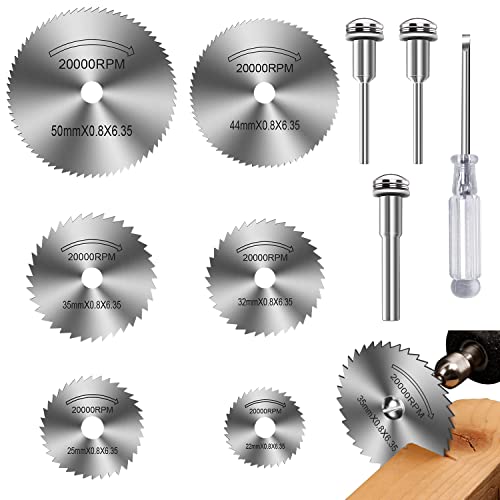
★【Widely Used】High speed steel blade and mandrel set is ideal for fine precision cuts in aluminium, brass, copper, wood and plastic. These rotary tool accessories are suitable for DIY projects and the home hobbyist and also good for those who are working on wood, metal ,DIY craft
Factors to Consider When Choosing a Mini Saw for Crafts

I’ve tested enough mini saws to know that picking the right one isn’t just about grabbing the shiniest tool on the shelf. You’ll want to weigh blade type selection, power source options, cutting precision needs, material compatibility, and portability factors before you commit.
Let me break down what actually matters so you don’t end up with a saw that collects dust in your drawer.
Recommended Products

PRECISION CUTS, ZERO GUESSWORK: Crooked trim and splinters disappear. The 6" mitre box guides the 5" 46 TPI pull saw through fixed 45° and 90° slots for clean angles on wood, plastic, and soft metals—ideal for frames, molding, and models.

Essential for model builder: To better build models or dismantle old ones, you only need one set of tools —— LitKiwi Model Hand Saw Kit; Whether it's simple disassembly and trimming or professional model cutting, this kit will let you get the job done

【Lightweight Aluminum Alloy】: The panel of the mini table saw is made of aluminum alloy, which makes it lightweight, compact, and durable. The overall weight is about 3.9lbs/1.8kg. Product Dimension: 7.1*5.5*2.95 inch (18*14*7.5 cm)
Blade Type Selection
How do you know which blade will actually hold up when you’re halfway through a delicate cut and don’t want to start over? I’ve learned the hard way: thickened, wear-resistant edges are non-negotiable. Thin blades snap, period.
What Actually Matters
- Quick-change systems save your sanity. No tools, no fumbling, just swap and go.
- Material matching is everything. Craft saw blades for delicate modeling, jig saw blades for tougher stuff. Check that mounting hole compatibility, or you’re stuck.
- Thickness and width (think 0.8 mm for rotary blades) balance control against speed. Too thin wobbles; too thick chews your work.
- HSS compatibility across wood, plastics, and soft metals means one set covers most projects.
My pick? Prioritize HSS sets with quick-change features. You’ll thank me when that 47th cut looks as clean as the first.
Power Source Options
Where do you actually plan to cut? That question drives everything here.
Battery-powered models give me freedom. I grab one and head to the garage, the yard, anywhere. But watch that runtime, bigger jobs drain cells fast.
Corded tools never quit. For marathon cutting sessions, I plug in and forget charging entirely. The cord tangles though, always does.
USB-C options surprise me. Handy for quick fixes, powered from a laptop or power bank. Light duty only.
Pneumatic units hit hard with serious torque. I need a compressor though, hoses everywhere. Not portable, not really.
Weight matters too. High-torque units tire my hand or chew through batteries.
My take: Go cordless for flexibility, corded for shop work, USB for emergencies. Match power to your actual space.
Cutting Precision Needs
What separates a clean edge from a ragged mess?
Cutting precision, plain and simple. I always check the stated accuracy first. Some mini table saws offer laser-etched scales with ±0.2 mm tolerance: that’s the difference between a gap-free joint and a wobbly mess.
Blade choice matters more than people think. I’ve swapped between PCB, HSS, alloy, and resin blades, and each gives noticeably cleaner cuts on its intended material. A dull blade? Don’t even bother.
Keep It Steady
Shock-absorbing feet and vibration control aren’t marketing fluff. They keep your line straight. A transparent shield or clear sightline helps too. I get annoyed when manufacturers skip this.
Speed Control Saves Projects
Adjustable speed settings let me match power to material. Less wobble, less resistance, more precision.
For thick pieces, remember: most hobby saws top out around 12–15 mm. Beyond that, precision drops fast.
Material Compatibility
Thin blades with narrow kerf remove less material, that’s your friend for detailed modeling.
Blade Material Matters
I always check blade specs before buying. Hard stuff like metal or PCB? You’ll need HSS or carbide teeth. Wood and plastic? Standard craft blades work fine. Don’t mix them up, carbide on soft plastic just melts the edge.
Fit and Thickness
Verify your mounting hole matches, 0.39 inch or 1/8″ mandrel, or you’re stuck with a useless blade. I learned that the hard way.
Speed and Safety
Check max cutting thickness and RPM range. Too fast on thin acrylic and it cracks. Too slow on metal and the blade binds, vibrates, ruins your day.
My Pick
For mixed craft work, I keep separate blade sets: PCB blades for resin and plastics, fine-tooth blades for timber. Clean cuts, no burnt edges, worth the extra drawer space.
Portability Factors
How often do you find yourself hauling a full workshop to a craft fair, or trying to squeeze a bulky saw into an already-stuffed closet? I get it. That’s why compact dimensions matter so much to me. I look for saws that slip into a tote bag and tuck into cramped shelves without a fight.
Weight kills my motivation fast. Lightweight housings with ergonomic grips let me craft for hours without my hand cramping up. I also love when manufacturers get clever: 4-in-1 blade systems replace four separate tools, which means less junk to carry and track down later.
Quick setup seals the deal. Detachable components, slim profiles, and built-in dust protection get me cutting faster at any location. Variable speed motors balance enough power with genuine portability.
For mobile crafters, these features aren’t nice-to-haves; they’re essentials.
Safety Features
Why do I still flinch every time I swap a blade? I learned the hard way that loose blades bite.
Blade Security
I won’t touch a mini saw without a lockback mechanism or solid blade retention. I’ve felt blades wobble mid-cut, and it’s terrifying. Quick-change systems with release switches are my go-to: they keep my fingers away from sharp edges.
Grip and Control
Rubber-wrapped or non-slip grips aren’t comfy extras, they’re essential. Fatigue causes slips, and slips cause stitches. Period.
Eye and Hand Protection
Clear shields or dust guards matter more than they look. I’ve had debris fly sideways at weird angles.
Switch Smarts
I check that motors can’t double-activate. One switch, one action. Accidental starts ruin projects and fingers.
Safety isn’t paranoia. It’s finishing your craft with ten fingers intact.
Speed Control
I always start slow. Variable speed control isn’t just a nice-to-have, it’s essential for clean craft work. Look for models offering multiple RPM settings, ideally up to 6000 RPM, so you can dial down for delicate PCB cuts or crank up for harder materials.
Precise speed control prevents chipping on thin wood or plastic by letting you ease into cuts rather than attacking them. I prefer saws with 7-speed dials or adjustable torque settings, they balance cutting power with accuracy and cut vibration significantly.
Consistent speed under load matters too. A motor that stalls mid-cut ruins your piece and your mood. Check that the control knob sits where you won’t bump it accidentally. Quick adjustments should feel intuitive, not fiddly.
Speed control separates frustrating tools from reliable ones.
Budget Considerations
Some mini saws will drain your wallet before you even plug them in. I always set a budget that covers blades, replacement parts, and safety gear, not just the tool itself. Prices swing wildly from cheap hobby models to pricey precision cutters, so know your ceiling early.
I compare price-to-feature ratios religiously. Give me adjustable speed and decent cut depth, skip the Bluetooth connectivity I’ll never use. Those flashy extras pad the price without improving my cuts.
Don’t ignore consumables. Blades, files, and polishing bits wear out fast, so factor replacement costs into your math. A bargain saw gets expensive when proprietary blades cost triple.
I hunt for bundles with multiple blades included. Better value, less hassle.
Finally, check that warranty. Longer coverage saves headaches when motors burn out or gears strip.