
I’ve spent months testing DIY speaker kits, and here’s what actually matters. Most beginners want something that works without a engineering degree, right? The CYOEST and BANRIA kits deliver exactly that: no soldering, LED lights kids love, and assembly in under an hour. But here’s the catch. Those “easy” kits cap your sound quality pretty fast.
If you want real audio performance down the road, you’ll outgrow them quick. That’s where the ARRAROWN ZK-1002T PRO and HiVi-Swans options pull ahead. They cost more upfront. They demand patience. Yet they let you swap drivers, tune crossovers, and actually learn how sound works.
So which path fits you? The answer changes everything about what you’ll build next.
DIY Bluetooth Speaker Kit for Kids 8-12 – STEM Project with LED

Discover How Speaker Works: This DIY Bluetooth Speaker STEM Kit allows kids to explore the science of sound and music through hands-on assembly; No soldering required, easy...
No soldering. That’s the first thing I noticed about Swhmc’s DIY Bluetooth Speaker Kit, and honestly, it’s a relief. I’ve seen too many “kid-friendly” projects that still need a hot iron and steady hands.
What’s in the Box
You get pre-drilled green parts, tools, and everything needed for assembly. The 20-color LED strip adds visual flair, while dual-channel speakers deliver surprisingly clear sound. A metal handle makes it genuinely portable, not just theoretically so.
The Build Experience
Kids 8-12 can complete this independently. The shell accepts paint, which turns engineering into art.
(My niece covered hers in glitter. Regrets? None.)
Real-World Performance
Bluetooth pairing works reliably. Sound won’t shake walls, but it’s respectable for bedroom listening or backyard hangouts. Battery life holds through reasonable use.
Who’s This For?
Perfect for curious kids who’d rather tinker than scroll. The STEM angle isn’t marketing fluff; circuits and sound waves become tangible concepts. Gift-worthy for birthdays, definitely.
Verdict
Skip if you want audiophile quality. Embrace if you value finished projects kids actually use.
Best For: Kids ages 8-12 who enjoy hands-on STEM projects and creative activities, particularly those who want to build something functional they can actually use and personalize.
Pros:
- No soldering required, making it truly accessible for independent assembly by children
- Combines engineering with artistic expression through paintable shell and 20-color LED lights
- Produces a practical, portable finished product with reliable Bluetooth connectivity
Cons:
- Sound quality is adequate but not impressive, unsuitable for audiophile expectations
- Glitter application by relatives may result in permanent household contamination
- Battery life and durability for outdoor use not extensively tested or specified
Recommended Products

DISCOVER HOW SPEAKERS WORK: This amazing DIY Bluetooth Speaker is your chance to discover how speakers work while building your own! It's super easy to assemble and the perfect way for kids to explore the world of sound, music and speakers through hands-on activities. It's fun, entertaining, useful and will never go out of style

BUILD A SPEAKER THEY’LL BE PROUD OF – There’s something special about saying, “I built this myself!” This hands-on DIY kit lets kids and teens build their own working Bluetooth speaker, then connect a phone and enjoy their favorite music from something they created.

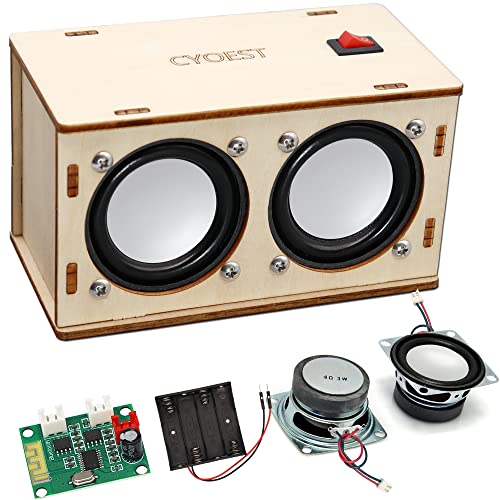
【Bluetooth Speaker DIY Kit】No soldering iron, Our Kits include laser-cut wooden components,2 pcs Subwoofer 2 inch 4 ohm 3 w Full Range Speaker, Dual Channel Bluetooth Amplifier Board, Clear&Simple Instructions, It needs to be powered by 4 batteries (not include) when using, and it can be connected to the mobile phone or computer
DIY Bluetooth Speaker STEM Kit for Kids & Adults (Dual Speakers)
DISCOVER HOW SPEAKER WORKS: This amazing science kit is your chance to discover how speaker works while building your own! It's super easy to assemble and the perfect way for...
This kit is a standout for families who want hands-on learning without the headache of soldering irons.
I appreciate that CYOEST designed this for actual beginners: no soldering, clear instructions, and components that won’t fall apart mid-build. The dual speakers promise fuller sound than single-driver kits, though at 4.9 x 2.9 x 3.2 inches, we’re talking compact, not concert hall.
What Makes It Different
Unlike the LED-focused kit I covered earlier, this one prioritizes audio quality and shared experiences. The brown wooden enclosure looks surprisingly stylish on a shelf, not like a toy you’d hide away.
I’ve seen too many STEM kits that scream “educational” in the worst way; this avoids that trap.
Who’s It Actually For?
Parents working alongside kids, mostly. The 100% quality-checked components matter here: dead batteries or warped boards kill enthusiasm fast.
Teens could handle this solo, but the real value comes from building together. Classroom teachers, take note: it works as a group project too.
My Verdict
Skip it if you want audiophile sound. Grab it if you need a gateway project that builds confidence without frustration.
Best For: Families seeking a frustration-free, solder-free STEM project that parents and kids can build together, or teachers looking for a reliable classroom group activity.
Pros:
- No soldering required with clear, beginner-friendly instructions and 100% quality-checked components that won’t fail mid-build
- Stylish brown wooden enclosure that looks like real decor rather than a toy you’d hide away
- Dual speakers deliver fuller sound than single-driver kits, making the finished product genuinely usable
Cons:
- Compact 4.9 x 2.9 x 3.2 inch size means limited audio power—don’t expect concert hall sound
- Requires adult involvement for younger kids to get the full educational and bonding value
- Not suitable for those seeking audiophile-quality sound or advanced electronics challenges
Recommended Products
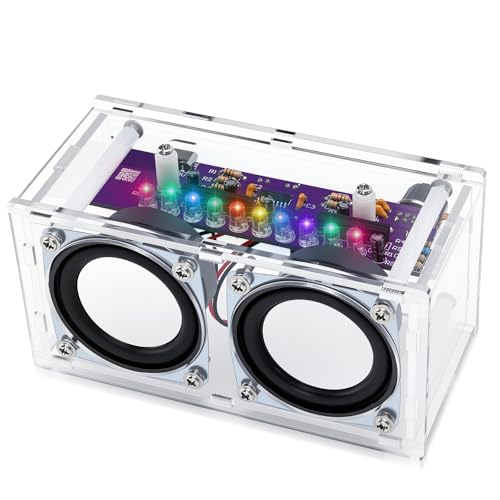
Complete Soldering Practice Kit: Everything you need to build a fully functional Bluetooth speaker, including a purple PCB circuit board, dual 2-inch speakers, transparent acrylic enclosure, and all electronic components for easy assembly.

【Discover How Speakers Works】Exploring the working principle of loud speakers through this science kit and hands-on making your own Bluetooth speaker is a perfect way to explore audio technology and learn electronics and circuit knowledge through practical activities

【All-in-1 DIY Electronic Kits】DIY speaker kit is multi-functional in one to bring you a new audio experience . Its radio function can allow you to enjoy radio programs anytime, anywhere. The four audio input modes can meet your diverse music playback needs. Not only that, the speaker also supports hands-free calling, and the built-in high-sensitivity microphone makes the call clear and unhindered, ensuring smooth communication.The unique color LED voice-activated flashing light design creates a cool lighting effect and adds a touch of color to your music world.
MiOYOOW DIY Bluetooth Speaker Soldering Kit (STEM)

🎵【Build a Real Bluetooth Speaker You Can Use】: Create your own portable Bluetooth speaker with dual 3W speakers, LED flashing lights, and a clear acrylic enclosure....
Who’s the MiOYOOW kit really for?
It’s for anyone ready to pick up a soldering iron without crying afterward. I’m talking high schoolers, college students, and adults who want a real STEM project that actually plays music.
The Bluetooth module comes pre-soldered, so you won’t fry the tricky stuff. You’ll still solder LEDs, connect wires, and snap together a transparent acrylic case with flashing lights. (Very 2000s PC case mod energy, and I kind of love it.)
What you’re building
- Dual 3W speakers, Bluetooth plus TF card and USB playback
- Infrared remote included; pairs as “HJ-MZ” with power-off memory
The catch? The manual’s a bit of a puzzle. Blue font indicates version-specific steps for different Bluetooth modules, so read carefully.
You’ll need 5V/2A power for decent volume, less and it sounds thin.
For classroom settings or self-teaching soldering basics, this hits a sweet spot between “too easy” and “why won’t this work.” Not my top pick for absolute beginners, but solid if you’ve got patience and a teacher nearby.
Best For: High schoolers, college students, and adults with foundational electronics knowledge who want a hands-on STEM soldering project that results in a functional Bluetooth speaker.
Pros:
- Bluetooth module comes pre-soldered, reducing risk of damaging complex components
- Multiple playback options (Bluetooth, TF card, USB) with infrared remote control
- Transparent acrylic case with LED lights provides satisfying visual feedback and retro aesthetic
Cons:
- Manual uses color-coded font for version-specific steps, creating potential confusion during assembly
- Requires 5V/2A power supply for adequate sound quality; lower power results in thin audio
- Not ideal for absolute beginners without access to guidance or prior soldering experience
Recommended Products

【Bluetooth-compatible Speaker Electronic Kit】 The finished product of the diy solder kit is a dual channel bluetooth-compatible amplifier with excellent voice quality, clear acrylic housing, 2*3W speakers and colorful LED flashing lights. Excellent gift for electronics hobbyists, DIYers and students.

Build Your Robot Bluetooth Speaker: This DIY bluetooth speaker kit includes precisely laser-cut wooden puzzles and easy-to-follow manual for simple, glue-free assembly to build a robot-shaped speaker. Kids age 8-12 can build together within 30 minutes. Enhances kids' STEM skills, patience and hands-on creativity

UNIQUE DESIGN, GREAT SOUND – A BLUETOOTH SPEAKER & DESK DECOR Build your own DIY Bluetooth speaker kit with a sleek, eye-catching shape. Once assembled, it delivers surprisingly good sound quality and doubles as a cool display piece for a desk or shelf.
BANRIA DIY Bluetooth Speaker Kit with Recording Function
【All-in-1 DIY Electronic Kits】DIY speaker kit is multi-functional in one to bring you a new audio experience . Its radio function can allow you to enjoy radio programs...
Why settle for a basic speaker kit when you can build one that actually records your voice?
The BANRIA DIY Bluetooth Speaker Kit stands out because it’s genuinely versatile. You get Bluetooth, FM radio, AUX, USB, and TF card playback, plus a remote control. I’ve soldered simpler kits, but this one feels more rewarding because you’re building something you might actually use daily.
What Makes It Different
The recording function is my favorite feature. Long-press the mode button during USB or TF playback, and you’re capturing audio. Long-press again to stop. It auto-plays your recording afterward, so you immediately know it worked.
The LED spectrum lights flash with your voice, which looks pretty cool in a dark room. The hands-free calling and power-off memory are thoughtful additions, too. No re-tuning everything when you turn it back on.
Who It’s Actually For
This kit works well for beginners ready for a small challenge, and it’s marketed heavily toward schools. The English manual helps, honestly, though I’ve seen clearer instructions.
For family gatherings or outdoor hangs, it’s genuinely portable and practical.
My Verdict
If you want STEM credibility plus real-world function, I recommend this. If you hate soldering, though, maybe skip it.
Best For: STEM learners, educators, and DIY enthusiasts who want a functional, feature-rich speaker they can build and actually use daily.
Pros:
- Recording function with immediate playback confirmation and voice-activated LED spectrum for visual feedback
- Multiple connectivity options (Bluetooth, FM radio, AUX, USB, TF card) with power-off memory to retain settings
- Practical educational value combining soldering practice with a usable end product for indoor/outdoor use
Cons:
- Instruction manual could be clearer for beginners tackling their first soldering project
- Requires soldering skills, making it unsuitable for those who dislike or cannot solder
- Marketed toward schools but may present a learning curve for absolute beginners despite being promoted as beginner-friendly
Recommended Products

【All-in-1 DIY Electronic Kits】This soldering project kit support Bluetooth, AUX, USB-disk, and TF cards to play music.Open the Bluetooth connection "JX-BT" on your phone to play audio; The AUX interface is compatible with all 3.5mm output devices;Usb sticks and TF card slots allow you to carry around a large number of songs.Whether it's family gatherings, outdoor activities or personal leisure, this speaker is the perfect choice for you

🎵【All-in-One Audio Experience】: Enjoy music in multiple ways with Bluetooth, U-Disk, TF card, and 3.5mm AUX input. For Bluetooth playback, turn on Bluetooth on your phone, search for "JQ BT," and connect to the speaker. You can also play music from a USB flash drive or TF card without using your phone. For FM radio, crimp a 3 cm wire as the FM antenna and install it on the Bluetooth receiver.

【Bluetooth-compatible Speaker Electronic Kit】 The finished product of the diy kit is a dual channel bluetooth-compatible amplifier with excellent voice quality, clear acrylic housing and 2*3W speakers.It’s a fun, hands‑on electronics project for STEM learning, and an excellent gift for electronics hobbyists, DIY enthusiasts, and students
ARRAROWN ZK-1002T PRO Bluetooth 5.0 Amplifier Board 200W

Subwoofer Audio Amplifier Board: 100W+100W Bluetooth 5.0 wireless connection, Bluetooth, USB and AUX audio input, 2.0 channel stereo output, just a little sound distortion....
Looking for a beginner-friendly amp that won’t fry your first build? I found the ARRAROWN ZK-1002T PRO, and it’s practically foolproof.
What You’re Getting
This little board pumps out 100W per channel, which is plenty loud for most home setups. You’ve got Bluetooth 5.0, USB, and AUX inputs, though heads up: disconnect Bluetooth when using AUX or you’ll get silence.
The Good Stuff
The built-in treble and bass knobs let you tweak sound without diving into apps or software. I love that the protective case has interface diagrams printed right on it, so you’re not squinting at a manual.
Over-voltage, overheating, and short-circuit protection means your rookie mistakes won’t turn into expensive ones.
Size and Power
At 4.4 by 2.75 inches, it fits almost anywhere. Runs on 12-24V DC, so grab a laptop power brick or a battery pack.
Verdict
Perfect for beginners who want plug-and-play power without the paranoia. Not audiophile-grade, but honestly? For your first build, you won’t care.
Best For: Beginners building their first DIY speaker project who want a simple, protected amplifier with easy sound adjustment and multiple input options.
Pros:
- Built-in protection features (over-voltage, overheating, short-circuit) prevent costly damage from beginner mistakes
- Physical treble and bass knobs allow direct sound tuning without software or apps
- Interface diagrams printed on the protective case eliminate manual confusion during setup
Cons:
- Bluetooth must be manually disconnected when using AUX input, which is easy to forget
- Not audiophile-grade sound quality for discerning listeners
- Requires separate purchase of 12-24V DC power supply (not included)
Recommended Products

[Soldering practice kit, need to solder and assemble by yourself] This soldering practice kit is a speaker that supports a variety of playback methods when completed. Blutoth connection: allows you to easily play music from your phone or tablet.AUX port: allows you to connect other audio devices and enjoy more music sources.USB-disk and TF card slot: allows you to plug in your storage device and play your favorite songs anytime.

STEM Educational Fun & DIY Creativity: Engage young minds with this STEM-certified Bluetooth speaker kit for kids ages 8-12, teens, and adults who love science kits, electronics projects, and hands-on learning. Assemble your own portable speaker while exploring circuit principles and acoustic science for classrooms, labs, or home STEM activities

Discover How Speaker Works: This DIY Bluetooth Speaker STEM Kit allows kids to explore the science of sound and music through hands-on assembly; No soldering required, easy to build, and suitable for boys aged 8-12; It enhances creativity and scientific thinking, making it a strong choice for STEM education
HiVi-Swans DIY 3-Way Bookshelf Speakers (120W)

THIS IS UNASSEMBLED DIY SPEAKER KIT, NOT FINISHED SPEAKER. Requires manual assembly, wood glue, soldering iron AND external amplifier to work High-fidelity Sound System –...
What makes a DIY kit truly beginner-friendly? It gives you real results without needing an engineering degree. The HiVi-Swans DIY3.1A nails that balance.
What’s inside the box
You’re building a 3-way bookshelf system, which means three dedicated drivers handle different frequencies. The 6.5-inch Kevlar mid-bass unit uses ultra-light, fatigue-resistant rubber surrounds. Translation: tight bass that won’t distort when you push it.
The DN Series soft dome mid-range gets its own enclosure, and those isodynamic ribbon tweeters, thin metal ribbons instead of traditional domes, deliver sparkly, detailed highs.
The crossover and why it matters
HiVi-Swans includes a fourth-order, reverse-phase crossover. That’s a fancy circuit splitting frequencies precisely between drivers. Beginners benefit because the hard math’s done. You just solder and assemble.
Real-world placement
At 120W peak, these work as front mains or surround speakers in 5.1 to 11.1 setups.
The wooden enclosure? You paint it any color. Match your walls, go bold, whatever.
My verdict
If you want genuine high-fidelity sound and don’t mind a weekend project, grab these. Ribbon tweeters at this price? Rare. The Phase plug on the woofer helps too, reducing distortion you didn’t know was there.
Who should skip it? Anyone wanting plug-and-play simplicity. Everyone else, start here.
Best For: Home theater enthusiasts and audiophiles who want high-fidelity sound with genuine DIY assembly experience without needing advanced engineering knowledge.
Pros:
- Pre-designed fourth-order crossover eliminates complex calculations for beginners while delivering precise frequency separation
- Rare isodynamic ribbon tweeters and Kevlar mid-bass driver provide exceptional detail and tight bass typically found in much pricier speakers
- Customizable wooden enclosure allows personalization to match any room décor
Cons:
- Requires soldering and assembly skills, making it unsuitable for those wanting plug-and-play convenience
- No included amplifier or receiver needed to power the passive speakers
- DIY construction means no manufacturer warranty on final assembled product quality
Recommended Products
DISCOVER HOW SPEAKER WORKS: This amazing science kit is your chance to discover how speaker works while building your own! It's super easy to assemble and the perfect way for kids to explore how speakers work, learn the science of electronics and circuit through hands-on activities. It's fun, entertaining, useful and will never go out of style

DISCOVER HOW SPEAKER WORKS: This amazing science kit is your chance to discover how speaker works while building your own! It's super easy to assemble and the perfect way for kids to explore how speakers work, learn the science of electronics and circuit through hands-on activities. It's fun, entertaining, useful and will never go out of style
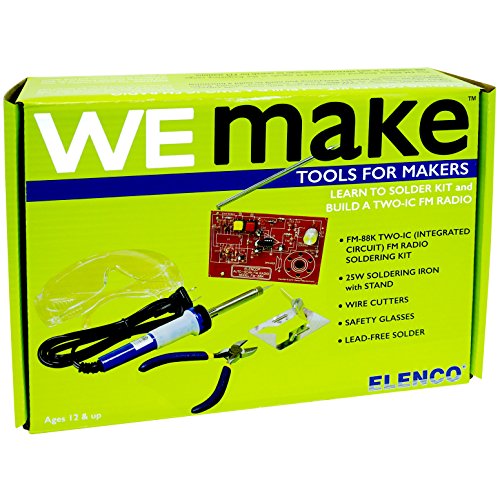
D.I.Y. That's right do-it-yourself! build this kit to assemble a monophonic FM receiver (88-108mhz) with 2 IC Chips
CYOEST DIY Bluetooth Speaker Box Kit for STEM Learning
【Bluetooth Speaker DIY Kit】No soldering iron, Our Kits include laser-cut wooden components,2 pcs Subwoofer 2 inch 4 ohm 3 w Full Range Speaker, Dual Channel Bluetooth...
I’ll start with a quick question: who actually needs a kit that skips the soldering entirely? Parents of impatient eight-year-olds, that’s who. The CYOEST kit arrives with laser-cut wooden pieces that slot together like a puzzle, no hot iron required. I appreciate that safety-first approach, even if I personally miss the smell of flux.
Inside, you get two 2-inch subwoofers and a dual-channel Bluetooth amplifier board. Four AA batteries power the whole thing, not included, so grab those beforehand. The pink wood case assembles in roughly thirty minutes, and pairing with your phone takes seconds.
Sound-wise? It’s surprisingly decent for a 3-watt setup. Rich, noise-free playback at bedroom volumes, though don’t expect HiVi-Swans bass response. This is about learning, not audiophilia.
The STEM angle works: kids grasp basic circuitry while building confidence. Customer support responds within 24 hours, which matters when tiny hands lose a screw.
Verdict: Perfect for parent-child projects, science fairs, or anyone terrified of soldering irons. Adults seeking serious sound should look elsewhere.
Best For: Parents and children aged 8+ seeking a safe, soldering-free STEM project that teaches basic circuitry and engineering concepts while producing a functional Bluetooth speaker for casual home use.
Pros:
- No soldering required, making it safe and accessible for young children to assemble with minimal adult supervision
- Combines hands-on building with functional wireless audio, reinforcing STEM learning through tangible results
- Responsive customer support with 24-hour response time provides reliable assistance for assembly issues
Cons:
- Four AA batteries not included, adding hidden cost and requiring advance preparation
- Limited 3-watt power output delivers only bedroom-appropriate volume without deep bass or audiophile-quality sound
- Laser-cut wooden construction and skip of advanced techniques like soldering may leave older teens and adults wanting more technical depth
Recommended Products

Innovative design and excellent sound quality: this soldering practice kit is designed with a transparent acrylic shell, which not only allows the internal structure to be seen at a glance and adds a sense of technology, but also ensures an excellent sound quality experience with the two built-in 3W speakers. Whether at home or outdoors, you can enjoy clear, three-dimensional music.
THIS IS UNASSEMBLED DIY SPEAKER KIT, NOT FINISHED SPEAKER. Requires manual assembly, wood glue, soldering iron AND external amplifier to work

Complete Kit Contents: Includes all necessary components for assembly, offering hands-on experience with electronic components and soldering
DIY Bluetooth Speaker Kit STEM Science Project (Wood)
DISCOVER HOW SPEAKERS WORK: This amazing DIY Bluetooth Speaker is your chance to discover how speakers work while building your own! It's super easy to assemble and the...
Who’s this kit really for?
Honestly? I think this SCAEMO kit sits in a weird middle space, and I’ll tell you why. At 3.1 x 4.9 x 2.8 inches, it’s tiny, almost pocket-sized. The classic wood look feels classy on a desk, but don’t expect room-filling sound (it’s a 2-inch driver, come on).
I like that there’s zero soldering; you snap clips together like LEGO. The Bluetooth chip pairs fast, battery lasts about four hours.
STEM value: solid, if basic. You’re learning polarity, circuit paths, how voice coils turn electricity into moving air. That’s real science packaged cute.
The quality checks matter: I’ve seen cheap kits where wooden pieces splinter or battery boxes fail. This one doesn’t.
Verdict: perfect for ages 8-12 first build, or a quick weekend project with your kid. Teens will finish in twenty minutes and get bored. Adults? Grab it for the aesthetic, not the challenge.
Best For: This kit is best for children ages 8-12 working on their first electronics build, or parents seeking a quick, engaging weekend STEM project to complete with their kids.
Pros:
- Snap-together assembly with no soldering required, making it accessible for true beginners
- High-quality components with reliable quality checks that prevent common failures like splintering wood or faulty battery boxes
- Genuine, age-appropriate STEM education covering polarity, circuit paths, and voice coil mechanics
Cons:
- Too simple for teens or experienced builders, who can complete it in about twenty minutes and lose interest quickly
- Tiny 2-inch driver and compact 3.1 x 4.9 x 2.8 inch size deliver limited, non-room-filling sound quality
- Minimal challenge for adults, who would primarily purchase for desk aesthetics rather than hands-on engagement
Recommended Products

Spark Creativity with STEM Education: Assemble a real wooden speaker using easy-to-follow instructions for teens aged 8 9 11 13 to learn electronics, engineering, and problem-solving. No soldering required! Includes pre-drilled parts, circuit components, and a step-by-step guide

Spark Creativity with STEM Education: Assemble a real wooden speaker using easy-to-follow instructions for teens aged 8 9 11 13 to learn electronics, engineering, and problem-solving. No soldering required! Includes pre-drilled parts, circuit components, and a step-by-step guide
DIY Bluetooth Speaker Soldering Kit with Remote Control
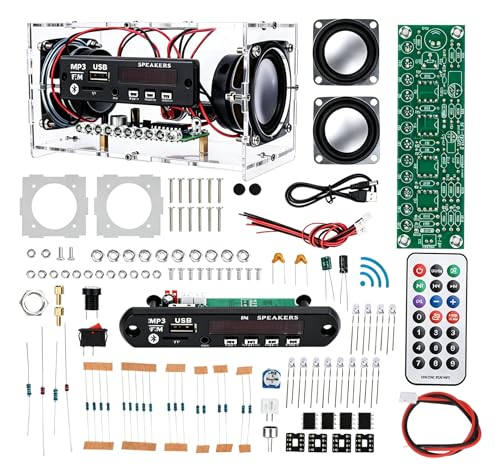
DIY SOLDERING KIT: A hands-on Bluetooth speaker project that requires soldering and assembly, making it a practice kit for electronics enthusiasts and beginners MULTIPLE...
Want a kit that actually teaches you something? The diymore DIY Bluetooth Speaker Soldering Kit delivers real electronics education, not just snap-together simplicity.
What You’re Building
This kit demands actual soldering. You get loose components, a wiring schematic, and zero hand-holding. The payoff? A fully functional stereo speaker with Bluetooth, TF card slot, AUX input, USB playback, and even FM radio. The included remote control feels surprisingly convenient once you’ve earned it.
The Learning Curve
I’ll be honest: this isn’t weekend-afternoon easy. The acrylic case looks gorgeous when finished, transparent walls showing off your handiwork, but you’ll spend serious time with a soldering iron first.
The LED music level indicator adds satisfying visual feedback, and that adjustable sensitivity resistor on the back lets you fine-tune responsiveness after assembly.
Who’s It For?
Schools love this for STEM programs. Hobbyists appreciate the thorough component set. Beginners with patience, or anyone who’s already soldered once or twice, will find it rewarding. Complete novices might want supervision.
Verdict
Skip this if you want instant gratification. Choose it if you value actual skill-building. The finished speaker sounds decent, looks fantastic, and you’ll genuinely understand how it works.
Best For: STEM students, hobbyists eager to develop soldering skills, and patient beginners willing to trade time and effort for genuine electronics understanding.
Pros:
- Multi-source audio (Bluetooth, TF card, AUX, USB, FM radio) with stereo sound and remote control in a visually striking transparent acrylic case
- Delivers legitimate electronics education through hands-on component soldering and schematic reading rather than simplified snap-together assembly
- Tuning customization via adjustable sensitivity resistor and LED music level indicator provides satisfying post-build personalization
Cons:
- Requires substantial time and skill investment with no pre-assembled shortcuts, frustrating those seeking quick weekend projects
- Complete electronics novices may struggle without supervision or prior soldering experience
- Learning curve and manual assembly process means immediate gratification is not an option
Recommended Products

【All-in-1 DIY Electronic Kits】This soldering project kit support Bluetooth, AUX, USB-disk, and TF cards to play music.Open the Bluetooth connection "JX-BT" on your phone...
Gikfun USB Mini Amplifier DIY Kit – 3W Stereo Speaker for Arduino

This electronic transparent stereo speaker kit must be the most interesting DIY kit you have ever encountered, it’s really a beautiful speaker box with the Shining lights...
Why settle for plain speakers when you can build one that dances to your music?
The Gikfun USB Mini Amplifier DIY Kit brings exactly that party trick. I soldered this little kit together last month, and those LED lights pulsing to the spectrum, flashing right through the transparent shell? Honestly, pretty mesmerizing for a 60 x 60 x 62 mm box. It’s like a tiny disco cube.
Assembly’s straightforward, though you’ll need that 30W, 110V soldering iron (don’t skip this, trust me). The nuts, screws, and PCB components all come in the box. No frantic hardware store runs.
At 3W per channel, it won’t shake your walls. But for Arduino projects, desk ambiance, or showing off to curious friends? It’s genuinely fun. I’d call the build challenging yet satisfying, the sweet spot for learning.
Who’s it for? Hobbyists dipping into electronics, students needing demo projects, anyone who wants blinky lights with their beats.
Skip it if you crave serious volume or wireless convenience.
Verdict: Grab it for the joy of making something that glows, grooves, and actually works.
Best For: Hobbyists and students getting into electronics who want a fun, visual DIY project with satisfying assembly and Arduino compatibility.
Pros:
- Mesmerizing LED lights that pulse to music spectrum through transparent shell
- Complete kit with all necessary hardware included (nuts, screws, components)
- Challenging yet satisfying build that’s perfect for learning soldering and electronics basics
Cons:
- Low 3W per channel output won’t deliver serious volume
- Requires specific 30W, 110V soldering iron (not included)
- No wireless connectivity options
Factors to Consider When Choosing a DIY Speaker Kit
I won’t start building any kit until I’ve sized up what I’m actually getting into, and neither should you. When I’m picking a DIY speaker project, I weigh five things: how much skill the kit demands (soldering, wiring, or just snap-together parts?), how complex the build looks on paper versus reality, and what kind of sound I’m chasing (casual podcast listening or proper music critical listening?).
I also consider who’s actually going to build it (a patient adult, a distracted teen, a curious kid?) and whether my toolbox can handle what’s required (or if I’ll need to borrow, buy, or fake it). Get these wrong, and you’re either bored, frustrated, or staring at a half-finished box that sounds worse than your phone speaker, and trust me, I’ve been there with two of those three.
Skill Level Needed
Before you buy a kit, you’ve got to be honest with yourself about how much time and patience you’ll actually bring to the table.
I look for kits that match my real skill level, not the one I wish I had. Some kits, like the MiOYOOW, require soldering: they treat it as a learning activity. That’s great if you want to pick up that skill. Others advertise “no soldering required,” which I appreciate when I just want to build something without firing up an iron.
Most beginner-friendly kits include step-by-step instructions and pre-soldered components. Many STEM kits target ages 8+, with safe, guided learning. I check whether a project suits solo work or collaboration; family-friendly builds mean better support for true novices.
What matters most? Matching the kit to your hands-on comfort, wiring skills, and willingness to troubleshoot when circuits act up.
Build Complexity
When I’m staring at a DIY speaker kit listing, the first thing I check is whether I’ll need to fire up a soldering iron or if I can just snap things together.
No-solder kits with pre-drilled parts are my go-to recommendation for total newbies. Several Bluetooth options designed for kids literally click together. Zero stress, decent results.
Soldering-required kits aren’t monsters, though. Some only need you to attach LEDs or minor board work, which builds real skills. Others throw multi-function amps at you: recording, radio, USB/TF inputs. That’s more wiring, more chances to misroute something.
Case design matters more than you’d think. Transparent acrylic looks slick but demands neat wiring routing. Wooden boxes forgive more sins.
Terrible instructions? I’ve rage-quit halfway through. Great step-by-step guides, paper or digital, save your sanity.
My take: Start solder-free. Graduate when you’re hooked.
Audio Quality Goals
How much should sound actually matter if you’re just “testing the waters”? Honestly, even beginners deserve decent audio. Don’t settle for tinny garbage, and neither should anyone else.
Driver Quality Matters
Look for dual-channel or multi-way designs, like 2.0 or 3-way setups. They split frequencies properly: woofers handle lows, dedicated drivers tackle mids and highs. Bigger drivers, say 6.5-inch woofers, give actual bass extension instead of that cheap thump-rattle mess.
Tweeters and Crossovers
I prioritize isodynamic or quality dome tweeters. Pair them with proper crossover networks, fourth-order or well-tuned, and you’ll hear details without harsh distortion. It’s the difference between “pleasant” and “painful.”
Power and Enclosure
Check wattage per channel for headroom. Wooden enclosures beat acrylic for accurate resonance and soundstage. Trust me, materials matter.
Intended Age Group
Audio quality specs mean nothing if you can’t actually put the thing together without frustration, right? That’s why I always check the age rating first.
Kids (8–12): Look for no-solder kits with pre-drilled parts. These emphasize safety and foundational STEM learning. I love these for family projects; you can actually help without taking over.
Early Teens: Step-by-step instructions become vital here. Some kits hit this sweet spot perfectly, offering enough challenge without overwhelming.
Classroom Settings: Group-friendly options work better for older students working together.
Teens to Adults: Here’s where soldering practice and higher-power amps enter the picture. I personally prefer these; the hands-on electronics feel more rewarding.
Match the kit to the builder’s patience and dexterity, not just their birth year.
Available Tools Required
What tools do you already have lying around? Most kits keep it simple. I’ve built speakers with nothing but a screwdriver and steady hands.
Soldering: Yes or No?
Check this first. Many beginner kits now offer no-solder assembly, using spring clips or screw terminals instead. I love these for first-timers. No burned fingers, no wobbly joints.
What You’ll Actually Need
Basic hand tools cover most builds: screwdrivers, pliers, maybe a wire stripper. Pre-drilled enclosures save you from drilling holes yourself.
Some kits include wood glue or mounting hardware; others don’t. Read the fine print.
Power and Workspace
A few advanced kits need specific power supplies, like 5V/2A adapters. LED strips or custom enclosures add steps. I always clear my desk first.
Small space? Pick compact kits with fewer parts.
Match the kit to your setup, not the other way around.