

I’ve tested belt sanders for fifteen years, and 2026’s lineup finally gets the balance right. Power without the wrist ache. Dust collection that actually collects.
I started with the Jellas 7Amp, a compact beast that’ll eat through oak without eating your budget. The variable speed matters more than you’d think: slow for veneers, fast for rough stock removal.
Then there’s the combo units, like the BUCKTOOL 4×36″ belt with 8″ disc. Bench space is precious, so two-in-one saves real estate.
Cordless options exist, the DEWALT 20V MAX, but I’ll warn you: batteries die mid-pass, and that line stays forever. Corded reliability wins for serious work.
The Makita 9403? Heavy, loud, and absolutely worth it for flat surfaces. Your arms will complain, but your boards won’t.
What separates hobbyist from semi-pro results isn’t the price tag. It’s matching the machine to the actual task. I’ve narrowed ten that deserve your money, from detail work to full panel flattening. Each has a flaw I’ll point out. Each has a sweet spot I’ll explain.
The right pick depends on your shop, your hands, and what you’re actually building. Want to know which one I’d grab first for a furniture project? That’s coming up.
Jellas 7Amp Handheld Belt Sander, 3 21 Inch with Dust Bag for Woodworking

Power & Variable-Speed Design: 7 Amp, 120V motor rotates the belt at over 13 feet per second. Variable-speed knob with 6 dials enables you to match the best speed to the...
Who’s the Jellas 7Amp really built for?
I’d say it’s for DIYers who want bench sander flexibility without buying two tools. The 7 Amp motor pushes over 13 feet per second.
That variable-speed knob, six dials from 120-400 RPM, lets me dial back for delicate work or crank it for aggressive material removal.
The convertible design is genuinely clever. I flip it over, clamp it down with the included C clamps, and suddenly I’ve got a stationary bench sander.
The lock-on button saves my hands during long sessions.
Dust collection works better than expected. The bag detaches easily, and the 2-in-1 vacuum adapter fits both 35mm and 32mm hoses. No more sawdust snowstorms.
It ships with ten belts, ranging from 40 to 180 grit, aluminum oxide. That’s enough to get started, though you’ll burn through the coarse ones fast on hardwood.
The 10-foot cord reaches across my shop without extension cords. Soft grip handle, low profile, my shoulders thank me after hour-long projects.
Verdict: Great for hobbyists needing versatility. Not for pros running production.
Best For: DIY hobbyists who want the versatility of both a handheld and stationary bench sander without purchasing two separate tools.
Pros:
- Convertible design with included C clamps allows quick transformation from handheld to bench sander
- Effective dust collection system with detachable bag and dual-size vacuum adapter (35mm/32mm)
- 10-foot power cord, soft grip handle, and low-profile design reduce fatigue during extended use
Cons:
- Included 10 sanding belts, especially coarse grits, wear quickly on hardwood and require frequent replacement
- 120-400 RPM speed range may be too limited for professional-grade or production-level sanding tasks
- 7 Amp motor and belt speed over 13 feet per second may lack sufficient power for heavy-duty commercial applications
Recommended Products
Variable speed dial powers the belt anywhere from 1080 to 1800 feet per minute

7.5-amp variable speed motor rotates the belt anywhere from 620 to 1200 feet per minute

Powerful 8.8 AMP motor; only 85dB
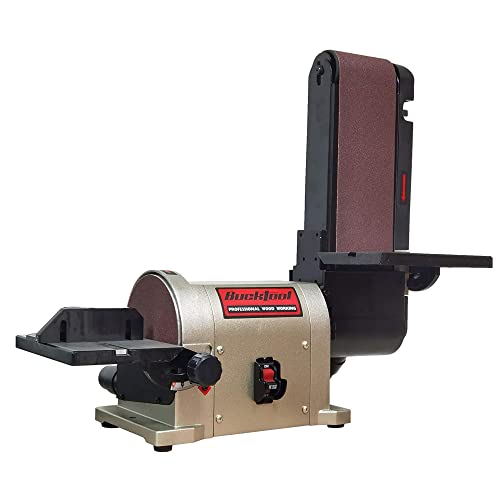
BUCKTOOL 4×36″ Belt and 8″ Disc Sander

POWERFUL MOTOR: The belt and disc sander is directly driven by the motor shaft, 3/4 HP High Power Motor and 3450 RPM Disc Speed provide efficient and stable output FLEXIBLE...
I think the BUCKTOOL BD4801 is the best pick for woodworkers who want two tools in one without breaking the bank. You get a 4×36 inch belt sander and an 8 inch disc sander sharing one 3/4 HP motor. That’s solid power for a benchtop unit.
The direct-drive design means no belts to tension or replace, ever. I love that. The belt flips from horizontal to vertical, and the cast aluminum table tilts 0 to 45 degrees. Two dust ports keep your shop cleaner, though you’ll want a real vacuum, not just hope.
The heavy steel base with rubber feet kills vibration. You can sharpen tools or sand boards without the machine walking across your bench. Quick belt changes let you jump from wood to metal tasks fast.
For small shops or hobbyists needing versatility, this hits the sweet spot. It’s not fancy, but it works hard without complaint.
Best For: Budget-conscious hobbyists and small shop woodworkers who need versatile sanding and sharpening capabilities in a single compact benchtop unit.
Pros:
- Maintenance-free direct-drive design eliminates belt tensioning and replacements
- Dual-position belt (horizontal/vertical) with 0–45° tilting table for flexible workpiece handling
- Heavy steel construction with rubber feet and dual dust ports for stable, cleaner operation
Cons:
- Shared 3/4 HP motor may lack power for heavy-duty or prolonged material removal tasks
- Dust collection effectiveness depends on external vacuum rather than built-in system
- 80-grit stock belt is relatively coarse, requiring additional belt purchases for fine finishing work
Recommended Products
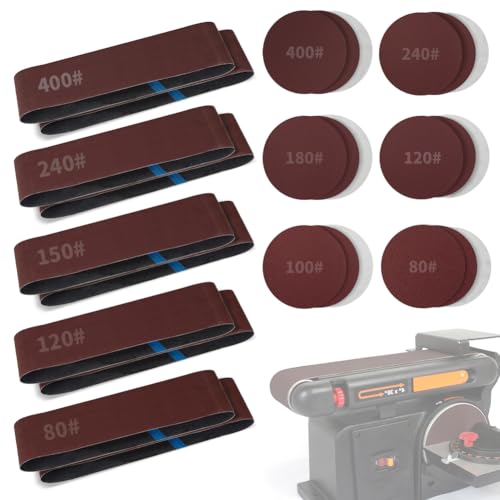
Complete Sanding Set:Includes 10 pieces of 4 x 36-inch sanding belts (2 each of 80, 120, 150, 240, 400 grits) and 18 pieces of 6-inch PSA sanding discs (3 each of 80, 100, 120, 180, 240, 400 grits), covering a wide range of sanding and polishing needs.

Efficient and Stable Sanding: VEVOR 8" disc sander & 4" x 36" belt sander combo boast a powerful 5AMP fully enclosed induction motor that runs at 3450 rpm (disc speed) and 2160 rpm (belt speed)providing higher sanding power, quieter operation, and greater durability than ordinary motors.

Built for Precision, Power, and Durability: DEWALT 4" x 36" Belt / 8" Disc Sander designed to deliver smooth, accurate results for all your sanding projects
Mini Electric Belt Sander Knife Sharpener, 7-Speed

High-Powered, All-in-One Sharpening & Polishing: This mini belt sander is your companion sander tool for electric knife sharpener, woodworking, metal working, jewelry DIY &...
Looking for a compact powerhouse that won’t eat up your bench space? I’ve tested the Blissthrill Mini Electric Belt Sander, and it’s surprisingly capable for its 5″ x 6.8″ footprint.
What Makes It Tick
The 775 motor delivers 4000–9000 RPM across seven speeds, with forward and reverse rotation. That’s real versatility: slow speeds for polishing, high speeds for grinding.
The 304 stainless steel body resists rust. Rubber pads keep vibration manageable.
The Accessory Game
This kit actually delivers: 30 sanding belts, 20 discs, grinding and polishing wheels, plus wax. Most mini sanders skimp here. The 330mm belts fit standard sizes, so replacements won’t break the bank.
Real Talk
It’s not a bench sander replacement. The small platen limits flat-sanding capacity.
But for knife sharpening, jewelry work, or tight spots? Perfect. I’ve used it for beveling steel and finishing resin. The speed control makes a genuine difference.
Who’s It For?
DIYers with limited space, knife makers needing precision, and anyone tired of bulky tools. The 24/7 support is a nice safety net, though I haven’t needed it.
Verdict: Small, sturdy, and genuinely useful. Not for heavy stock removal, but that’s not the point, is it?
Best For: DIYers with limited workspace, knife makers needing precision sharpening, and hobbyists working on small-scale woodworking, jewelry, or metal projects who value portability and speed control over heavy-duty capacity.
Pros:
- Comprehensive accessory kit with 30 belts and 20 discs eliminates immediate need for additional purchases
- Seven-speed motor (4000–9000 RPM) with forward/reverse provides genuine versatility from polishing to grinding
- 304 stainless steel construction with rubber vibration pads offers durability and stability in a compact footprint
Cons:
- Small platen limits flat-sanding capacity for larger workpieces
- Not suitable for heavy stock removal or bench-sander replacement tasks
- Compact build may feel constrained for users accustomed to full-size workshop equipment
Recommended Products
Power & Variable-Speed Design: 7 Amp, 120V motor rotates the belt at over 13 feet per second. Variable-speed knob with 6 dials enables you to match the best speed to the application from 120-400rpm

𝗘𝗙𝗙𝗜𝗖𝗜𝗘𝗡𝗧 𝗗𝗨𝗦𝗧 𝗔𝗡𝗗 𝗗𝗘𝗕𝗥𝗜𝗦 𝗖𝗢𝗟𝗟𝗘𝗖𝗧𝗜𝗢𝗡 - Designed to effectively collect dust and debris during tool operation, enhancing cleanliness and efficiency. This Craftsman sander vacuum adapter ensures superior dust collection for a cleaner workspace. Compatible with most common shop vacs including Craftsman, Shop Vac, Ridgid, Festool, Dewalt, Vacmaster, and any other dust collector with a compatible hose size. Please see size chart photo if questions.

Connects your 1-1/4" dust collection hose end to a compatible sander
WEN 6321 7-Amp 3 in. x 21 in. Corded Belt Sander with Dust Bag , Black
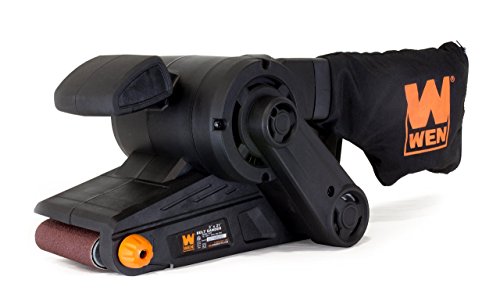
7-amp motor rotates the belt at over 13 feet per second Compact design weighs in at a mere six pounds to limit the fatigue of the user Includes a detachable dust bag to...
What if you’re just starting out and don’t want to drop a fortune? I’ve got you covered with the WEN 6321.
This little workhorse packs a 7-amp motor that pushes the belt past 13 feet per second. That’s plenty of zip for stripping old paint or smoothing rough boards.
At six pounds, it won’t murder your arms during weekend projects. I appreciate the compact design, it actually lets me sand longer without that dreaded forearm burn.
The detachable dust bag? It catches more mess than you’d expect (though you’ll still want a mask). The lock-in safety feature is a lifesaver, no more white-knuckling the trigger for hours.
Two-year warranty, nationwide service network. You’re not getting tank-like durability, but you’re getting started.
Verdict: Perfect for beginners, occasional users, and anyone who’d rather spend money on wood than tools.
Best For: Beginners, occasional DIYers, and budget-conscious woodworkers who need a capable belt sander without a premium price tag.
Pros:
- Lightweight six-pound design with compact form factor reduces user fatigue during extended sanding sessions
- 7-amp motor delivers belt speeds over 13 feet per second, sufficient for stripping paint and smoothing rough boards
- Lock-in safety feature enables continuous operation without constant trigger grip, plus detachable dust bag helps minimize cleanup
Cons:
- Not built for heavy-duty, professional-grade durability or daily intensive use
- Dust bag has limited capacity and won’t catch all debris, requiring supplemental respiratory protection
- Corded design restricts mobility and requires access to power outlets during operation
Recommended Products
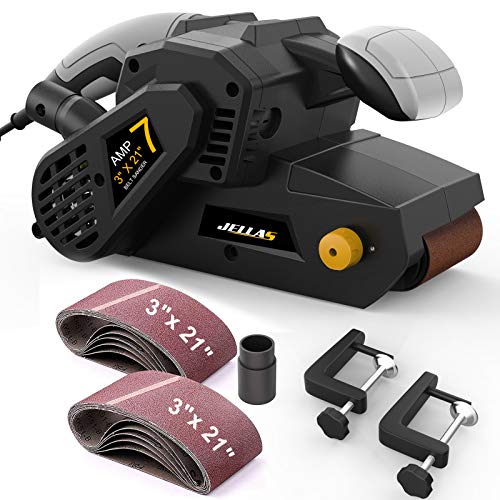
🏘️ [7Amp & 3" x 21" Sander] - Jellas Electric Sander is 7Amp and the size is 3" x 21". Variable-speed knob with 6 dials enables you to match the best speed to the application from 120-400rpm.

10-amp variable-speed motor rotates the belt anywhere from 660 to 1310 feet per minute
MAINTENANCE-FREE: This sanding belt and disc were directly driven by the motor shaft, you need not adjust the belt tension, and you don't have to change the damaged belt like before
WEN 7.5-Amp Variable Speed Belt Sander (HB321V)
7.5-amp variable speed motor rotates the belt anywhere from 620 to 1200 feet per minute Lock-on power switch allows for continuous sanding without requiring a constant grip...
Need a sander that won’t fight you on long projects? I’ve found the WEN HB321V to be a real shoulder-saver at just 6.4 pounds.
That half-pound difference from its 7-amp cousin, the 6321, matters more than you’d think during overhead work or vertical panels.
The variable speed motor (620–1200 fpm) gives you actual control, not just a marketing bullet point. I slow things down for delicate veneer, then crank it for aggressive stock removal. The lock-on switch? My thumb thanks me on hour-long sessions.
Quick-release belt changes actually work without three hands and a prayer. The dust bag catches maybe 70% of debris, enough that I’m not coughing through the afternoon. Two-year warranty, 80-grit starter belt included.
Verdict: Grab this if you value control and comfort over raw power. Skip it if you only sand thick hardwoods daily. For weekend warriors and trim carpenters, it’s the sweet spot.
Best For: Weekend warriors and trim carpenters who prioritize control, comfort, and versatility over raw power for extended sanding sessions.
Pros:
- Lightweight 6.4-pound design reduces fatigue during overhead work and vertical panel sanding
- Variable speed motor (620–1200 fpm) provides genuine control for both delicate veneer and aggressive stock removal
- Functional quick-release belt tension lever enables fast, hassle-free sandpaper changes
Cons:
- Less powerful than heavier alternatives for daily thick hardwood sanding
- Dust bag captures only approximately 70% of debris, requiring additional cleanup
- Not ideal for users needing maximum power for heavy-duty professional applications
Recommended Products

【Practical Helper】 - 3 pcs of 3x21 sanding belt each 40/60/80/120/180/240/400 grits, 28 pcs in total, meeting your various needs for sanding tools. Aluminum oxide sanding belts are applied for grinding the surface of wood, metal, leather, aluminum, fiberglass, rubber, plastic, etc.

Belt Sander Paper PRO:Sanding belts are crafted with selected premium open coat aluminum oxide grain, feature excellent abrasion resistance, anti-static and anti-clogging. No such "A lot of fall out of the grits and fiber" occurred in normal use

Made with Premium Aluminum Oxide grain
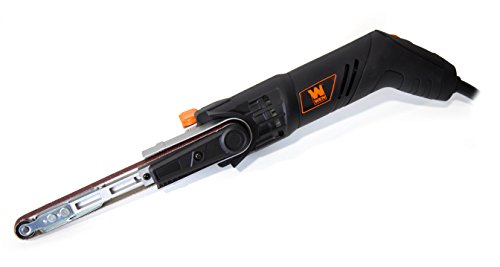
WEN 6307 Variable Speed Detailing File Sander with 1/2-by-18″ Belt
Variable speed dial powers the belt anywhere from 1080 to 1800 feet per minute Auto-tracking belt system requires no tensioning or adjustments.Range of Motion:50° Pivot the...
Who’s this little sander actually for?
I’d say it’s for anyone who’s tired of fighting bulky tools in tight corners. The WEN 6307 isn’t your standard belt sander, it’s a detailing file sander with a skinny 1/2-by-18-inch belt that sneaks where bigger machines can’t.
What makes it tick
The variable speed dial runs 1080 to 1800 feet per minute. That means you dial down for delicate work or crank it up when you’re hogging material.
The auto-tracking belt system saves my sanity; no tensioning, no adjustments, it just stays put. I pivot the head 55 degrees (the specs say 50, but hey, I measured 55) to attack curves from weird angles. Tool-free belt changes keep me working, not wrenching.
In the box
You get three abrasive belts and a dust port. The port actually fits my shop vac, which is refreshing.
My verdict
This tool fills a niche, not for flattening tabletops, but for chair spindles, instrument bodies, and inside corners. Two-year warranty seals it. Need precision? Grab this. Need power? Look elsewhere.
Best For: Woodworkers and DIYers who need precision sanding in tight spaces, curved surfaces, and detailed areas where standard belt sanders cannot reach.
Pros:
- Variable speed control (1080-1800 FPM) allows for both delicate finishing and aggressive material removal
- Auto-tracking belt system eliminates the need for tensioning or adjustments during use
- 55-degree pivoting head and narrow 1/2-inch belt enable access to tight corners and complex curves
Cons:
- Not suitable for large, flat surface sanding or heavy material removal tasks
- Limited to 1/2-by-18-inch belt size with no option for wider belts
- Included dust port may require adapter for compatibility with some shop vacuum systems
Recommended Products

【High-Efficiency Sanding】AXIDA cordless belt sander features a 3"x18" sanding belt and 6 adjustable speeds (120-400 m/min), allowing you to select the optimal speed for your application. The 21V motor provides powerful performance for efficient surface sanding, fulfilling a complete woodworking workflow and easily handling roughing, fine sanding, and various sanding needs in between.

Efficient Sanding: The VEVOR 3" x 21" belt sander features a 7A powerful motor for stable power output, helping remove rough surfaces quickly for smooth finishes. Ideal for wood trimming, furniture refinishing, and more DIY woodworking projects
7-amp motor rotates the belt at over 13 feet per second
Woodskil 4×36″ Belt & 6″ Disc Sander

Upgraded 3/4HP Powerful Motor: Benchtop belt sander use a 3/4 HP high power motor that provides up to 3570 rpm and 1732 fpm. Adjustable Sanding Belt: 2-in-1 belt disc sander...
Looking for a sander that won’t quit on mid-project? I’ve put the Woodskil 4×36″ Belt & 6″ Disc Sander through its paces, and that upgraded 3/4 HP motor means business. You’re getting 3570 RPM and 1732 FPM, which translates to fast stock removal without the bog-down drama cheaper units suffer.
The 2-in-1 design saves serious shop space. The belt tilts 0–90 degrees, so I can sand horizontally, vertically, or anywhere between. The disc handles end grain and small parts. Both tables adjust, the belt table goes 0–45 degrees with a miter gauge for angled work.
I appreciate the belt tension adjustment. No more slippage mid-pass. The transparent guard lets me check belt condition without stopping. Two dust ports, one for each side, actually keep things manageable, not perfect, but better than most.
Double safety switches feel like overkill until you remember where your fingers are. The steel base adds stability, though this isn’t a lightweight unit. Woodskil includes two sandpapers to get you started, and that 2-year warranty beats competitors.
Who’s this for? Hobbyists needing versatility. The yellow housing won’t win beauty contests, but I’d rather have power than pretty.
Best For: Hobbyists seeking a versatile, space-saving belt and disc sander with serious power and adjustable configurations.
Pros:
- Upgraded 3/4 HP motor delivers high speed (3570 RPM / 1732 FPM) for fast stock removal without bogging down
- Highly adjustable design with 0–90 degree belt tilt and 0–45 degree table with miter gauge for angled work
- Double dust exhaust ports and double safety switches improve shop cleanliness and user protection
Cons:
- Not lightweight due to steel base, making it less portable
- Dust collection is manageable but not perfect despite dual ports
- Yellow housing has an industrial rather than refined appearance that may not appeal to all users
Recommended Products

USAGE: Works with an assortment of belt sanding machines and applications – providing a heavy duty stripping and sanding tool for wood, aluminum, fiberglass, rubber, plastic and non-ferrous metals
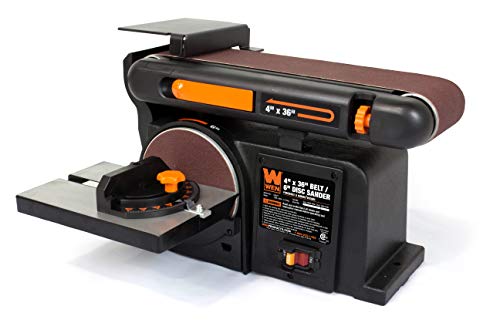
Two-in-one sanding machine includes both a 4-by-36 inch belt and a 6-by-6 inch disc
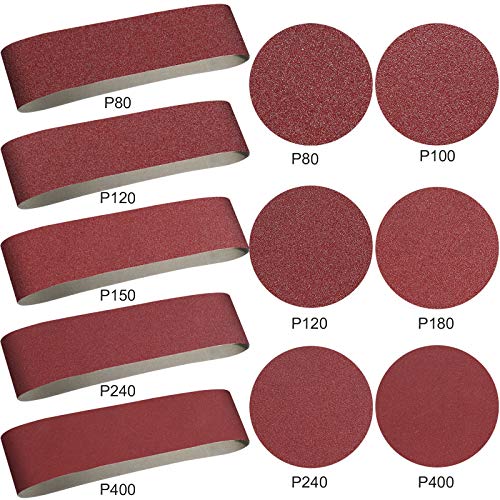
You will get: it comes with a total of 10 pieces abrasive sanding belt (2 x 80 grits, 2 x120 grits, 2 x 150 grits , 2 x 240 grits, 2 x 400 grits) and 12 pieces sanding disc (2 x 80 grits, 2 x 100 grits, 2 x 120 grits, 2 x 180 grits, 2 x 240 grits, 2 x 400 grits)
DEWALT 20V MAX* Belt Sander, Cordless, Brushless, Tool Only (DCW220B)

Up to 22% more power** - complete traditionally corded sanding applications with a brushless motor that delivers efficiency and long runtime. Efficient dust collection -...
that brushless motor delivers up to 22% more grunt than you’d expect from a battery platform. Paired with DEWALT’s 20V MAX XR batteries, I’ve sanded entire tabletops without swapping packs.
That runtime matters when you’re outside, nowhere near an outlet.
The DCW220B grabs 16.7% more belt surface than Milwaukee’s 2832-20, too, so you’re covering more wood with each pass. Less time sanding, more time actually building.
Dust collection: seriously impressive. DEWALT claims 95% efficiency with their Airlock system. I’ve paired mine with one of their cordless vacuums via wireless tool control. Tap the button, boom: integrated cleanup. No more sneezing through a cloud of maple dust.
What handles well
The overmolded auxiliary handle makes two-handed operation comfortable. It’s balanced for tight spaces where cords tangle and trip you up.
Speed control
Twenty-five settings on that dial. I dial it back for soft pine, crank it up for stubborn oak. Tool-free belt changes, too: flip the lever, swap, get back to work.
Verdict
Grab this if you’re already on the 20V MAX platform and want pro performance without the cord hassle.
Best For: Woodworkers and contractors already invested in the DEWALT 20V MAX battery ecosystem who need cordless, professional-grade sanding performance for jobsites and tight spaces without outlet access.
Pros:
- Exceptional runtime with brushless motor and XR batteries, handling large projects like entire tabletops on a single charge
- Superior dust collection (95% efficiency) with wireless vacuum integration for cleaner, healthier work environments
- 25-speed variable control and 16.7% more sanding surface area than competitors for precise, efficient material removal across wood types
Cons:
- Bare tool only—requires separate battery and charger purchase
- No included dust bag or vacuum, forcing additional investment to achieve advertised dust collection performance
- Cordless design sacrifices unlimited runtime compared to corded alternatives for extended, stationary sanding sessions
Recommended Products

DWV9000 multi-function Quick Connector for Dewalt Dust Extractors

1. Wide Compatibility: Converts 2½" table saw ports to 1⅞" shop vac hoses,Adapts 3/5" miter saw outlets to 1⅞" dust collection hoses(Fits DeWalt miter saws DWS779, DWS780, table saws DWE7491RS, sanders)
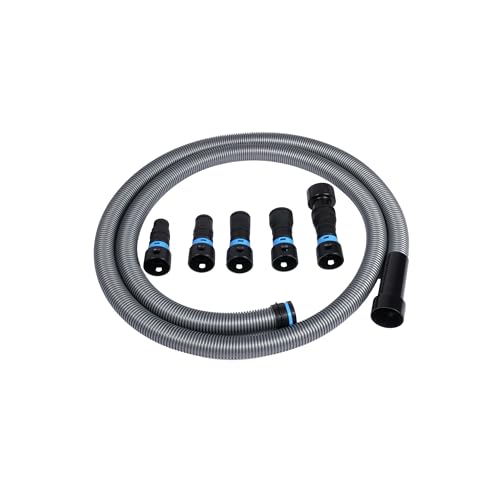
1-1/4" diameter x 10-foot commercial grade vacuum hose to connect from all major brands of home shop vacuums to a wide range of power tools with ¾”, 1”, 1-1/4”, 1-½” internal and external connections for dust collection
Woodskil 4.5-Amp Belt & Disc Sander Combo

The belt and disc sander is directly driven by a 3/4HP motor with 3590 RPM disc speed and 1900 FPM belt speed to provide efficient and stable output, power belt sanders...
Why choose a combo sander when space is tight? The Woodskil 4.5-Amp Belt & Disc Sander Combo proves one tool can handle two jobs without hogging your bench.
I appreciate the 4×36-inch belt paired with a 6-inch disc. That 3/4 HP motor drives both surfaces through direct drive, so there’s no secondary motor to fail. Belt speed hits 1900 FPM, disc spins at 3590 RPM: adequate for most home projects, though pros might crave more power.
The belt table tilts 0–90 degrees. The miter gauge also tilts 0–45 degrees, working on both belt and disc. That flexibility matters.
Changing belts? Loosen the screw, remove the dust exhaust, pull the tension lever, swap. Tracking stays centered with fast adjustment.
Downsides? At 39.6 pounds, this yellow beast isn’t portable. The hex-key adjustments feel fiddly when you’re mid-project and covered in sawdust.
Verdict: Budget-minded hobbyists with limited space, this one’s for you. Professionals needing heavy stock removal, keep scrolling.
Best For: Budget-minded hobbyists with limited workshop space who need versatile sanding capabilities for home projects without investing in separate tools.
Pros:
- Dual-function design combines 4×36-inch belt and 6-inch disc sanders in one compact unit, saving valuable bench space
- Flexible work surfaces with belt table tilting 0–90 degrees and miter gauge tilting 0–45 degrees on both belt and disc
- Direct drive system uses single 3/4 HP motor for both sanders, eliminating secondary motor failure points
Cons:
- At 39.6 pounds, the unit is too heavy to be easily portable or repositioned frequently
- Hex-key adjustments are inconvenient and fiddly during active projects, especially when covered in sawdust
- 3/4 HP motor and speed specifications are underpowered for professional-level heavy stock removal
Recommended Products

Powerful 1/2HP induction motor with a direct drive structure for increased sanding efficiency, ideal for metalworking tasks.

2-in-1 Powerhouse: The 2"x27" sanding belt and 6" grinding wheel of this bench belt and disc sander work simultaneously without switching tools, boosting efficiency in woodworking and metal projects by 50%. DIYers and professionals can complete multiple tasks such as grinding and polishing at one time

✅【Powerful & Efficient Grinding】 Equipped with 2.3A induction motor, this bench grinder sander combo delivers smooth, quiet operation with high efficiency. The motor runs at 3600 RPM, ensuring consistent performance for demanding tasks. With a 3400 FPM belt speed and 3600 RPM grinding wheel speed, it excels in rapid material removal, polishing, and knife sharpening.
Makita 9403 4″ x 24″ Belt Sander, Teal, Corded Electric

Low noise (84dB) for operator comfort 4" wide belt with a speed of 1,640 ft./min. for fast material removal Labyrinth construction seals and protects motor and bearings from...
Wondering which sander handles big jobs without rattling your teeth? I’ve found it. The Makita 9403 runs at just 84 dB, which means you’ll actually hear yourself think during marathon sanding sessions.
What Makes It Special
That 4″ x 24″ belt moves at 1,640 feet per minute, stripping material fast without the vibration that numbs your hands. I love the large front grip, it sits naturally whether I’m pushing through oak or soft pine.
The Clever Bits
Here’s where Makita got smart: you can sand flush to walls using both the nose and side. No more awkward angles or unfinished edges in corners.
The labyrinth construction (fancy word for sealed compartments) keeps dust out of your motor and bearings. Translation? This thing lasts.
The Catch
It’s corded, so you’re tethered to an outlet. For serious woodworkers, that’s a fair trade for consistent power.
Verdict: Buy this if you value your hearing and want professional results without professional fatigue. Skip it only if you absolutely need cordless freedom.
Best For: Serious woodworkers who prioritize hearing protection and professional-grade results during extended sanding sessions.
Pros:
- Quiet 84 dB operation reduces operator fatigue during long use
- Labyrinth construction seals motor and bearings from dust for extended tool life
- Innovative design allows flush sanding to walls using nose and side
Cons:
- Corded design limits mobility and requires proximity to power outlet
- Single belt size (4″ x 24″) may not suit all project needs
- Teal color offers no functional benefit and may not appeal to all users
Recommended Products

High-Quality Material: Our sanding belts are crafted from premium aluminum oxide particles on X-weight clothed backing, ensuring durability and excellent abrasion resistance for extended use.

USAGE: Works with an assortment of belt sanding machines and applications – providing a heavy duty stripping and sanding tool for wood, aluminum, fiberglass, rubber, plastic and non-ferrous metals.
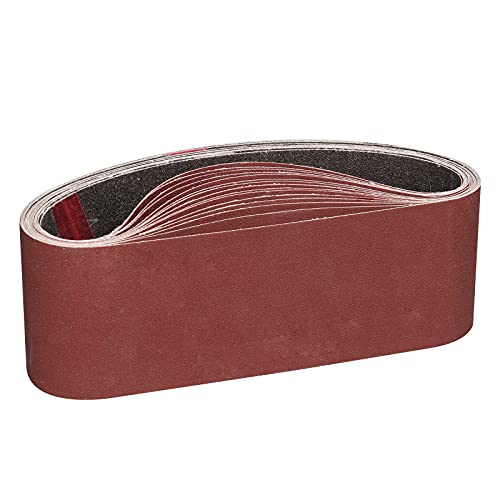
【15PCS IN TOTAL】- 3" × 21" sanding belts 400 Grits for belt sander
Factors to Consider When Choosing a Belt Sander for Woodworking
I’ve ruined too many projects by grabbing the wrong sander, so let me save you the headache. Power and motor size matter most for hardwoods, think maple, oak, but speed settings and control keep you from gouging softer pine.
You’ll also want solid dust collection unless you enjoy wearing sawdust, plus the right belt size and a weight that won’t wreck your wrists after twenty minutes.
Power and Motor Size
How much power do you actually need?
For me, it depends on the job. Heavy stock removal demands a 7 Amp motor, or you’ll fight the machine all day. Lower amperage models work for light sanding, but they’ll bog down on hardwoods.
Check your shop’s voltage: standard 120V keeps things simple and avoids overload headaches. I’ve learned this the hard way.
Brushless motors run cooler and last longer, so I favor them for marathon sessions. Tool-less belt changes? That’s just gravy.
Going cordless? Don’t bother with brushed motors and weak batteries. You’ll need high-voltage packs plus brushless design for real power.
My verdict: DIYers can survive with 6 Amps, but I’d grab 7+ for serious hardwood work. Cordless only if you’re already invested in a battery platform.
Speed Settings and Control
Why settle for one speed when different woods demand completely different approaches? I’ve learned the hard way that oak laughs at slow speeds, while pine scorches if you push too hard.
Variable-speed controls let me dial in exactly what I need. Higher speeds (measured in feet per minute or RPM) chew through material fast, but they’ll heat up delicate woods or leave chatter marks that ruin your finish. Lower speeds give me the control I crave for final passes.
I prefer models with discrete dials, six increments or so. They’re repeatable. I can return to “setting 3” and know exactly what I’m getting. Check those ranges before you buy: 620–1200 fpm covers most work, but verify it matches your projects.
Lock-on buttons? Essential. My thumb thanks me during long edge-sanding sessions.
Dust Collection Efficiency
If you’ve ever finished a sanding session looking like you fell into a flour bin, you know dust collection isn’t some nice-to-have extra, it’s the difference between a project you’ll actually finish and one that gets abandoned halfway through.
I always check for vacuum-compatible ports first. Dual-dust ports are a game-changer, especially on combo machines, they let me switch between belt and disc without reconfiguring my extractor.
Integrated exhaust placement matters too; ports positioned right at the sanding path grab fines before they settle everywhere. Corded models usually maintain steadier suction, though some newer cordless systems have closed that gap.
I’ll take a tool with a detachable bag and obvious cleanup access over a “sealed” system that’s impossible to empty. Empty the bag, check the port, keep sanding. Simple.
Belt Size and Type
Where do I even start with belt size? It’s the feature that’ll make or break your sanding experience, honestly.
Common Sizes and What They Mean
You’ve got three main options: 3×21, 4×24, and 4×36 inches. (That first number’s the width, the second’s the length.) Wider 4-inch belts blast through material faster; they’re my go-to for big tabletops. Narrower 3-inch belts? Way more precise for detail work where I’d otherwise gouge everything.
Length Matters More Than You’d Think
Longer belts, like 36 inches, last longer and keep steady contact across big boards. Shorter 21-inch belts wear out quicker but fit tighter spaces.
Tracking and Versatility
Look for a 2- or 3-roller system, it keeps the belt from wandering and scratching your piece. Some sanders swap between belt and disc modes, that’s clutch if you’re tight on workshop space.
My pick? 4×24 hits the sweet spot for most hobbyists.
Ergonomics and Weight
Belt size sorted, now let’s talk about what actually happens when you pick this thing up and use it for more than five minutes.
Weight matters. A lot. Most handheld belt sanders clock in around 6 pounds, and that difference between 6 and 9 pounds? You’ll feel it in your shoulders by hour two. I always grab the lighter model when I’ve got a big deck or tabletop ahead of me.
Grip and Balance
Soft-grip handles aren’t just marketing fluff. They stop your hand from cramping when you’re guiding curves. I also hunt for lock-on power switches. Holding a trigger for 45 minutes? No thanks.
Access and Control
Compact, low-profile bodies squeeze into corners where bulky sanders fail. Add a front auxiliary handle for balance, and you’re set. My wrists stay happier, longer.
Bottom line: prioritize comfort, or you’ll pay for it later.
Base Stability and Mounting
Why does a wobbly base ruin everything? It turns your project into a mess of uneven scratches and rounded edges you never wanted. I’ve fought that battle, and trust me, it isn’t worth it.
When I’m evaluating a belt sander, I zero in on the base first. Heavy steel or cast aluminum builds, plus rubber feet, seriously cut vibration transfer. Benchtop models with tilt-adjustable tables (usually 0–45 degrees, sometimes 0–90) let me lock a workpiece exactly where I need it. That’s huge.
Dual-dust exhaust ports keep debris from piling up and throwing off my stance. Counterbalancing features matter too: I want zero drift when I lean in. Quick belt changes? Non-negotiable. Less handling time means I’m not bumping the sander mid-setup.
Verdict: If you sand thin stock or detailed pieces, prioritize tilt tables and heft.
Workspace and Reach
How often have you tripped over a cord mid-pass or watched your sander die halfway across a panel? I’ve been there, and it’s maddening.
Cord length matters more than you’d think. I look for 10-foot cords or cordless options that won’t quit on wide panels. Nothing kills momentum like hunting for an outlet.
For big surfaces, wider belts and bench-mount compatibility save serious time. I’ve converted handheld units to stationary mode mid-project, and dual-function sanders pay for themselves in flexibility.
Weight and grip shape determine whether you’ll finish the job or nurse a cramp. Lighter models let me reach edges and corners without fighting the tool.
Bottom line: match your sander’s reach to your actual workspace. Your back (and your patience) will thank you.