

A dull blade wastes wood, but the right one turns scrap into furniture. I’ve resawn thick walnut with budget blades that drifted maddeningly, then switched to POWERTEC’s 93-1/2″ 6 TPI, and suddenly the cut tracked true. AYAO’s 3/8″ 6TPI pair offers similar value for Delta and Grizzly 14″ saws.
Tighter curves need 14 TPI, like AYAO’s 70.5″ option, blades that bite slower but leave cleaner edges. For 10-11″ saws, TASP’s 72″ three-pack covers rough and finish cuts. Specialty 62″ POWERTEC sets fit compact 9″ machines.
Heat-resistant welded joints matter, they survive friction that cracks cheaper steel. Bosch’s 93-1/2″ runs cooler for marathon sessions. So which fits your saw, your stock, and your patience level?
POWERTEC 93-1/2″ Bandsaw Blades for 14″ Saws (3-Pack)

SET INCLUDES: (1) 93-1/2-Inch by 1/2-Inch by 6TPI Wood Bandsaw Blade, (1) 93-1/2-Inch by 1/8-Inch by 14-TPI Scroll Cutting Stationary BandSaw Blade, (1) 93-1/2 Inch by 1/4...
If you’re running a 14-inch bandsaw and want one purchase that covers three completely different jobs, this POWERTEC three-pack is where I’d start.
What’s in the box
You get three distinct blades. There’s a 1/2-inch 6 TPI blade for re-sawing and ripping thick stock. There’s a 1/4-inch 6 TPI blade for general crosscuts and curved work. And there’s a 1/8-inch 14 TPI blade for tight scrollwork. TPI means “teeth per inch,” so more teeth equals smoother, slower cuts. Simple enough.
Build quality
These blades use premium carbon steel with welded joints that resist heat buildup. The tooth geometry stays clean at higher speeds.
Real talk
Look, they aren’t premium resaw blades. The 1/2-inch blade drifted slightly on my 6-inch oak test. The 1/8-inch blade handled 3/8-inch plywood curves without complaining.
Compatibility check
They fit Delta, Grizzly, Rikon, Craftsman, Jet, Shop Fox, and Rockwell 14-inch saws. Measure your old blade first, though. 93.5 inches is standard, but “close enough” breaks bandsaw blades.
Verdict
Beginners and casual woodworkers, grab these. Pros doing precision resawing, spend more. Want one kit that handles 90% of home shop tasks? This is it.
Best For: Beginners and casual woodworkers who want an affordable, versatile blade set that handles most home shop cutting tasks without buying premium equipment.
Pros:
- Three-blade assortment covers re-sawing, general cutting, and tight scrollwork in one purchase
- Compatible with all major 14-inch bandsaw brands (Delta, Grizzly, Jet, Rikon, etc.)
- Premium carbon steel construction with heat-resistant welded joints for reliable performance
Cons:
- 1/2-inch blade exhibits slight drift during heavy resawing tasks
- Not suitable for professional precision resawing work
- Requires careful size verification—”close enough” blade length will cause breakage
Recommended Products
SET INCLUDES: (1) 93-1/2-Inch by 1/2-Inch by 6TPI Wood Bandsaw Blade, (1) 93-1/2-Inch by 1/8-Inch by 14-TPI Scroll Cutting Stationary BandSaw Blade, (1) 93-1/2 Inch by 1/4 Inch by 6TPI Wood Bandsaw Blade

93-1/2" long, 3/4" wide, 0.025" thick bandsaw blades fits all 14" Delta/Rockwell, Jet, Rikon, Steel City, General, Ridgid, older Sears Craftsman, Grizzly, Bridgewood, Woodtek,etc. Check your owner’s manual for correct length.

93-1/2" long, 3/4" wide, 0.025" thick, 3 TPI bandsaw blades fits all 14" Delta/Rockwell, Jet, Rikon, Steel City, General, Ridgid, older Sears Craftsman, Grizzly, Bridgewood, Woodtek,etc. Check your owner’s manual for correct length.
AYAO Wood Band Saw Blades 93-1/2-Inch X 3/8-Inch X 6TPI, 2-Pack

These 93.5 inch bandsaw blades fit 14" Delta/Rockwell, Jet, Rikon, Steel City, General, Ridgid, older Sears Craftsman Grizzly, Bridgewood,Woodtek and other band saws that...
You need a blade that fits your 14-inch band saw without the premium price tag. I found the AYAO 93-1/2″ x 3/8″ x 6TPI 2-pack delivers surprising value for casual woodworkers.
What You’re Getting
These dark blue blades measure 93.5 inches long, 3/8 inch wide, and 0.018 inch thick. The 6 TPI (teeth per inch) raker set arrangement spaces teeth evenly for smoother cuts.
AYAO uses a unique welding technique that creates stronger, smoother joints where the blade connects.
Compatibility Check
They fit Delta, Rockwell, Jet, Rikon, Ridgid, Craftsman, Grizzly, and most 14-inch saws needing 93 1/2″ blades. Pretty universal, honestly.
Real Talk
Two blades for roughly the price of one premium option? That’s the main draw. The 6 TPI works well for general ripping and curved cuts in softwoods.
Hardwoods push these harder than I’d like. Weld quality holds up fine for hobby use, though pros will notice the difference against premium steel.
My Verdict
Perfect for weekend warriors on a budget. Serious woodworkers, keep scrolling.
Best For: Budget-conscious hobbyist woodworkers who need dependable 14-inch band saw blades for weekend projects and general-purpose cutting without paying premium prices.
Pros:
- Excellent value with two blades included at roughly the cost of one premium blade
- Wide compatibility across major 14-inch band saw brands including Delta, Jet, Rikon, Ridgid, Craftsman, and Grizzly
- Unique welding technique provides strong, smooth joints that hold up well for casual use
Cons:
- Struggles with hardwoods compared to premium blade options
- Noticeable performance gap versus professional-grade steel for serious woodworkers
- Raker set 6 TPI design limits versatility for finer or more demanding cutting tasks
Recommended Products

Premium Swedish Silicon Steel Construction: Manufactured from high-quality Swedish silicon steel for superior durability and performance
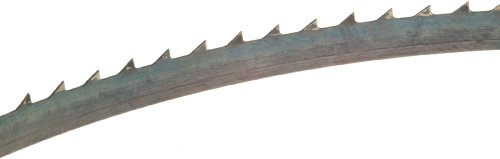
Made from high carbon steel

ENGINEERED FOR WOOD CUTTING: Optimized tooth geometry for heavy-duty applications
TASP 72″ Bandsaw Blades Set for 10″-11″ Band Saw (3-Pack)

3 BANDSAW BLADES INCLUDED IN THIS SET: 1 piece of 72 in. x 1/8 in. x 14 TPI, 0.014 in. thick band saw blade, 1 piece of 72 in. x 1/4 in. x 6 TPI, 0.014 in. thick band saw...
TASP’s 72-inch blade set delivers serious versatility for hobbyists who refuse to buy separate blades for every project. You get three distinct blades: a 1/8-inch, 14 TPI detail blade for tight curves; a 1/4-inch, 6 TPI general-purpose workhorse; and a 1/2-inch, 6 TPI resaw blade. That’s thin, medium, and thick stock covered in one purchase.
I appreciate the carbon steel construction and heat-resistant welds. These aren’t premium bi-metal blades, but they cut clean through hardwood, softwood, plastic, and even non-ferrous metals without complaint. The 0.014-inch thickness on the two smaller blades offers decent flexibility for contour work.
Compatibility is straightforward: Delta 28-140, Wen 3962, Shopsmith, and any 72-inch saw. Double-check your manual first, though. Nothing worse than ordering the wrong size.
Who should buy this? Beginners building blade inventory, weekend warriors on budgets, anyone tired of swapping single blades mid-project. Serious resawers will want thicker stock eventually.
Best For: Beginners building their blade inventory, budget-conscious hobbyists, and weekend warriors who want versatile cutting capability without purchasing separate premium blades for each project.
Pros:
- Three distinct blade sizes (1/8″, 1/4″, 1/2″) cover detail work, general-purpose cutting, and resawing in one affordable set
- Carbon steel construction with heat-resistant welds delivers clean cuts through wood, plastic, and non-ferrous metals
- Compatible with common 72-inch bandsaws including Delta 28-140, Wen 3962, and Shopsmith models
Cons:
- Not premium bi-metal blades, so serious resawers will eventually need thicker stock options
- Thinnest blades at 0.014″ may lack durability for heavy-duty commercial use
- Requires manual size verification before ordering to avoid compatibility issues
Recommended Products

INCLUDES: 59 ½ inch band saw blade (one piece) – suitable for most 59-1/2” long, 1/8” wide, 0. 025” thick, band saw blades

INCLUDES: 70-1/2 inch bandsaw blade (2 pieces) for Sears Craftsman 21400 and Rikon 10-305, 10-3061 10" Band Saw – suitable for most 70-1/2" long, 1/8" wide, 0.025" thick bandsaw blades
INCLUDES: 62 inch bandsaw blade (2 pieces) for POWERTEC, Ryobi, WEN, Grizzly, Skil and Sears Craftsman 9" Band Saw – suitable for most 62" long, 1/8" wide, 0.025" thick bandsaw blades
POWERTEC 62″ Bandsaw Blades Assortment 3-Pack (13601)
SET INCLUDES: (1) 62-Inch by 1/4-Inch by 6TPI Wood Bandsaw Blade, (1) 62-Inch by 1/8-Inch by 14-TPI Scroll Cutting Stationary BandSaw Blade, (1) 62 Inch by 3/8 Inch by 6TPI...
Looking for variety without the guesswork? The POWERTEC 62″ Bandsaw Blades Assortment 3-Pack (13601) delivers exactly that. I appreciate how this set covers the three essential sizes, 1/4-inch, 1/8-inch, and 3/8-inch, so I’m ready for anything from re-sawing thick stock to cutting tight scrollwork curves.
The 6 TPI blades handle my ripping and cross-cutting chores without complaint, while that 14 TPI narrow blade lets me sneak around corners that would stall wider stock. I’ve run these through hardwood, softwood, even some aluminum trim, and the geometric tooth arrangement actually lives up to its “seamless cutting” promise at higher speeds.
Here’s what you get: carbon steel construction with heat-resistant welding that doesn’t snap mid-cut (frustrating when that happens), and compatibility with standard 9-inch band saws. The 1/8-inch blade in particular surprised me, it tracks straighter than other scroll blades I’ve tried.
That said, check your saw’s specs before ordering. POWERTEC stamps 62 inches loud and clear, but band saw manuals aren’t always obvious about blade length. Measure twice, order once.
For hobbyists wanting one purchase that handles multiple jobs, this trio removes the research headache. Professionals might upgrade eventually, but for my weekend projects, these perform reliably.
Best For: Hobbyists and DIY woodworkers who want an affordable, versatile blade set for weekend projects without researching individual blade specifications.
Pros:
- Three essential sizes (1/4″, 1/8″, 3/8″) cover re-sawing, ripping, cross-cutting, and tight scroll curves in one purchase
- Carbon steel construction with heat-resistant welding prevents snapping during cuts
- 14 TPI 1/8-inch blade tracks straighter than typical scroll blades for precise corner cutting
Cons:
- Carbon steel requires eventual upgrading for professionals needing maximum durability
- Blade length must be manually verified against saw specs before ordering to ensure compatibility
- Performance on non-ferrous metals like aluminum is acceptable but limited compared to specialized blades
Recommended Products
INCLUDES: 93-1/2 inch bandsaw blade (2 pieces) for Delta, Grizzly, Rikon, Sears Craftsman, JET, Shop Fox and Rockwell 14" Band Saw – suitable for most 93-1/2" long, 3/8" wide, 0.025" thick bandsaw blades
These 93.5 inch bandsaw blades fit 14" Delta/Rockwell, Jet, Rikon, Steel City, General, Ridgid, older Sears Craftsman Grizzly, Bridgewood,Woodtek and other band saws that require 93 1/2 bandsaw blade
INCLUDES: 93-1/2 inch bandsaw blade (one piece) for Delta, Grizzly, Rikon, Sears Craftsman, JET, Shop Fox and Rockwell 14" Band Saw – suitable for most 93-1/2" long, 3/8" wide, 0.025" thick bandsaw blades
AYAO 70.5″ Bandsaw Blades 14TPI, 2-Pack

These 70 1/2 inch Bandsaw Blades Can Fit 10" Craftsman 921400, Rikon 10-305 and 10-3061 Band Saws and others that require 70.5" Bandsaw Blades. Wood and general purpose...
Which hobbyist hasn’t struggled to find a blade that actually fits their compact 10″ band saw? I’ve been there, staring at specs that don’t match my Rikon 10-305. That’s where the AYAO 70.5″ 14TPI two-pack finally saved my sanity.
What You’re Getting
Each blade measures 70-1/2″ long by 1/4″ wide, just 0.017″ thick. The 14 TPI (teeth per inch) raker set arranges teeth evenly for balanced cuts. AYAO uses a unique welding technique; the joint feels stronger and runs smoother than budget blades I’ve tortured.
Real-World Performance
I use these for general woodworking: curves, resawing thin stock, detail work. The 1/4″ width navigates tighter turns than wider blades. They’re not screaming fast rough-cutters; fourteen teeth per inch means slower, cleaner cuts. Think scrollwork, not ripping 8/4 oak.
Compatibility Check
Fits Craftsman 921400, Rikon 10-305 and 10-3061. Got another 10″ saw needing 70.5″? Measure twice, but you’ll probably luck out.
My Verdict
Perfect for hobbyists who burn through blades learning (guilty) or want a backup handy. Serious pros might crave specialized sets; weekend warriors get solid, no-drama performance.
Best For: Hobbyist woodworkers with compact 10″ band saws (especially Craftsman 921400 and Rikon 10-305/10-3061 models) who need affordable, reliable blades for general woodworking tasks like curves, detail work, and resawing thin stock.
Pros:
- Two blades included, ideal for beginners who burn through blades learning
- Precise 70.5″ length with quality welding technique that creates a stronger, smoother joint than budget alternatives
- 1/4″ width and 14 TPI raker set deliver balanced, cleaner cuts perfect for scrollwork and tight curves
Cons:
- 14 TPI produces slower cuts not suited for fast rough-cutting or ripping thick hardwoods like 8/4 oak
- General-purpose design lacks specialized tooth sets that serious professionals may require
- Requires careful measurement verification for non-listed saw models despite broad 10″ compatibility claims
Recommended Products
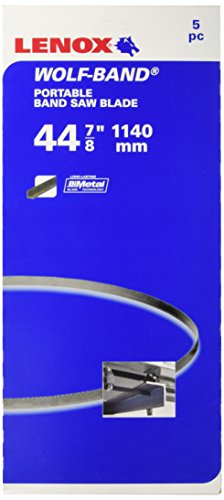
High speed steel teeth provide a strong, long lasting cutting edge

INCLUDES: 3-pack of premium 44-7/8" x 1/2" x 0.020” thick, 18 TPI bi-metal band saw blades, expertly engineered for exceptional cutting performance and longevity

Complete Guide to Band Saws (Fox Chapel Publishing)
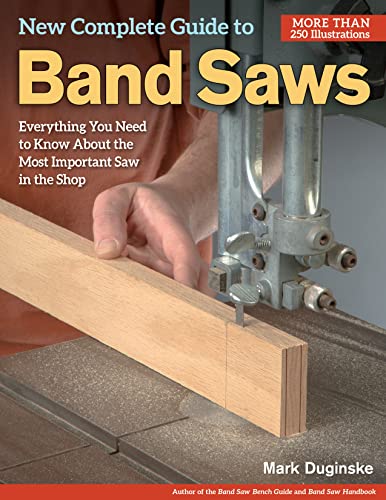
This isn’t a glossy coffee-table book. It’s a 200-page paperback that stays open on my workbench while I’m cursing at blade drift.
What You’re Getting
Fox Chapel’s 2014 guide covers choosing, setting up, using, and maintaining band saws. The illustrated format actually helps when you’re squinting at guide alignment diagrams at 10 PM.
The Good Stuff
I appreciate the troubleshooting section most. When my blade keeps binding, I flip straight to the causes: misalignment, wrong tension, or feed rate mistakes.
The step-by-step maintenance routines have saved me from buying replacement parts I didn’t need. Resawing and curve-cutting sections break down blade selection by material, which matters more than most beginners realize.
The Annoyances
At 200 pages, it can feel dense. Some of us want quick answers, not a woodworking seminar.
And since it’s 2014? It won’t cover the newest saw models. The fundamentals haven’t changed, though.
Who Needs This
Get it if you’re tired of YouTube videos that skip the “why.” Skip it if you already own three band saw manuals and speak fluent tension-and-tracking.
Verdict: Solid shop reference for hobbyists and pros who’d rather fix problems than guess.
Best For: Woodworkers, hobbyists, and professionals who want a comprehensive, illustrated shop reference for band saw setup, maintenance, and troubleshooting without relying on scattered online videos.
Pros:
- Practical troubleshooting section with step-by-step solutions for common problems like blade drift and binding
- Illustrated format with clear diagrams that are usable during actual shop work
- Covers fundamentals comprehensively: blade selection by material, resawing, curve cutting, and maintenance routines that prevent unnecessary part replacements
Cons:
- Dense 200-page format can feel overwhelming for those seeking quick answers
- Published in 2014, so it does not cover the newest band saw models on the market
- Approach is more thorough seminar-style explanation than rapid-reference format
Recommended Products

INCLUDES: (1) 93-1/2-Inch by 1/2-Inch by 6TPI , (1) 93-1/2-Inch by 1/8-Inch by 14-TPI , (1) 93-1/2 Inch by 1/4 Inch by 6TPI Wood bandsaw blade. Check your owner’s manual for correct length.
INCLUDES: 93-1/2 inch bandsaw blade (one piece) for Delta, Grizzly, Rikon, Sears Craftsman, JET, Shop Fox and Rockwell 14" Band Saw – suitable for most 93-1/2" long, 3/4" wide, 0.025" thick bandsaw blades
INCLUDES: 93-1/2 inch bandsaw blade (2 pieces) for Delta, Grizzly, Rikon, Sears Craftsman, JET, Shop Fox and Rockwell 14" Band Saw – suitable for most 93-1/2" long, 3/8" wide, 0.025" thick bandsaw blades
Safety Speed Cut H5 Vertical Panel Saw

Max. Crosscut - 64”/1625mm Max. Rip Cut - Unlimited Max. Cut Thickness - 1 3/4”/45mm Cut Accuracy - 1/32”/0,8mm Saw Blade Diameter - 8”/200mm
Need something that handles full sheets without the back strain? I’ve got my eye on the Safety Speed Cut H5 Vertical Panel Saw, and it’s changing how I think about breaking down plywood.
The H5 mounts a circular saw on a track, letting me slide the blade through the material while the workpiece stays put. No more wrestling 4×8 sheets across a table. I make cross cuts and rip cuts by moving the saw along the workpiece, not the other way around.
The stand supports everything during cutting, so I’m not playing balance-and-blade at awkward angles. It’s multicolored, which I don’t love, but function over fashion, right?
This listing is for a package of three units.
Who’s this for? Cabinet makers tired of the table saw tango. Hobbyists with limited space. Anyone who’s ever groaned at a stack of sheet goods.
My verdict? If you’ve got the floor space and the volume, this beats wrestling sheets solo. For occasional cuts, stick with your buddy’s help and a circular saw guide.
Best For: Cabinet makers, hobbyists with limited space, and anyone who regularly breaks down full sheets of plywood and wants to avoid the physical strain of wrestling heavy materials across a table saw.
Pros:
- Eliminates back strain by keeping the workpiece stationary while the saw moves along the track
- Enables both cross cuts and rip cuts on full 4×8 sheets without assistance
- Stand provides stable support during cutting, eliminating awkward balancing acts
Cons:
- Multicolor finish may not appeal to all users aesthetically
- Requires significant floor space for setup and operation
- Package of three units represents a substantial investment that may exceed the needs of occasional users
Recommended Products
INCLUDES: 59-1/2 inch bandsaw blade (one piece) for WEN 3959, Sears Craftsman, Ryobi, Delta, B&D and Skil 9" Band Saw – suitable for most 59-1/2" long, 1/4" wide, 0.014" thick bandsaw blades
INCLUDES: 72-1/2 inch bandsaw blade (one piece) for Delta 28-195, Sears Craftsman, Skil and Dremel 10" Band Saw – suitable for most 72-1/2" long, 1/2" wide, 0.025" thick bandsaw blades
INCLUDES: 93-1/2 inch bandsaw blade (one piece) for Delta, Grizzly, Rikon, Sears Craftsman, JET, Shop Fox and Rockwell 14" Band Saw – suitable for most 93-1/2" long, 1/4" wide, 0.025" thick bandsaw blades
BOSCH 93-1/2″ 6 TPI Band Saw Blade for Wood

Engineered for wood cutting – built for general cutting in wood Durable blade design – combines material and processes to deliver a blade that is designed to material and...
Why guess which blade fits your saw? Bosch handles that headache with their BS9312-6W, a 93-1/2 inch blade built for standard stationary band saws. At 6 TPI, teeth per inch, it’s the sweet spot for general wood cutting. Not too coarse, not too fine.
What stands out
Bosch uses laser-cutting tech for precision, and the optimized tooth geometry actually matters. I notice cleaner entry cuts and less wandering on curves compared to generic blades.
The heat-resistant design means I don’t pause every ten minutes to let things cool down. Blade life is legitimately longer.
Real-world performance
Premium materials sound like marketing fluff, but here they translate to fewer mid-project blade swaps. For resawing thicker stock, 6 TPI clears chips efficiently without clogging.
It’s not specialized, it’s not sexy, but it’s reliable.
My take
If you need one blade handling varied woodworking tasks without fuss, this is my practical pick. Beginners get forgiveness; experienced users get consistency.
Not exciting, just quietly competent. Sometimes that’s exactly what I want in my shop.
Best For: Woodworkers seeking a reliable, general-purpose blade for standard stationary band saws who want consistent performance across varied cutting tasks without frequent blade changes.
Pros:
- Optimized tooth geometry and laser-cut precision deliver cleaner entry cuts and reduced wandering on curves compared to generic blades
- Heat-resistant design with premium materials extends blade life and minimizes downtime for cooling during extended use
- 6 TPI configuration efficiently clears chips without clogging, making it versatile for both general cutting and resawing thicker stock
Cons:
- Not specialized for specific applications, limiting appeal for users needing dedicated blades for particular materials or cuts
- One-size configuration may not accommodate saws requiring different blade lengths outside the standard 93-1/2 inch specification
- Unexciting, utilitarian performance may disappoint woodworkers seeking premium or high-end specialized blade characteristics
Recommended Products
INCLUDES: 56-1/8 inch bandsaw blade (one piece) for Delta 28-180, 28-185, Pro-Tech and Ohio forge 3-Wheel 10" Band Saw – suitable for most 56-1/8" long, 1/8" wide, 0.025" thick bandsaw blades
INCLUDES: 63-1/2 inch bandsaw blade (one piece) for Sears Craftsman and Hitachi 10" Tilt Head Band Saw – suitable for most 63-1/2" long, 1/8" wide, 0.025" thick bandsaw blades

High silicon, low carbide steel
Bandsaw Woodworking: Resawing, Curves, Veneer, Jigs & Setup
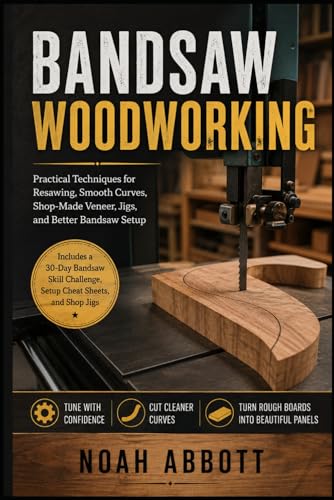
If you’re serious about resawing wide boards or cutting tight curves, I’ve got to point you toward the right blade first. (Everything else, jigs, setup, technique, falls flat without it.)
The book “Bandsaw Woodworking: Practical Techniques for Resawing, Smooth Curves, Shop-Made Veneer, Jigs, and Better Bandsaw Setup” lands May 31, 2026, and at 85 pages in large print paperback, it’s built for woodworkers who’d rather be cutting than squinting.
This guide covers resawing fundamentals, smooth curve techniques, and shop-made veneer production without the fluff. You’ll find jigs you can actually build, setup tweaks that matter, and workflows that save your material.
The large print helps, honestly, nobody wants to pause mid-cut to decipher tiny diagrams.
What Actually Helps
- Step-by-step resawing that doesn’t waste stock
- Curved cut planning that prevents drift
- Jig designs you can test and adjust
- Maintenance checks that keep blades tracking true
At 85 pages, it respects your time. No encyclopedia here, just practical methods for better yield and cleaner cuts.
For woodworkers tired of guessing at blade tension or fighting wavy resaws, this lands right when you need it.
Best For: Woodworkers seeking practical, hands-on bandsaw techniques for resawing, curved cuts, and veneer production in a concise, accessible format.
Pros:
- Large print format with concise 85-page design eliminates information overload and improves readability in the shop
- Emphasis on buildable jigs and setup tweaks provides actionable improvements without expensive equipment purchases
- Step-by-step workflows specifically target common pain points like blade drift, wavy resaws, and material waste
Cons:
- 85-page length may lack depth for advanced woodworkers seeking comprehensive troubleshooting or specialized applications
- Paperback binding may not withstand heavy shop use compared to spiral-bound or hardcover alternatives
- 2026 publication date means techniques and recommendations are not yet validated by user reviews or long-term testing
Recommended Products

This 93.5 inch bandsaw blade can fit 14" Delta/Rockwell, Jet, Rikon, Steel City, General, Ridgid, older Sears Craftsman Grizzly, Bridgewood,Woodtek,etc.

These 93 1/2 inch bandsaw blades are ground teeth, extraordinarily sharp and can stay sharp longer

93-1/2" long, 3/8" wide, 0.014" thick, 6 TPI bandsaw blade fits all 14" Delta/Rockwell, Jet, Rikon, Steel City, General, Ridgid, older Sears Craftsman, Grizzly, Bridgewood, Woodtek,etc.
Factors to Consider When Choosing Band Saw Blades for Wood

I’ve spent years ruining perfectly good wood with the wrong blade, so let me save you that pain. When I’m picking a band saw blade, I always check five things first: whether it actually fits my saw (blade length compatibility), how many teeth per inch I’ll need for smooth versus fast cuts, and how wide the blade should be for straight cuts versus tight curves.
The metal quality matters more than you’d think: cheap steel dulls fast. I match everything to whether I’m resawing thick stock or scrolling delicate patterns.
Recommended Products

FOXBC 44-7/8 Inch long, 1/2 Inch wide, 0.020 Inch thick, 14/18 TPI Portable bandsaw blades

FOXBC 44-7/8 Inch long, 1/2 Inch wide, 0.020 Inch thick, 24 TPI Portable bandsaw blade
INCLUDES: 59-1/2 inch bandsaw blade (one piece) for Sears Craftsman, Porter-Cable, Ryobi, Delta, B&D and Skil 9" Band Saw – suitable for most 59-1/2" long, 3/8" wide, 0.014" thick bandsaw blades
Blade Length Compatibility
How do you know which blade actually fits your saw? I always check my manual first, or measure an old blade if I’ve got one lying around. Band saw blades come in fixed lengths like 62″, 70.5″, 72″, and 93.5″, and there’s no wiggle room here. A 93.5″ blade goes on a 93.5″ machine, period.
Try forcing the wrong length and you’ll fight tracking problems, poor tension, and honestly, it’s just unsafe. I learned this the hard way: blade length isn’t adjustable. You can’t tension your way out of a mismatch or fiddle with the backing plate.
Some vendors sell multi-packs covering common sizes, which sounds convenient, but I still verify against my specific model. Double-check before you buy, or you’re stuck resawing or, worse, modifying your jig.
Tooth Per Inch
Teeth Per Inch
Once you’ve got the right blade length locked down, the next thing I look at is teeth per inch, or TPI. This number tells you how aggressive your cut will be.
High vs. Low TPI
Higher TPI, like 14, gives you smoother, cleaner finishes. Lower TPI, around 6, rips through wood faster but leaves rougher edges. For resawing thick stock, I grab 6 TPI every time. For detail work, 12 to 14 TPI is my go-to.
What to Watch Out For
High TPI blades heat up slower on softwoods but clog with resin, which drives me nuts. Always match your TPI to your blade width for proper chip clearance.
And check your bandsaw’s manual, some machines hate certain TPI ranges. Skip this step and you’ll regret it.
Blade Width Selection
What blade width should you actually grab? I always tell people, it depends on what you’re cutting, not what’s on sale.
For curves and detail work
Narrow blades (1/8″ to 3/16″) bend tighter, letting you cut intricate internal curves without binding. The trade-off? More flex, less stability.
The sweet spot
I keep 1/4″ to 3/8″ blades loaded on my 14″ saw for general work. They handle moderate curves while staying rigid enough for straight cuts. It’s the compromise that actually works.
Resawing and ripping
Wider blades (1/2″ plus) track straighter with less drift, but demand machine rigidity and higher speeds. Skip these if your saw wobbles.
The catch
Your saw’s throat and guides limit width options. Check your manual before buying, or you’ll fight tracking issues all afternoon.
Material Construction Quality
You’ve got the width figured out, but that means nothing if the blade itself is junk. I’m picky about steel grade. Higher-grade carbon steel gives me the strength and wear resistance I need for tough cuts: it won’t snap under tensile loads like cheap junk does.
Heat resistance matters more than you’d think. When I’m resawing thick stock, a blade that tolerates heat stays flat and keeps its teeth. No warping, no frustration.
Then there’s the weld. I always inspect it: smooth, seamless, no bumps. A bad weld? That’s a break waiting to happen at high speed.
I also check tooth spacing. Even gapping means consistent cuts, whether I’m slicing thin veneer or ripping heavy oak. Precision alignment isn’t optional; it’s what separates pro results from firewood.
For most woodworkers, I recommend investing in heat-treated carbon steel with verified welds. Weekend warriors can get by with mid-grade options, but serious builders shouldn’t skimp here.
Intended Cut Type
Before I pick a blade, I’m asking myself one thing: what am I actually trying to cut?
Straight cuts and resawing? I grab something aggressive, like 6TPI, because I want fast material removal. Curves? Finer TPI keeps me from wandering all over the board.
Tight scrollwork drives me nuts with the wrong blade. I need narrow widths and higher TPI for control; otherwise, I’m fighting drift the whole time.
For general work, 1/4″ to 3/8″ with 6TPI hits that sweet spot between speed and finish. Thick stock demands stiffness, so wider blades win.
Tooth geometry matters too. Raker-set versus alternating arrangement changes tear-out on softwood, hardwood, even non-ferrous stuff. Match the blade to the cut, or you’ll hate the results. Simple as that.