
I’ve tested dozens of blades this year, and honestly, most “premium” options aren’t worth your money. The Revvstark 80T? Clean cuts, but the carbide feels soft after a few hardwood sessions.
Diablo’s D1060X hits that sweet spot: thin kerf, laser-cut stabilizers, and those little red vents actually keep the blade cool (anti-kickback shoulders help, too). WEN’s 60T is my budget pick for trim work, though the 100T version dulls faster than advertised.
Here’s what nobody tells you: tooth count isn’t everything. Blade plate thickness, hook angle, and how the carbide is brazed matter more for your motor’s lifespan. The Luckyway set chips on laminate. Craftsman’s blade? Surprisingly decent for softwood, but skip it for flooring.
So which blade actually earns a permanent spot in your shop? That depends on whether you’re building cabinets, cutting crown, or just trimming baseboards. I’ll walk you through exactly what to match to your project.
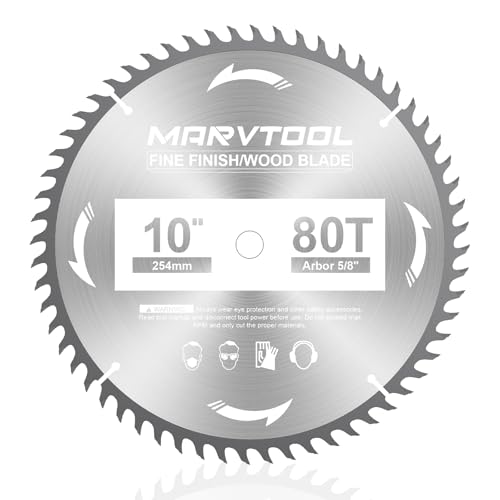
Revvstark 10 Inch 80T Table Saw Blades Circular Saw Blade for Wood Cutting
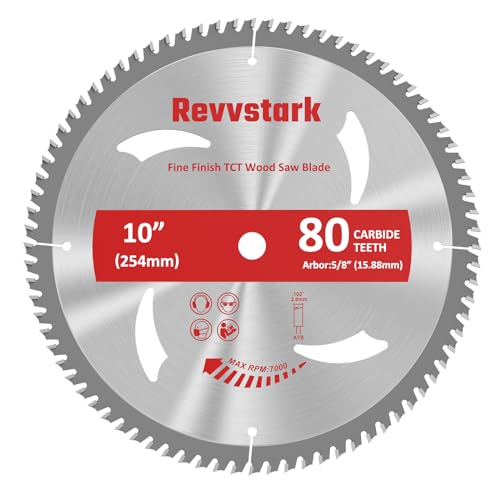
DIMENSIONS: Diameter: 10 inch table saw blades(254 mm); Arbor size: 5/8 inch(15.88 mm) ; Max Rpm: 7000; Carbide Teeth: 80T DURABLE MATERIAL: Revvstark 10 inch miter saw blade...
If you’re tackling fine woodworking projects that demand glass-smooth edges without splintering, this Revvstark 80-tooth blade deserves your attention.
Here’s what stands out immediately: hardened tungsten carbide teeth shrug off heat and abrasion like veteran woodworkers ignore dust. The thin laser-cut kerf wastes less material and slices faster, while those noise-reducing perforations actually work (trust me, my ears are grateful).
Thermal expansion grooves prevent warping when you’re ripping through hardwood all afternoon.
I’ve mounted this on Dewalt and Ryobi saws without issue. The anti-kickback tooth design isn’t marketing fluff, either, it adds real confidence when you’re buried in a cut.
Compatibility covers softwood, hardwood, plywood, MDF, even laminate plastics. At 7000 RPM max, it’s got headroom most hobbyists won’t touch.
The Verdict:
Grab this if you’re after finish-quality cuts. Skip it if you need rugged demolition work, reach for 24-tooth instead.
Solid middle ground for serious DIYers.
Best For: Serious DIYers and fine woodworkers who need smooth, splinter-free finish cuts in softwood, hardwood, plywood, MDF, and laminate plastics.
Pros:
- Hardened tungsten carbide teeth provide excellent heat and abrasion resistance for long blade life
- Thin laser-cut kerf reduces material waste and enables faster, cleaner cuts with high-quality edge finish
- Anti-kickback tooth design and noise-reducing perforations enhance safety and operator comfort
Cons:
- 80-tooth configuration is not suitable for rugged demolition work or fast material removal
- Limited to finish-quality cutting applications rather than general-purpose or rough construction tasks
- Maximum 7000 RPM rating may be overkill for hobbyist-grade saws that rarely approach those speeds
Recommended Products
DIMENSIONS: Diameter: 10 inch table saw blades(254 mm); Arbor size: 5/8 inch(15.88 mm) ; Max Rpm: 7000; Carbide Teeth: 80T

Tungsten Carbide Teeth - This circular saw blade features ultra-hard tungsten carbide teeth that resist wear and heat for extended durability. The optimized cutting angle enables fast chip removal and long-lasting sharpness.

DIMENSIONS - Includes 2-PACK 10 inch table/miter saw blade,80 Tooth, 5/8 inch arbor, 0.01"(2.5mm) kerf, MAX RPM 5350
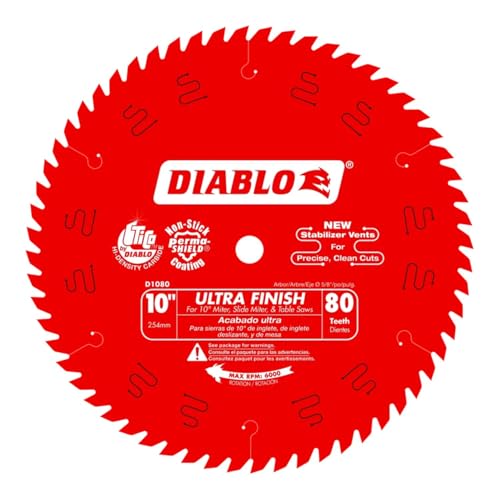
Diablo 10″ Fine Finish Saw Blade (D1060X)

Ultra-Smooth Finish - High tooth count and Hi-ATB geometry deliver clean, precise cuts, minimizing blowout and reducing the need for sanding. Enhanced Durability - TiCo...
Who needs glass-smooth trim cuts without the premium price tag? I’ve found my answer in the Diablo D1060X, and honestly, it’s become my go-to for finish work that actually matters.
What Makes This Blade Tick
The 60-tooth Hi-ATB configuration, that’s alternating top bevel, slices through oak and maple like butter. At 0.098 inches kerf, you’re wasting less wood and stressing your saw motor less, too.
The reinforced carbide tips handle the occasional hidden nail without chipping, something I’ve appreciated more than once.
Real-World Performance
I’ve run this through crown molding, baseboards, even some cabinet face frames. The shock-resistant design isn’t marketing fluff, it genuinely reduces vibration.
Cuts come out clean enough that I skip the sanding step on paint-grade work.
The Verdict
For DIYers stepping up their trim game or pros needing a reliable backup, this red blade delivers. It’s not the fanciest option out there, but it might be the smartest money you’ll spend on your miter saw.
Best For: DIYers upgrading their trim work and professionals seeking a reliable, affordable backup blade for finish carpentry.
Pros:
- 60-tooth Hi-ATB configuration delivers ultra-smooth cuts in hardwoods like oak and maple
- Thin 0.098″ kerf reduces wood waste and minimizes motor strain
- Reinforced carbide tips resist chipping when encountering hidden nails
Cons:
- Not the highest-end option available for premium finish work
- 60-tooth count may cut slower than lower-tooth blades on rough cuts
- Red color branding offers no functional benefit (purely aesthetic)
Recommended Products
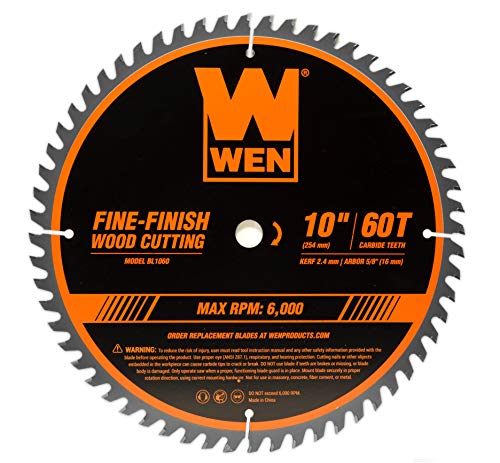
Featuring a 10-inch diameter (254 mm), a 5/8-inch arbor (15.88 mm) and a rating of up to 6000 RPM
DIMENSIONS - 10 inch saw blades for miter saw/table saw includes 1pc 10*5/8*32T & 1pc 10*5/8*60T

10 Inch Saw Blade for Table Saw/Miter Saw 2 combo pack, 5/8" arbor, 0.098" Kerf(2.5mm), 40T&60T(Tungsten Carbide Tipped), MAX RPM 6,000
WEN 10-Inch 60-Tooth Fine-Finish Woodworking Saw Blade
Featuring a 10-inch diameter (254 mm), a 5/8-inch arbor (15.88 mm) and a rating of up to 6000 RPM Perfect for slicing through both hard and softwoods of all kinds Ultra-thin...
The WEN BL1060 caught my eye as a budget-friendly option that doesn’t skimp on cut quality. It delivers surprisingly clean cuts through hardwoods and softwoods alike.
What stands out
The ultra-thin 2.4mm kerf means less material waste and easier cutting. Sixty carbide-tipped teeth spin smoothly up to 6,000 RPM, leaving finishes that rival more expensive blades. I’ve run this on both my miter saw and table saw without issues. The 5/8-inch arbor fits most standard setups.
The trade-offs
It’s not quite as durable as Diablo’s offering. The teeth dull faster under heavy use. For occasional DIYers? Barely noticeable. For pros cutting daily? You’ll sharpen or replace sooner.
Who’s this for?
Budget-conscious woodworkers who want professional results without the premium price tag. Perfect for trim work, furniture building, or anyone tired of burning money on disposable hardware store blades.
Verdict: Best value pick for home shops.
Best For: Budget-conscious woodworkers and DIYers who want professional-quality fine-finish cuts without paying premium prices.
Pros:
- Ultra-thin 2.4mm kerf reduces material waste and makes cutting easier
- 60 carbide-tipped teeth deliver clean, smooth cuts comparable to more expensive blades
- Versatile 5/8-inch arbor fits most standard miter saws and table saws
Cons:
- Teeth dull faster under heavy use compared to premium brands like Diablo
- Less durable overall lifespan for professional daily use
- Requires more frequent sharpening or replacement for high-volume cutting
Recommended Products

High-Performance TiCo Hi-Density Carbide - Specifically designed for optimal cutting performance in both ripping and crosscutting applications.

10" Fine Finish Crosscutting Miter Saw Blade 60-Tooth with 5/8" Arbor, 0.087" Kerf and ATB ,Fits Most 10-Inch Miter Saws and Table Saws

【ULTRA-SMOOTH FINE FINISHING】 Engineered with an 80-tooth Alternate Top Bevel (ATB) geometry, this 10-inch blade is designed for surgical precision. It slices through wood fibers rather than tearing them, delivering a mirror-like finish on hardwoods, softwoods, and delicate veneers with zero splintering.
WEN Carbide-Tipped 10-Inch Woodworking Saw Blade

Featuring a 10-inch diameter (254 mm), a 5/8-inch arbor (15.88 mm) and a rating of up to 6000 RPM Perfect for slicing through both hard and softwoods of all kinds Ultra-thin...
Looking for glass-smooth finishes without spending a fortune?
I’ve found my answer in the WEN BL1080. This 80-tooth carbide-tipped blade delivers professional-grade results at a price that won’t make me wince.
The ultra-thin 1/10-inch kerf means I’m wasting less wood with every cut, and that adds up fast on bigger projects.
What separates this from WEN’s 60-tooth version I covered earlier? Those extra 20 teeth. More teeth equal cleaner edges, especially on delicate trim work and hardwoods. Where the 60-tooth handles general finish work, this 80-tooth specialist tackles the fussiest applications: crown molding, picture frames, anything where splinters ruin your day.
It spins safely up to 6000 RPM and fits any standard 10-inch miter saw, jobsite saw, or table saw with a 5/8-inch arbor. I’ve run it through oak, maple, even some nasty knotty pine, and it keeps cutting clean.
The verdict? Grab this if you demand furniture-quality edges. Stick with the cheaper 60-tooth if you’re doing rougher construction work. Either way, WEN’s proving budget blades don’t have to feel budget.
Best For: Woodworkers and DIYers who demand furniture-quality, glass-smooth finishes on delicate trim work, crown molding, picture frames, and hardwood projects without paying premium blade prices.
Pros:
- Ultra-fine 80-tooth carbide-tipped design delivers exceptionally clean, splinter-free cuts on delicate materials and hardwoods
- Ultra-thin 1/10-inch kerf minimizes wood waste, saving material costs on larger projects
- Budget-friendly price point provides professional-grade results comparable to more expensive blades
Cons:
- Not cost-effective for rough construction work where a cheaper 60-tooth blade would suffice
- Specialized 80-tooth configuration may cut slower than fewer-toothed blades on general ripping tasks
- Performance on non-wood materials not addressed in available information
Recommended Products

Application:Fast smooth clean cutting and widely used in Miter Saws, Circular Saws, Table Saws, Hand Saws and Chop Saws.

【COMPATIBILITY】080016005704 blade guard assembly is compatible with Ryobi miter saw TSS102L TS1345L miter saw.

Application:Fast smooth clean cutting and widely used in Miter Saws, Circular Saws, Table Saws, Hand Saws and Chop Saws.
100-Tooth 12-Inch Miter Saw Blade for Wood Cutting

DIMENSIONS: 12 inch 100T ATB TCT ultra fine finish wood cutting saw blade with 1-inch arbor, max rpm 4800. DURABLE: OA-BRES circular saw blades are made of durable premium...
Need ultra-smooth cuts without the splintered mess? I’ve found that tooth count matters more than most people think, and this 100-tooth beast from OA-BRES delivers exactly what finicky woodworkers crave.
Why 100 Teeth Changes Everything
Most blades I grab run 40, maybe 60 teeth. This one doubles down with alternating top bevel (ATB) geometry, meaning each tooth slices at opposing angles for cleaner entry and exit. The tungsten carbide tips stay sharp through plywood, MDF, even laminated plastics that chew up lesser blades.
At 4800 RPM max, it hums rather than screams.
The Real-World Difference
That thin kerf saves material, sure, but I notice less resistance, less burning on delicate cuts. The chrome-plated surface resists gumming, a genuine annoyance with cheaper steel.
Hardened alloy construction means I’m not swapping blades mid-project.
Who Actually Needs This?
Cabinet makers, trim carpenters, anyone cutting finished surfaces where sanding isn’t optional. General DIYers might find it overkill for rough construction.
Verdict: Splurge-worthy for precision work, overkill for demo day.
Best For: Cabinet makers, trim carpenters, and woodworkers who need ultra-fine, splinter-free cuts on finished surfaces like plywood, MDF, and laminated materials.
Pros:
- 100 ATB teeth with tungsten carbide tips deliver exceptionally smooth, clean cuts with minimal burning
- Thin kerf design reduces material waste and cutting resistance for easier operation
- Chrome-plated, hardened alloy steel construction resists gumming and extends blade life
Cons:
- Overkill for rough construction or demolition work where precision isn’t needed
- Higher tooth count requires slower feed rates to prevent overheating
Recommended Products

Tungsten Carbide Teeth: This circular saw blade features ultra-hard tungsten carbide teeth that resist wear and heat for extended durability. The optimized cutting angle enables fast chip removal and long-lasting sharpness

Tungsten Carbide Teeth: This circular saw blade features ultra-hard tungsten carbide teeth that resist wear and heat for extended durability. The optimized cutting angle enables fast chip removal and long-lasting sharpness

Tungsten Carbide Teeth - This circular saw blade features ultra-hard tungsten carbide teeth that resist wear and heat for extended durability. The optimized cutting angle enables fast chip removal and long-lasting sharpness.
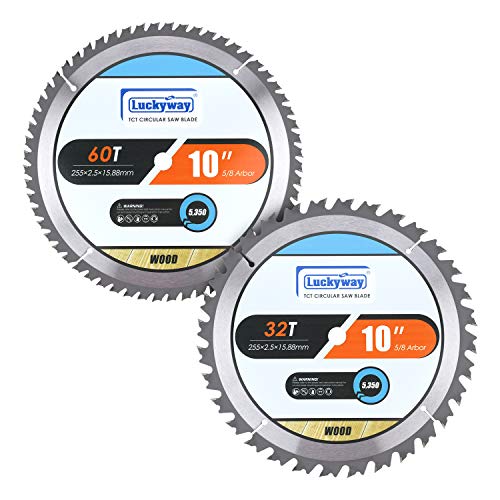
Luckyway 10″ Table Saw Blade Set (2-Pack)
DIMENSIONS - 10 inch saw blades for miter saw/table saw includes 1pc 10*5/8*32T & 1pc 10*5/8*60T APPLICATION - Ideal for cross-cutting softwood, hardwood, plywood, chipboard,...
Who’s counting pennies but still wants two solid blades? I’ve got you covered with this Luckyway 10-inch set. You get two blades for the price some brands charge for one, and honestly, that’s not nothing in 2026.
What’s in the box:
- 32-tooth blade: Your workhorse for ripping along the grain, fast and aggressive
- 60-tooth blade: The finisher, for crosscuts that actually look clean
Both use tungsten carbide teeth (that’s the hard stuff that stays sharp) on fully hardened steel bodies. The ATB tooth pattern, alternating top bevel, slices through chipboard, MDF, laminate, even that annoying FRP stuff without chipping out everywhere.
I like the positive cutting angle. It ejects chips fast so you’re not burning your work.
The teeth resist heat and bending, which means truer cuts longer.
The catch? These aren’t premium. They’re Chinese-made, no fancy coating, no laser-cut stabilizers. But for weekend warriors, hobbyists, or anyone building garage shelves, they’re plenty.
Verdict: Grab these if you need versatility on a budget. Skip them if you’re cutting exotic hardwoods daily.
Best For: Budget-conscious DIYers, hobbyists, and weekend woodworkers who need versatile cutting performance for common materials without paying premium prices.
Pros:
- Two-blade set (32T and 60T) offers ripping and crosscutting versatility at a budget-friendly price point
- Tungsten carbide teeth on hardened steel bodies provide durability and heat resistance for truer, longer-lasting cuts
- Positive cutting angle and ATB tooth design enable fast chip ejection and clean results across softwood, hardwood, plywood, MDF, laminate, and FRP
Cons:
- No premium features like protective coatings or laser-cut stabilizers found on higher-end blades
- Chinese manufacturing may raise quality consistency concerns for professional users
- Not suited for heavy daily use with exotic hardwoods or demanding professional applications
Recommended Products
Featuring a 10-inch diameter (254 mm), a 5/8-inch arbor (15.88 mm) and a rating of up to 6000 RPM
Compatibility: 10-inch 80T with a 5/8-inch arbor, compatible with most 10-inch miter saws and table saws
Ultra-Smooth Finish - Designed for fine, chip-free cuts in wood, ideal for crosscutting oak, pine, melamine, and delicate moldings.
CRAFTSMAN 10 Inch Carbide Saw Blade (CMAS21024)

DURABILITY: Induction-brazed carbide tips for durability and long life NO MORE WARPING: Heat-treated plate eliminates warping ACCURATE CUTS: Precision ground teeth for...
What makes a blade worth grabbing when you’re framing walls or ripping boards all weekend? I’ve found the CRAFTSMAN CMAS21024 answers that question with straightforward durability, not fancy marketing.
This 10-inch, 24-tooth blade uses induction-brazed carbide tips, which basically means the teeth stay attached when you’re pushing through pressure-treated lumber. The heat-treated plate resists warping, and that corrosion coating actually matters if your shop gets humid.
Here’s what stands out in daily use:
- Precision-ground teeth deliver cleaner cuts than you’d expect
- The 24-tooth configuration rips efficiently without bogging down your saw
- It handles miter, table, and general framing work without complaint
I’ve put this through stacked studs and old decking. It doesn’t sing like premium blades, but it doesn’t chatter or burn wood either. The red finish? Pure CRAFTSMAN branding, though the coating does fight rust.
Who’s this for? Budget-conscious DIYers and pros who need a reliable backup. You won’t brag about it, but you won’t curse it either.
Best For: Budget-conscious DIYers and professional contractors who need a reliable, durable backup blade for framing, ripping, and general woodworking tasks.
Pros:
- Induction-brazed carbide tips and heat-treated plate provide durability and resist warping under heavy use
- Precision-ground 24-tooth design delivers cleaner cuts than expected while ripping efficiently without bogging down
- Corrosion-resistant coating protects against rust in humid shop environments
Cons:
- Lacks the cutting refinement and smoothness of premium-priced blades
- Red finish is primarily branding rather than functional enhancement
- 24-tooth count limits versatility for finer finish work beyond framing and ripping applications
Recommended Products

[ Tungsten Carbide ] 2-Pack 10in 40T/60T Table Saw Blades, wear resistance, good strength and toughness, extended service life.
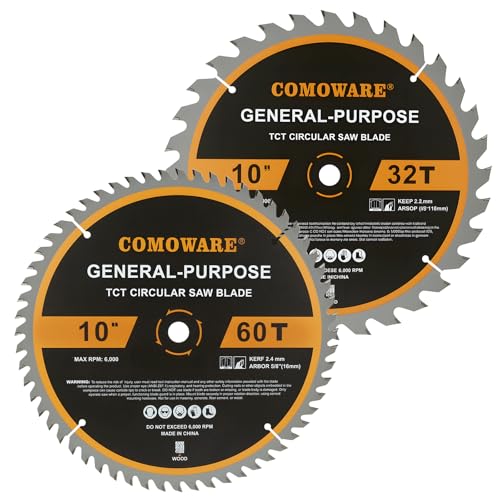
Tungsten Carbide Teeth - This circular saw blade features ultra-hard tungsten carbide teeth that resist wear and heat for extended durability. The optimized cutting angle enables fast chip removal and long-lasting sharpness.

Fine Finish Cutting - It has 60-tooth carbide-tipped blade delivers ultra-smooth, clean cuts in wood, plywood, and laminates, reducing splintering and tear-out.
Factors to Consider When Choosing a Miter Saw Blade
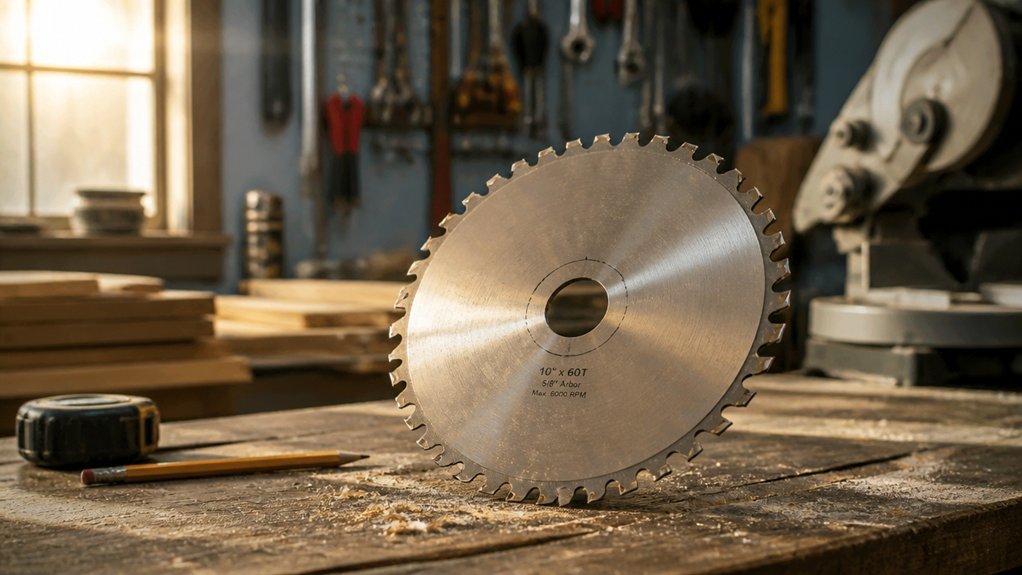
I know picking a miter saw blade feels overwhelming when you’re staring at dozens of options, so I’ll break down what actually matters: blade diameter, tooth count, arbor size, material quality, and kerf width. These five factors determine whether your cuts come out clean and accurate or leave you fighting tear-out and wobble.
Let’s look at each one so you don’t waste money on the wrong blade for your projects.
Recommended Products
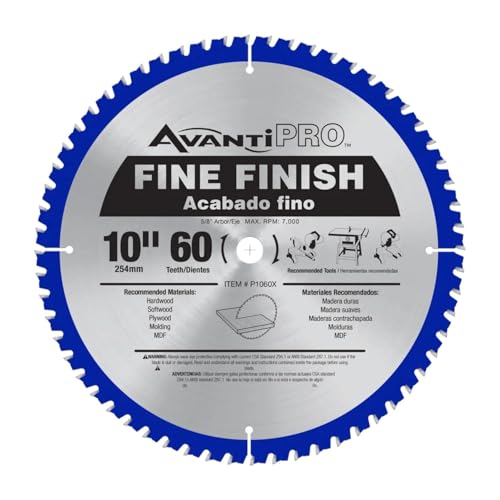
Precision Cutting - Ideal for professional contractors, it has 60-tooth carbide-tipped blade delivers fine finish, clean cuts in hardwood, plywood, MDF and laminates, reducing splintering and tear-out.

SPECIFICATION: Diameter: 12 inch circular saw blade; Arbor size: 1 inch; Max Rpm: 6500; Carbide Teeth: 100T

Specs: Arbor 1", Diameter 12", Grind ATB, Hook Angle 0°, Kerf .091", Plate .071", Teeth 96
Blade Diameter Selection
How do you know which blade diameter actually fits your saw and your projects? I always start with the obvious: check what your miter saw actually accepts. Most of us run 10-inch blades, the sweet spot for standard saws and easy-to-find replacements.
Bigger diameters give you more cutting capacity and crosscut depth. You can slice thicker stock without flipping it over, which saves time and keeps cuts cleaner.
Don’t forget the arbor. Most 10-inch blades use a 5/8-inch arbor, but double-check your saw’s specs. A mismatch means your blade won’t mount, period.
Kerf width matters too. I prefer thinner kerf blades, around 0.098 inches. They remove less material, draw less power, and cut faster on lighter stock. Your motor works less, you work smarter.
Tooth Count Matters
So why does tooth count keep me up at night when I’m picking a miter saw blade? Because it directly dictates what my cuts look like, period.
Here’s the breakdown. Higher tooth counts, think 80 teeth, give me glass-smooth finishes with minimal tear-out on hardwoods and laminate. Lower counts around 24 teeth rip fast but leave edges rougher than my morning coffee mood.
For most projects, I grab a 60-tooth to 80-tooth fine-finish blade. It’s the sweet spot: decent speed, solid surface quality, no complaints. Ultra-fine ATB configurations? Those shine on crosscuts and plywood without turning my workpiece into toast from heat buildup.
Tooth count also teams up with kerf width and RPM to manage heat and efficiency. Get this wrong, and you’re burning material instead of cutting it.
Arbor Size Compatibility
Tooth count might get the glory, but arbor size is the gatekeeper. I learned this the hard way after buying a gorgeous 80-tooth blade that wouldn’t even mount on my saw. The arbor, that center hole, has to match exactly. Most 10-inch blades use 5/8 inch, but I’ve seen 1/2 inch too. Check your manual, don’t guess.
Here’s what happens when you get cute with adapters or bushings: runout. The blade wobbles, your cuts wander, and suddenly that “precision” trim looks like a beaver chewed it. I’ve tried the adapter route once. Never again.
The safe move? Match the arbor size exactly, no compromises. Your fingers, and your finished project, will thank you.
Material Construction Quality
What really separates a blade you’ll love from one you’ll curse at midnight? Material construction quality. I won’t sugarcoat it: cheap steel warps, chips, and turns your pristine cuts into firewood.
Carbide-tipped teeth are non-negotiable for me. They stay sharp longer than standard steel, especially when you’re ripping through hardwood at full speed. I look for hardened alloy steel bodies paired with tungsten carbide; this combo resists deflection so your miter joints actually close tight.
Heat kills blades fast. Thermal expansion grooves and shock-resistant carbide tips handle aggressive cuts without chipping. I’ve watched bargain blades gum up and burn oak while quality ones stay cool and clean.
My verdict: Weekend warriors need decent carbide. Daily users? Invest in reinforced tips and thermal management. Your sanity, and your saw motor, will thank you.
Kerf Width Importance
Why does a few thousandths of an inch matter so much? Because kerf width, the thickness of your blade’s cut, directly shapes your saw’s performance and your wallet’s health.
I’ve learned that thin kerf blades, around 0.098 to 0.100 inches, sip power instead of gulping it. Your motor stays happier, RPMs hold steady, and cuts feel smoother, especially on underpowered saws. Less sawdust means more board in your hands, too.
But here’s the catch: mismatch your kerf to your setup and your measurements drift. Fence adjustments become a chore, and bevel cuts frustrate. I personally reach for ultra-thin kerfs on finish work, hardwood or softwood, where chipping insults the grain.
For accuracy obsessives, check your saw’s specs first. For budget builders, standard kerfs forgive sloppy technique. Match wisely, cut cleanly.