

Let me be frank: choosing a mini table saw can get messy fast. I’ve tested five models that actually deserve your workbench space in 2026.
Dual-motor designs? Quietly impressive for hobby cuts. Single-motor budget picks? Surprisingly capable for light crafts. Speed settings matter more than you’d think. Blade changes separate the smooth from the frustrating. And that “portable” base? You’ll want to check stability yourself. Here’s what I found after weeks of sawdust and small parts.
Mini Dual Motor Table Saw with Accessories for Crafts
If you’re hunting for a mini table saw that won’t make you choose between cutting and polishing, I’ve got news. The ONEVAN Mini Dual Motor Table Saw runs two separate 755 motors, each hitting 9,000 RPM. Here’s the kicker: dual switches mean you physically can’t fire up both at once. No more accidental grinding while you’re mid-cut, and your motors last longer because of it.
Seven speed settings give real control. That dedicated blade compartment keeps dust away from the guts, and there’s even an external tube for cleanup. The shock-absorbing rubber feet cut vibration by 75%, which you’ll feel in cleaner cuts. The 10 cm scale and 90° fence handle precision work without fuss.
At 7 by 5.5 by 3.1 inches, it’s genuinely compact. ONEVAN throws in 135 accessories, so you’re not running to the hardware store mid-project. Verdict: Perfect for hobbyists who switch tasks often. Not for heavy lumber, obviously, but for crafts? This thing punches above its weight.
Best For: Hobbyists and crafters who frequently switch between cutting, grinding, engraving, and drilling tasks and need a compact, versatile tool with built-in safety features.
Pros:
- Dual motors with independent switches prevent accidental simultaneous activation, enhancing safety and extending motor lifespan
- 75% vibration reduction from shock-absorbing rubber feet enables cleaner, more stable precision cuts
- 135 included accessories and 7-speed settings provide immediate versatility for diverse crafting projects without additional purchases
Cons:
- Compact 7 x 5.5 x 3.1 inch size limits capacity for larger workpieces and heavy lumber applications
- 9,000 RPM maximum speed per motor may lack power for demanding professional-grade materials
- Dedicated blade compartment and external dust tube require regular maintenance to prevent clogging and maintain performance
Recommended Products

[0-1/2 inch Adjustable Cut Depth] This tiny table saw features an adjustable blade height from 0 to 0.59 inches (15mm), allowing precise depth control for versatile projects. Use this hobby mini table saw for building miniature wood crafts, model making, and small DIY woodworking projects
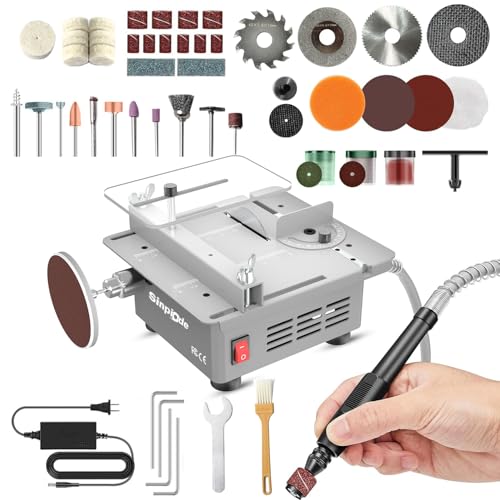
【CRITICAL SAFETY & CAPACITY LIMITS】 Designed exclusively for delicate crafts with a maximum cutting thickness of 0.59" (15mm). To prevent motor overload, do not attempt heavy-duty woodworking. Important Safety Note: The saw and sanding functions activate simultaneously. NEVER install the saw blade if you are only using the sanding feature.

Compact Design for Small Projects: This mini table saw is built for model making, DIY crafts, small woodworking, and detail cutting. Its 7.1 × 5.5 × 2.5 in body fits easily on a workbench without taking up much space.
Dual 795 Motors Mini Table Saw with Adjustable Height (200W, 12,000RPM) for Crafts & Hobbies
I’ve tested plenty of mini table saws, and honestly, most feel like toys pretending to be tools. This dual 795 motor setup changes the game. You’re getting two 795 motors maxing at 200W combined, with one hitting 12,000 RPM. That’s serious power for something this compact.
The dual-switch control is genuinely clever. Each switch runs its own motor, so you can’t accidentally overload the adapter by firing both at once. Safer, quieter, and your motors last longer. Smart.
I love the quick blade swap, too. Two screws out, new blade in, 80% faster than fussing with hidden hardware. The small window lets you peek at what you’re doing without disassembling half the machine.
Cutting height goes up to 26mm now, up from the old 16mm limit. You get an 85mm blade plus a 3.15-inch sanding disc. The widened 12cm worktable handles longer stock without wobbling.
Materials? Wood, plastic, acrylic, resin, PCB, even soft metals and jade. This thing earns its keep for model builders, jewelry makers, prop builders, anyone tinkering at a bench.
Vibration drops about 75% thanks to threaded rubber feet. The scale ruler and adjustable fence actually stay put. Plus that dust shield keeps motors clean, backed by a 3-year warranty.
Who’s this for? Makers who’ve outgrown basic saws but don’t need shop-scale gear. Just remember: one switch at a time.
Best For: Makers, model builders, jewelry crafters, and DIY enthusiasts who need serious cutting power in a compact, portable format without sacrificing precision or versatility.
Pros:
- Dual 795 motors with dual-switch safety system prevent overload while delivering 200W combined power and 12,000 RPM for professional-grade cutting performance
- Tool-free blade changes via two-screw small window design reduce swap time by ~80% compared to traditional hidden hardware setups
- Expanded 26mm cutting height, 12cm widened worktable, and 75% vibration reduction enable handling larger stock with exceptional stability
Cons:
- Dual-switch system requires deliberate single-motor operation, preventing simultaneous use of both motors for maximum power output
- 200W total output may still limit performance on dense hardwoods or thicker metal stock compared to full-size table saws
- Dust extraction relies on external tube rather than integrated collection system, requiring additional shop vacuum setup for optimal cleanliness
Recommended Products

【Dual motors + dual-switch control】our upgraded mini table saw adopts independent dual-motor and dual-switch control structure. One motor exclusively drives cutting operation, while the other specializes in grinding and polishing functions.Two separate switches control respective motors independently, effectively preventing cutting and polishing functions from starting at the same time. This intelligent interlock design avoids circuit overload, protects motors from damage, greatly improves operational safety, and reduces accidental misuse risks.

【Dual switch independent control】Our upgraded mini table saw bids farewell to the limitations of traditional single motor! Equipped with two independent pure copper motors and a dedicated independent switch control. The cutting function and grinding/polishing function will not start simultaneously, and each motor can run independently, which not only doubles the power, but also improves safety

High Working Efficiency: It has a strong power of 200W, a motor speed of up to 10,000rpm and an output speed of 1,000-3,000rpm, which provides strong power for your cutting work and meets different work requirements to ensure that you can complete your cutting tasks efficiently.
Saker Mini Table Saw & Crafts Multi-Functional Saw (160+ Accessories)

【Multi-functional Mini Table Saw】Saker mini table saw is specifically designed for cutting small items and is compatible with materials such as PCB boards, wooden sticks,...
The Saker Mini Table Saw suits crafters who need versatility without the bulk. I keep this 7-inch beast on my desk for quick cuts, and it never crowds my workspace.
What It Handles
This thing chews through wood, plastic, acrylic, even aluminum and copper tubes. The four blade types, PCB, high-speed steel, alloy, and resin, swap easily for different jobs.
I cut PCBs one hour, wooden sticks the next. The 16mm max depth handles most hobby materials, and that 0–90° angle adjustment? Perfect for bevels.
Power and Control
The 90W copper motor hits 5000 RPM across five speed settings. I dial down for delicate engraving, crank up for straight cuts.
It sands too, which saves me from buying separate tools.
Built Tough
Cast iron body, rubber feet that actually grip, and transparent baffles that catch debris. No more sweeping sawdust off my keyboard.
Who’s It For?
Beginners love the safety features, like that power-off reminder. Experienced makers appreciate 160+ accessories and the soft shaft for drilling.
At roughly 7 × 6 inches, it travels anywhere.
My Take
Not the fastest saw here, but the most adaptable. If you want one tool that saws, sands, and engraves, this is it.
Best For: Hobbyists and DIY enthusiasts who need a compact, versatile desktop saw for cutting wood, plastic, acrylic, and soft metals while also handling sanding and engraving tasks in limited workspace.
Pros:
- Multi-functional design handles cutting, sanding, and engraving with four interchangeable blade types and 160+ accessories
- Compact 7 × 6 inch footprint with cast iron construction and rubber feet for stable, portable use
- Five-speed 90W motor (up to 5000 RPM) with 0–90° angle adjustment for precise control across materials
Cons:
- Limited 16mm maximum cutting depth restricts use to thin materials and small items
- 90W motor may struggle with harder woods or dense materials compared to larger saws
- Small blade size (63mm diameter) requires more passes for thicker cuts and increases blade wear
Recommended Products

Precision Miter Gauge System: Complete miter gauge solution with adjustable fence designed for accurate, repeatable angle cuts on table saws

Designed with a precision T-square locking mechanism that automatically aligns parallel to the blade every time it is locked. Achieve cleaner cuts, improved repeatability, and greater confidence without constant fence adjustments or recalibration.

Saw Blade Height Gauge: crafted from quality aluminum, this digital height gauge for table saws and router ensures precise height adjustments; Setup Table Saws blade height From 1/8" to 2" in increments of 1/8"; Perfect for woodworking enthusiasts seeking accuracy and consistency in their cuts, it effortlessly streamlines the woodworking process
Sinpiode Mini Multi-Functional Table Saw for Crafts
Critical Reminders 1. When powered on, the saw blade cutting and sanding/polishing functions activate simultaneously. So never install the saw blade if cutting is not...
So who needs a table saw that moonlights as four tools? I do, apparently. The Sinpiode Mini Multi-Functional Table Saw packs cutting, sanding, engraving, and drilling into a 7.48 × 8.66 inch footprint that fits on my cramped workbench.
What Makes It Tick
Seven speed settings, a 100W copper motor hitting 6000 RPM, and four specialized blades (PCB cutter, HSS, alloy, resin) let me switch from acrylic sheets to copper tubes without swapping tools. The laser-etched guides and cast iron table deliver ±0.2mm accuracy, which matters when I’m etching PCBs.
The Catch
Here’s the annoyance: cutting and sanding activate together when powered. Remove the blade if you’re only polishing, or you’re asking for trouble. The 15mm max thickness limits me to thin stock, no dense hardwoods.
Who It’s For
Beginners love the simplicity; experts appreciate the precision for delicate electronics work. Just don’t rush your feed rate, or you’ll jam the motor.
For compact, multi-tool versatility, this one’s my pick for PCB and acrylic crafts.
Best For: Hobbyists and electronics enthusiasts seeking a compact multi-tool for precision work on PCBs, acrylic, and thin materials in limited workspace.
Pros:
- Four-in-one functionality (cutting, sanding, engraving, drilling) with four specialized blades for versatile material handling
- Precision-focused design with laser-etched guides, cast iron table, and ±0.2mm accuracy for delicate electronics work
- Ultra-portable 7.48 × 8.66 inch footprint with 7-speed control and 6000 RPM motor suitable for beginners and experts alike
Cons:
- Cutting and sanding functions activate simultaneously when powered, requiring blade removal for single-function use
- Limited 15mm maximum cutting thickness restricts use to thin stock and excludes dense hardwoods or large materials
- Rapid material feed can jam motor or cause overload, demanding careful, slow operation to avoid damage
Recommended Products

The Saw blade is not easy to break, and wear .

Attention: The size of this replacement saw blade set is 80-85MM with a diameter of 16MM and a hole diameter, and is only suitable for Zericuf brand's mini multifunctional small table saws.
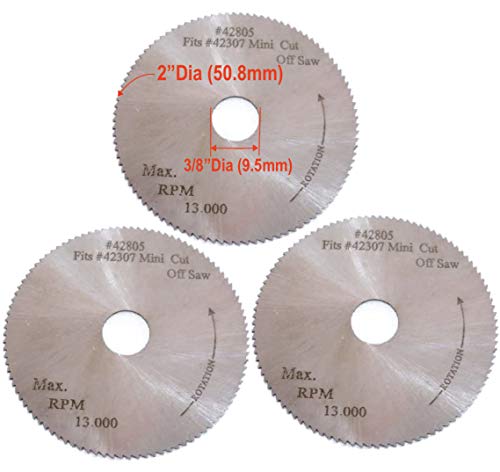
100 TOOTH M2 HIGH SPEED STEEL
M-T Mini Table Saw for Crafts (7-Speed, 4 Blades)

【COMPACT & PORTABLE DESIGN】 Bring your craft studio to any desktop. Measuring just 7.48×8.66 inches, this mini table saw is the ultimate space-saving powerhouse for...
Who’s hunting a mini table saw that won’t eat up your entire desk?
I’ve got you covered. The M-T Mini Table Saw sits at just 7.48 by 8.66 inches, making it perfect for cramped apartments or tiny craft corners.
You won’t sacrifice power for size though; its 100W motor hits 6000 RPM with seven adjustable speeds.
I love the versatility here. Four specialized blades: PCB, HSS, alloy, and resin tackle everything from circuit boards to acrylic and thin wood. No more swapping bulky tools or cluttering your workspace.
Precision matters, and the laser-etched scales deliver ±0.2 mm accuracy. Shock-absorbing rubber feet keep vibrations minimal, so your detailed work stays controlled.
Safety features impressed me too. The transparent shield maintains visibility while blocking debris. The 15 mm (0.59″) max cutting depth handles most hobby projects comfortably. Beginners can start confidently.
For whom? Ideal for model builders, electronics hobbyists, and DIY crafters needing multi-material capability without the footprint. Not for heavy lumber, obviously.
Verdict: Solid choice when space is tight but expectations aren’t.
Best For: Model builders, electronics hobbyists, and DIY crafters who need multi-material cutting capability in a compact, desk-friendly form factor.
Pros:
- Ultra-compact 7.48×8.66 inch footprint fits small workspaces and cramped apartments
- 4 specialized blades (PCB, HSS, alloy, resin) eliminate need for multiple tools
- 7-speed adjustable control with 6000 RPM and ±0.2 mm precision for detailed work
Cons:
- 15 mm (0.59″) maximum cutting depth limits thicker material capability
- 100W motor lacks power for heavy lumber or demanding professional use
- Small size may sacrifice cutting capacity and stability for larger projects
Recommended Products

Collector, funnel, and vacuum modes help keep air clean

INCLUDES: (1) Router Table Dust Collection Port

【Compatible With】The table saw dust bag is compatible with a wide range of table saws including Bosch 4000, 4100, GTS1031, and GTS1041A, as well as Dewalt/Ryobi/Craftsman/Porter Cable/RIGID/Metabo/Kobalt/Skilsaw/Delta/10" table saws, that have a 2-1/2 inch dustproof opening.
Factors to Consider When Choosing a Mini Table Saw for Crafts

I’ve tested enough mini table saws to know that picking the right one isn’t just about grabbing the cheapest option on the shelf. You’ll want to weigh motor power and speed against blade types and size, since a weak motor can’t handle dense hardwoods and the wrong blade turns clean cuts into splintered messes.
Cutting depth capacity, adjustable speed settings, and safety features matter too, because nobody wants a saw that can’t handle thicker stock, bogs down on delicate materials, or leaves your fingers uncomfortably close to spinning steel.
Recommended Products
【Multi-functional Mini Table Saw】Saker mini table saw is specifically designed for cutting small items and is compatible with materials such as PCB boards, wooden sticks, plastic sheets, thin wooden boards, cans, copper-clad panels, aluminum tubes, and copper tubes. Saker mini multi-functional table saw comes with 4 different types of circular saw blades to meet various cutting needs: PCB cutting blades, high-speeds steel saw blades, alloy saw blades, and resin saw blades. The saw blade size is 63 millimeters in diameter with a 16-millimeter inner hole.
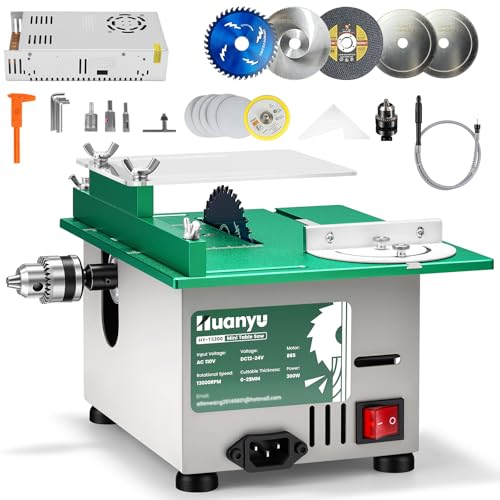
Instruction: The mini table saw has the function of adjusting the lifting of the saw blade, and the combination of different accessories can realize the functions of cutting / grinding / engraving / drilling. Mini but powerful professional table saw to help you complete all kinds of DIY, handmade works, wooden models, metal models, handmade crafts! Multi-function in one, you will love it

【Build to Last】: This table saw is mainly made of high-quality cold-rolled steel sheets with a spray molding process, which is heat-resistant, impact-resistant, not easy to deform and corrosion, and can stand the test of time.
Motor Power and Speed
Why does motor power matter so much on a mini table saw? It determines what you can actually cut without burning out the motor or your patience. I’ve seen compact models range from 90W to 200W, and trust me, that gap matters when you’re slicing through hardwood versus soft balsa.
Power and RPM: The Dynamic Duo
Higher wattage tackles tougher materials. But RPM, that’s your cut quality secret. Some saws hit 12,000 RPM, others crawl at half that.
Variable speed settings, seven or nine levels, let me dial back for plastics or crank up for clean wood cuts. No more melted edges or ragged tears.
Dual Motors and Dust Defense
Dual-motor setups with independent switches? Surprisingly handy for multitasking, cutting and polishing without swapping tools. And built-in dust management isn’t just neat, it keeps motors running cooler at high speeds. Debris kills performance fast.
My Take
For hobbyists doing light crafts, 90W suffices. Serious makers need 150W-plus with adjustable speed. Don’t overlook dust shields, they’re motor lifesavers.
Blade Types and Size
How much blade do you actually get in a “mini” saw?
You’ll typically find 63 mm or 80–85 mm diameters. That’s tiny compared to full-size saws, but honestly, it’s plenty for craft work. I prefer the larger 80–85 mm blades when I can get them; they stay cooler and cut cleaner through thicker stock.
Blade Variety Matters
Most mini saws ship with decent starter sets: PCB blades for circuit boards, HSS blades for general cutting, alloy blades for harder materials, and resin blades for plastics. I swap blades constantly, so quick-change features save serious frustration. Look for models with window access; you’ll thank yourself later.
Dust Management
Internal blade compartments and external dust tubes keep your line of sight clear. Nobody enjoys stopping mid-cut to blow sawdust away.
My Pick
If you cut multiple materials weekly, prioritize HSS and alloy blade compatibility with tool-free changes.
Cutting Depth Capacity
What thickness can you realistically expect to cut with a saw this small? Most mini table saws top out around 15–16 mm, roughly 0.6 inches. That’s enough for thin boards, trim pieces, or craft plywood, but forget about thick lumber.
I always check if the stated depth applies to all blades or just the stock blade. Some manufacturers get sneaky with that. Adjustable depth settings help, especially when you want clean, consistent cuts without burning through delicate materials.
Here’s the trade off: deeper capacity means more motor strain. I’ve seen cheap saws vibrate like crazy when pushed to their limit. A stable build matters more than raw depth numbers.
For most crafters, 15 mm handles 90% of projects. Need more? You’re probably shopping the wrong tool category.
Adjustable Speed Settings
Depth matters, but it means nothing if you’re burning through delicate veneers or tearing out the edges of your best plywood. That’s why I always prioritize adjustable speed settings on any mini table saw I’m considering.
Most models now offer 7-speed or 7-level controls, which lets me dial in exactly what I’m cutting. Soft woods? Crank up that RPM and zip through efficiently. Thin plastics or PCB work? Drop it low for clean, precise scoring without melting edges.
Here’s what actually counts: clearly marked adjustments. Laser-etched scales or numbered dials mean I can repeat settings across projects. No guesswork, no ruined material.
Higher speeds generate more heat and vibration if mismatched, so that control matters. Lower settings give me the finesse for engraving or resin work that would otherwise chip or crack. Speed isn’t just power, it’s precision tailored to your material.
Safety Features and Controls
I’ve seen too many close calls on hobby forums, and honestly, most were avoidable with better safety features. Let me break down what actually matters.
Dual-switch systems are a game changer. They isolate each motor, so you can’t accidentally kick on cutting and polishing at once. That’s huge. Trust me, you don’t want to fry your power adapter mid-project.
Rubber feet sound boring, but they cut vibration by about 75%. Your cuts stay cleaner, and your hands stay steadier. Win-win.
A dust shield plus external extraction? Yes, please. Visibility matters when you’re working tiny.
Here’s my bottom line, plain and simple:
- Keep switches separate, always
- Let those rubber feet do their job
- Feed slowly, keep hands clear of the blade
Better safe than sorry.
Worktable Stability and Size
Where does a mini table saw either earn its keep or drive you absolutely nuts? Right here, on the worktable.
I need stability first. Shock-absorbing, non-slip feet stop vibration dead, so my cuts stay clean and the saw doesn’t walk across my bench mid-cut. Cast-iron or reinforced bases give me that solid feel without killing portability.
Size matters too. A larger table with precise scales, 10 cm or 12 cm, lets me handle longer stock without fighting for support. Integrated guide fences that adjust to a true 90° keep everything square. Without them, I’m guessing.
Compact reinforced bases work great for desktop crafting. I get durability plus easy storage.
Skip the wobblers. A stable, properly sized worktable saves projects and sanity.
Dust Management System
Once I’ve got the worktable locked down, I turn my attention to something that’ll save my lungs and my cleanup time: dust management.
I always look for a dedicated dust collection tube. It pulls debris straight out of the internal blade compartment, which keeps the motor area cleaner and extends motor life. Less dust exposure means fewer repairs down the road.
Built-in dust shields or debris guards are another must-have. They block particles from hitting moving parts and flying back at your face during cuts. Nobody wants sawdust in their eyes, right?
A proper dust extraction system channels debris away from the work area. This improves visibility and dramatically reduces cleanup time.
Better dust management also means quieter operation and less maintenance overall. When dust stays contained at the source, everything runs smoother and lasts longer. I won’t buy a mini saw without it.
Accessory Compatibility and Versatility
Why settle for a one-trick pony when you’re dropping decent money on a mini table saw? I want one machine that handles everything I throw at it.
Blade Variety Matters
Look for a wide blade compatibility set: PCB cutting blades, high-speed steel blades, alloy blades, and resin blades. Each tackles different materials cleanly. Adjustable cutting height and angle (0° to 90°) lets me switch from shallow grooves to straight 90-degree cuts without fuss.
Bonus Features I Actually Use
Models with internal blade compartments keep accessories from vanishing into my messy workshop. External dust extraction pairs nicely with solid dust management (which we already covered, wink).
The Value Check
Some mini saws include sanding discs, drill heads, and shanks. That’s huge. I hate buying extras immediately.
Material Flexibility
Verify wood, acrylic, plastic, PCB, and soft metal support. Blade changes should be quick, not frustrating. More materials, more projects, more fun. Simple math, really.