
Like Gutenberg’s press democratized books, 2026’s beginner printers finally make 3D creation actually accessible. I’ve tested dozens, and the gap between “works out of the box” and “weekend project from hell” remains enormous.
The FlashForge AD5M auto-levels in one click. The Entina Tina2S streams prints from your phone. Resin or filament? Compact or combo? I’ll walk you through what actually matters before you spend a dime.
FLASHFORGE AD5M 3D Printer (220x220x220mm)

Unleash Your Creativity: The Perfect Companion for Beginners and Experts Alike. The AD5M combines brand-new technology and superior craftsmanship to meet the needs of all...
Why do so many beginners burn out before their first print finishes? Usually, it’s the endless tweaking. The FLASHFORGE AD5M eliminates that headache entirely.
I’m genuinely impressed by how this machine handles the boring stuff so you don’t have to. One-click automatic leveling measures the exact distance between nozzle and build plate, no manual calibration required.
Power goes out? It saves your layer and picks up where it left off. That’s peace of mind I wish I’d had starting out.
The CoreXY all-metal structure keeps things stable and quiet, even when you’re pushing speed. I love the quick-release nozzle system: pop it out in three seconds, no tools, swap between 0.25mm detail work and 0.8mm fast prints. The double-sided PEI plate flips for PETG; parts release cleanly.
Remote control through the Flash Maker app means I’m not chained to the printer. The Orca-flashforge slicer handles batch jobs and network monitoring without fuss.
Verdict: Perfect for beginners who want reliability without sacrificing room to grow. Experts will appreciate the speed and network features too.
Best For: Beginners who want a reliable, low-maintenance first printer and experts who need speed, remote management, and network printing capabilities.
Pros:
- One-click automatic leveling eliminates manual calibration headaches
- Tool-free 3-second nozzle swaps enable quick switching between detail and speed
- Resume-after-outage feature prevents print failures from power interruptions
Cons:
- 220x220x220mm build volume may be limiting for larger projects
- Proprietary Orca-flashforge slicer required for full feature access
- No mention of enclosed chamber temperature control for engineering materials
Recommended Products

Up to 16 Colors: Bring your designs to life with vibrant multi-color/multi-material printing capabilities, perfect for showcasing your creativity. Note: Connecting Bambu Lab AMS is required.
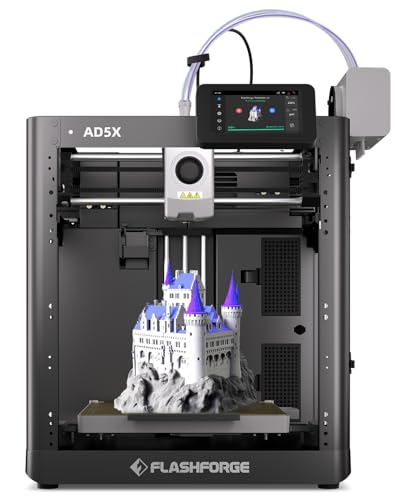
Multi-Color 3D Printing with IFS Technology: The FLASHFORGE AD5X features Intelligent Filament Switching (IFS), enabling seamless multi-color printing for vibrant and intricate designs in a single print job.
ANYCUBIC Photon Mono 4 Resin 3D Printer

【7'' 10K High Resolution】Photon Mono 4 boasts an impressive 105% increase in print precision compared to Mono 2. With a resolution of 9024x5120, each pixel measures a...
The ANYCUBIC Photon Mono 4 packs professional-grade resin printing into a beginner-friendly package, but who benefits most? I think this one’s for beginners who want detail without headache.
That 7-inch 10K screen (that’s 9024×5120 pixels, tiny 17 micron dots) delivers jewelry-grade precision at 70 mm/h. The LighTurbo light source keeps things evenly lit, so you won’t get weird shadow artifacts.
Setup’s genuinely painless. Four screws, one leveling session, done. I love that; repeat leveling kills my enthusiasm.
The laser-etched Print Platform 2.0 grips resin prints firmly but releases them cleanly. No more chipped miniatures or broken nails.
The power-resume feature saves your bacon during outages. No app support though, which irks me slightly.
Build volume is modest at 6.04 x 3.42 x 6.49 inches, enough for tabletop minis, jewelry, and dental models.
Verdict: Grab this if you crave detail and hate tinkering. Skip if you need massive parts or smartphone controls.
Best For: Beginners and hobbyists who want high-detail resin printing without complex setup or maintenance, particularly those creating tabletop miniatures, jewelry, or dental models.
Pros:
- Exceptional precision with minimal effort: 10K resolution (9024×5120) with 17μm pixels and LighTurbo uniform lighting delivers professional-grade detail at 70 mm/h without calibration headaches.
- True one-time setup: 4-point leveling with four screws eliminates the need for repeat leveling, preserving long-term enthusiasm for printing.
- Reliable print recovery and adhesion: Power-resume feature protects against outage losses, while laser-engraved Print Platform 2.0 ensures strong grip during printing and clean, damage-free removal.
Cons:
- No smartphone integration: Anycubic APP service is not supported, removing remote monitoring or control capabilities.
- Modest build volume: 6.04 x 3.42 x 6.49 inches restricts production of larger parts or bulk batch printing.
- Limited scalability for advanced users: One-time leveling convenience trades against fine-tuneability that experienced users may want for specialized resins or extreme precision applications.
Recommended Products
【7'' 10K High Resolution】Photon Mono 4 boasts an impressive 105% increase in print precision compared to Mono 2. With a resolution of 9024x5120, each pixel measures a mere 17x17μm on the X and Y axes. This enhanced capability allows for creating models with exceptional detail and dynamic richness.

【Fast and Stable】Anycubic photon mono 4 ultra adopts the new generation ACF film and Intelligent Release Algorithm, accelerating the maximum fast print speed to 120mm/h. ACF film minimises frosted texture to increase light penetration for a much smoother release process to maintain the print accuracy

【10K Precision, Remarkable Detail】ANYCUBIC Photon Mono 4 Ultra delivers a 105% boost in print precision compared to photon mono 2. A 7'' 10K LCD screen features a resolution of 9024 x 5120, with each pixel measuring just 17x17μm. Utilizing an 8mm T-type screw rod and precision guide rails, it excels in producing detailed and vibrant models.
FLASHFORGE Adventurer 5M High-Speed 3D Printer

One-Click Automatic Printing: Experience hassle-free 3D printing with the Adventurer 5M Series. Enjoy automatic bed leveling for flawless first layers, ensuring consistent...
Looking for speed without the headaches? I’ve found it in the FLASHFORGE Adventurer 5M, and honestly, I’m surprised they packed this much punch into a beginner-friendly machine.
What Makes It Fast
The CoreXY setup hits 600mm/s travel speed with 20,000mm/s² acceleration. That’s 12 times faster than old-school printers, which means your weekend project finishes before lunch.
The all-metal frame keeps everything rigid, so speed doesn’t mean sloppy.
The Smart Bits
One-click auto leveling saves me from the paper-test torture I suffered on my first printer. The 280°C direct extruder handles PLA through PETG, and swapping nozzles takes three seconds, literally. I timed it.
Real Talk on Size
The 220mm cube build volume fits most of what I actually print. The dual-sided PEI plate pops prints off without scraping, and 35-second heat-up means less waiting, more making.
The Catch?
You’ll want to clean the nozzle regularly, and the app monitoring feels basic compared to pricier options. Still, for pure speed with minimal fuss, this hits a sweet spot beginners rarely find.
Best For: Beginners and makers who want high-speed 3D printing without complex setup or maintenance hassles.
Pros:
- Blazing 600mm/s print speed with rigid all-metal CoreXY structure maintains quality at velocity
- One-click auto leveling and 3-second nozzle swaps eliminate tedious manual adjustments
- 35-second heat-up and dual-sided PEI platform get you printing faster with easier part removal
Cons:
- 220mm build volume limits larger projects
- Basic mobile app monitoring compared to premium alternatives
- Requires regular nozzle cleaning to maintain performance
Recommended Products

【Higher Scratch-Resistance】 The models printed with ELEGOO Abs-like 3.0 Pro Resin are not easily damaged by the friction and impact of daily use, providing more stable aesthetics.
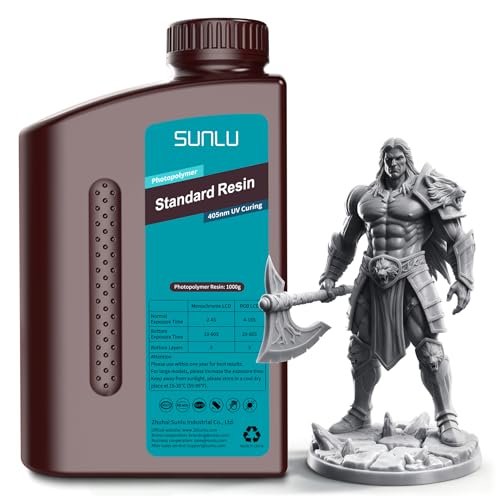
①【Easy to Use】- SUNLU standard resin has strong fluidity and is compatible with different printers and printing speeds. The printed products are easy to form and are suitable for novices.

①【SUNLU Standard Plus 3D Printer Resin】SUNLU Standard resin 2.0 is an upgraded version of the regular standard resin. Standard Plus resin has greater printing advantages: higher printing accuracy, lower volume shrinkage, and greater toughness. The overall printing performance of Standard Plus resin is better.
Entina Tina2C Mini 3D Printer for Kids & Beginners

【Easy Start – Beginner Friendly 3D Printer】Tina2C mini 3d printer is designed for first-time users, with guided setup through the Poloprint Cloud app. Fully optimized...
Need a printer you can actually set up before your coffee gets cold? The Entina Tina2C gets you printing in about eight minutes through the Poloprint Cloud app, which I find pretty refreshing after fighting with complicated setups on other machines.
What makes it tick
This little orange box targets kids and absolute beginners, and it shows. The app guides you through everything, plus it packs AI-powered features like photo-to-print and over 20 creative modules.
They’ve baked in STEM courses too, so it actually teaches while you print. The auto-leveling works, and I appreciate the power-loss recovery. Nothing worse than a 90% complete print dying because your roommate microwaved popcorn.
Real-world use
That 3.9-inch cube build volume limits you to small projects, but that’s honestly fine for learning. The magnetic build plate pops off for easy removal, and the self-cleaning nozzle means less fiddling.
I like the quiet operation with LED lighting that shows progress without blinding you.
Bottom line
It’s compact, safe, and genuinely educational. Perfect for classrooms, kids, or anyone who wants to start small without the headache.
Best For: Kids, absolute beginners, and educators seeking a hassle-free introduction to 3D printing with built-in STEM learning tools.
Pros:
- Guided setup via Poloprint Cloud app gets you printing in as fast as 8 minutes with no technical headaches
- AI-powered features including photo-to-print, 20+ creative modules, and regularly updated STEM courses turn printing into active learning
- Auto-leveling, power-loss recovery, and self-cleaning nozzle minimize failed prints and maintenance frustration
Cons:
- 3.9-inch cube build volume severely limits project size to small models only
- Reliance on app ecosystem may frustrate users wanting more traditional slicer control
- 2.4G WiFi and basic hardware specs suggest limited upgrade path as skills advance
Recommended Products
Perfect Fit for Adventurer 5M Series: 235x235mm textured PEI build plate engineered for Flashforge Adventurer 5M, 5M Pro, and AD5X 3D printers; seamless alignment with heated bed ensures full 235x235mm printing area compatibility.
Compatible Models: 230x230mm Double-Sided Matte Black PEI Printing Platform for Anycubic Kobra 2/Pro/Neo, Kobra/Go/Neo. Please re-level the 3d printer after installing the printing platform to achieve better printing results.

【Thickened Textured PEI Design】For Bambu Lab X2D/P2S/P1S/P1P/A1/X1 Series Textured PEI build plate is made of flexible spring steel plate, with a total thickness of 0.77mm, both sides can be used freely, will not deform, and reduce warping. It uses powder spraying technology to present a unique textured surface, giving the bottom of the model a unique texture. It can withstand repeated use and has long-lasting performance. It is a long-lasting solution to meet your 3D printing needs, ensuring that your printing platform remains functional for a long time
Entina TINA2S Mini 3D Printer with WiFi Cloud Printing

[Mini 3D Printer for Beginners & Kids]: Tina2S 3d printer is a compact, fully assembled WiFi 3d printer designed for kids, beginners, and home users. No setup or calibration...
Why spend hours fiddling with setup when you could be printing? The Entina TINA2S arrives fully assembled, so I literally unboxed it and started printing within minutes. No calibration headaches, no leveling nightmares. Just plug it in and go.
This little green machine targets kids, beginners, and home users who want cloud convenience without complexity. The enclosed design keeps fingers safe and noise low, perfect for classrooms or apartments. I appreciate the LED progress bar, too. No more hovering to check status.
Connectivity That Actually Works
Here’s where the TINA2S shines over its sibling, the Tina2C. WiFi cloud printing through Poloprint gives you 1,500+ ready-to-print models, plus regular updates. I use the app for quick prints, USB for larger files, and TF cards when my internet acts up.
The upgraded WiFi module transfers files faster than budget competitors, and one-click pairing actually works on the first try.
Print Quality and Hardware
The dual-Z-axis structure keeps movements stable, even at 200 mm/s peak speeds. Auto bed leveling with a flexible spring steel plate means better first layers and easier cleanup.
I swap nozzles quickly when switching between detailed miniatures (0.04 mm precision) and faster drafts.
The Trade-offs
Build volume stays compact at 3.9 × 4.7 × 3.9 inches. That’s small, honestly. You’re not printing helmets here. But for toys, prototypes, and learning projects? Perfect.
Verdict: Choose the TINA2S if cloud features and app control matter to you. Pick the Tina2C if you want basic functionality for less money.
Best For: Kids, beginners, and home users who want a fully assembled, cloud-connected mini 3D printer with app-based printing and minimal setup.
Pros:
- Ready to print out-of-the-box with no assembly or calibration required, featuring auto bed leveling and one-click app pairing for immediate use
- Versatile connectivity including WiFi cloud printing with 1,500+ models, USB, and TF card options with reliable, upgraded WiFi module for faster transfers
- Safe, quiet enclosed design with LED progress monitoring, flexible spring steel build plate for easy removal, and dual-Z-axis stability at up to 200 mm/s speeds
Cons:
- Limited build volume of 3.9 × 4.7 × 3.9 inches restricts printing to small projects only
- Premium pricing over the Tina2C sibling for cloud features that require internet connectivity to fully utilize
- Enclosed compact design may limit airflow and material options compared to open-frame printers for advanced users
Recommended Products

16 MILLION COLORS AND ADJUSTABLE EFFECTS – Create more than 16 million RGB color combinations with stepless brightness adjustment and multiple gradient effects through the APP. The remote provides 16 preset colors, four gradient modes and 10 brightness levels for quick adjustments

16 MILLION COLORS AND ADJUSTABLE EFFECTS – Create more than 16 million RGB color combinations with stepless brightness adjustment and multiple gradient effects through the APP. The remote provides 16 preset colors, four gradient modes and 10 brightness levels for quick adjustments

Remote and Voice Control: The Outdoor smart wifi plug supports to the BN-HUB / HBN Smart App, you could turn on / off the connected electronics with your smartphone at anywhere and anytime. Also compatible with Amazon Alexa and Google Assistant to control your devices via simple voice command, perfect for parents, elderly, disabled or if the plug is hard-to-reach.
Bambu Lab A1 Mini 3D Printer + LED Lamp Kit

A1 mini + LED Lamp Kit for Creative Light Projects: Bring your ideas to life with the included LED Lamp Kit. Simply print compatible lamp models and turn your 3D creations...
Who’s this tiny powerhouse actually for?
I’d say it’s for anyone who wants speed without the headache. The Bambu Lab A1 Mini handles full-auto calibration, so I’m not fiddling with bed leveling for twenty minutes. It just works.
The LED Lamp Kit is where this gets fun. I can print compatible lamp models and suddenly my plastic doodads become actual room décor, functional lights, personalized gifts. That’s a creative hook other mini printers miss.
MakerWorld integration means thousands of ready-to-print models. The Bambu Handy app lets me monitor prints from the couch. For toys, tools, or just experimenting, this ecosystem removes friction.
Is it overkill for absolute beginners? Maybe. But I’ll grow into it rather than outgrow it.
Best For: Creatives and hobbyists who want high-speed, reliable 3D printing with minimal setup hassle and room for creative expansion through the LED Lamp Kit and integrated ecosystem.
Pros:
- Full-auto calibration eliminates tedious bed leveling and gets you printing quickly
- LED Lamp Kit adds unique creative functionality, turning prints into decorative lighting and personalized gifts
- Seamless ecosystem with MakerWorld model library and Bambu Handy app for remote monitoring
Cons:
- May be overkill for absolute beginners who only need basic printing
- Compact “mini” build volume limits size of single-print projects
- Requires investment in ecosystem (app, online library) to maximize value
Recommended Products

【200mm/s Max Speed】Flsun Super Racer offers a maximum printing speed of 200mm/s, significantly boosting speed while upholding printing quality, thereby saving 50% time compared to other printers


High-Speed Precision: Experience unparalleled speed and precision with the Bambu Lab A1 3D Printer. With an impressive acceleration of 10,000 mm/s², the A1 delivers blazing-fast printing while maintaining exceptional accuracy and detail in your prints.
SCRIB3D P1 3D Printing Pen with Display
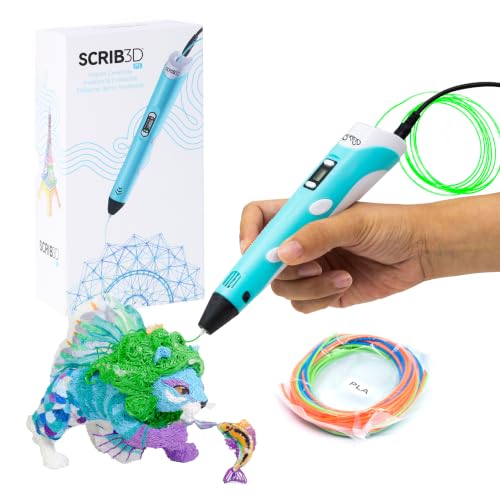
[A GIFT FOR THE WHOLE FAMILY] Create, Draw, Doodle, and Build in 3D with this affordable yet high grade 3D pen. The new SCRIB3D P1 3D Pen helps improve spatial thinking,...
Looking for a way to dip your toes into 3D making without the steep learning curve or hefty price tag of a full printer? I’ve found the SCRIB3D P1 3D Printing Pen, and honestly, it’s a blast.
What’s in the box? You get the pen itself, three starter PLA colors (30 feet total), a stencil book with project guide, and a power adapter. That’s it. No complicated assembly, no slicer software to wrestle with. Just plug it in, wait for the red light to turn green (about 2–3 minutes), and you’re doodling in midair.
How it actually works. Double-click the forward button to start, feed filament through the back, and draw. The stepless speed slider lets you slow down for intricate details or speed up for filling larger areas. Need to stop? Hit reverse to retract. Simple.
Safety stuff that matters. The ceramic nozzle won’t burn your fingers like cheaper pens might, and the 2-minute auto-sleep feature saves you from accidental meltdowns. It handles both PLA (160–210°C) and ABS (210–235°C), though I stick with PLA for its forgiving nature.
My honest take. This isn’t a replacement for a proper 3D printer, obviously. You won’t be printing functional parts with precision tolerances. But for handmade decorations, quick repairs, or collaborative projects with kids? It’s genuinely fun. The 1-year warranty and responsive support don’t hurt either.
Who should grab this? Absolute beginners testing the waters, art teachers on a budget, or anyone who wants to understand how filament behaves before committing to a full machine.
Best For: Beginners exploring 3D creation, art teachers on a budget, and anyone wanting to understand filament behavior before investing in a full 3D printer.
Pros:
- Ready-to-use kit with no complicated assembly or software required—just plug in, heat up, and start doodling
- Stepless speed slider and temperature control allow precise adjustments for both intricate details and faster infill work
- Safety features include ceramic nozzle and 2-minute auto-sleep to protect users from burns and accidents
Cons:
- Not a replacement for a proper 3D printer—cannot produce functional parts with precision tolerances
- Limited to 30 feet of starter filament, requiring additional purchases for extended use
- 2–3 minute warm-up time and manual filament feeding/retraction may feel slow compared to automated alternatives
Recommended Products

【7'' 10K HD Mono LCD】Anycubic Photon Mono 4 is equipped with a 7'' 10k mono LCD screen with a resolution of 9024x5120, XY axes pixel of 17x17um, 105% increase in print precision compared to its predecessor. This enhanced capability allows for creating models with exceptional detail and dynamic richness

【7'' 10K HD Mono LCD】Anycubic Photon Mono 4 is equipped with a 7'' 10k mono LCD screen with a resolution of 9024x5120, XY axes pixel of 17x17um, 105% increase in print precision compared to its predecessor. This enhanced capability allows for creating models with exceptional detail and dynamic richness
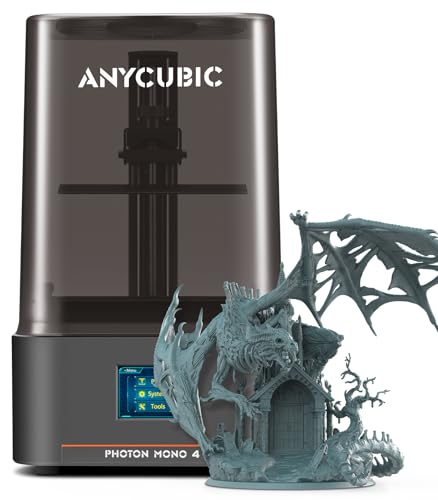
【10K High Resolution】7-inch 10K (9024 x 5120 px) HD Screen of Photon Mono 4 delivers over twice the detail (+105%) vs. Mono 2. With 17×17μm pixel precision, see every micro-detail come to life in stunning clarity
Portable 3D Printer for Beginners (100mm Build Volume)

Foolproof Setup with Video Guides – Never get stuck! We provide a crystal-clear Quick Start Guide and step-by-step video tutorials. Watch them online to get started. Simple...
A portable 3D printer with a 100mm build volume fits perfectly in my backpack. I think you’ll love how little space it demands.
The CAIDAQC compact FDM machine (that’s Fused Deposition Modeling, the standard plastic-extruding tech) gives you 100x100x100 mm to work with. Sounds tiny? It’s actually plenty for keychains, miniatures, and phone stands.
I get 0.05–0.3 mm layer resolution, which means smooth surfaces if I’m patient, or faster prints at rougher settings.
Setup’s honestly foolproof. Modular assembly, video guides, and the bed levels without swearing. The removable build plate saves my fingernails.
What’s Included:
- 10m PLA starter filament
- 8GB TF card with reader
- Tools and illustrated manual
- 12V Type-C adapter
It handles PLA and flexible TPU (1.75mm), so I can experiment beyond basics. The 0.4mm nozzle is standard, replaceable anywhere.
Online video tutorials cover troubleshooting, which I appreciate since nobody likes searching Reddit at midnight.
Verdict: Perfect for students, classrooms, or anyone testing 3D printing without committing desk space. The 100mm limit frustrates me occasionally, but honestly? Constraints breed creativity.
Best For: Students, beginners, and hobbyists who want a portable, low-commitment introduction to 3D printing for small projects like miniatures, keychains, and STEM learning.
Pros:
- Highly portable with backpack-friendly size and simple modular assembly with video guides
- Includes complete starter kit (filament, tools, memory card, manual) with no hidden costs
- Supports both PLA and flexible TPU for versatile material experimentation
Cons:
- 100mm build volume limits project size and occasionally frustrates larger ambitions
- 10m starter filament is minimal for sustained use
- Single 0.4mm nozzle requires replacement sourcing rather than included alternatives
Recommended Products

【𝐔𝐩𝐠𝐫𝐚𝐝𝐞𝐝 𝐂𝐥𝐚𝐬𝐬𝐢𝐜 𝐑𝐞𝐬𝐢𝐧 𝐅𝐨𝐫𝐦𝐮𝐥𝐚】ANYCUBIC Classic Standard UV Resin is preferred by the majority of consumers. Based on our customers' feedback, we have upgraded the classic resin formula. The Upgraded Resin has been improved in printing success rate, adhesion, printing accuracy, hardness, toughness, flowability, odor and cleaning. Bring you a better printing experience.

【Max Strength, Min Cracks】 Boasting Shore Hardness 86D, Anycubic ABS-Like Resin 3.0 offers strong crack resistance—handles drilling without cracking or warping.
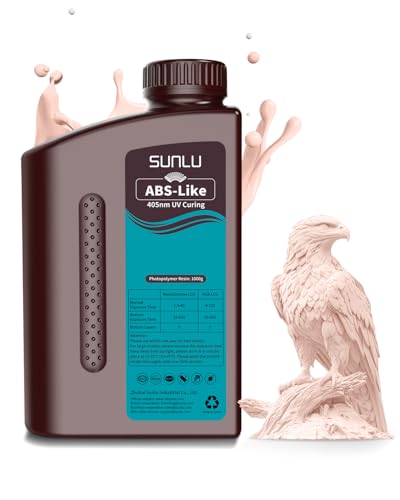
①【Less Brittle & More Strength】- Compared to other types of 3D Printer Resin, SUNLU ABS-Like Photopolymer Resin has better toughness, Non-brittle and has excellent abrasion resistance. If you need to print miniature or tiny objects, SUNLU ABS-Like 3D Printer Resin is your first choice.
TINA2 Plus 3D Printer with WiFi Cloud (HEPHI3D)

FULLY ASSEMBLY: Auto bed leveling fast 3d printing for beginners, Tina2 Plus is an entry-level mini 3d printer, fully assembled, no complicated installation and setting as...
What grabbed me was the speed claim: 250mm/s max, though I’d stick closer to 150mm/s for reliable results. That still saves about 75% of your printing time compared to slower machines, which matters when you’re itching to see your creation finished.
The TINA2 Plus arrives fully assembled, so I’m printing within minutes of unboxing. No frustrating calibration marathons, just auto bed leveling and go.
Its compact footprint fits anywhere, dorm room to kitchen counter.
The WiFi cloud feature genuinely simplifies things. I browse 3,000+ models in the Poloprint app, slice on my phone, and send it wirelessly. No tethered laptop, no SD card hunting.
It’s open source too, so I can use Cura or PrusaSlicer when I outgrow the basics.
The included high-speed PLA roll means I’m creating immediately. For beginners, teens, or impatient makers who want speed without complexity, this hits a sweet spot.
Best For: Beginners, teens, and impatient makers who want high-speed 3D printing without complicated setup or technical complexity.
Pros:
- Fully assembled with auto bed leveling for immediate out-of-box printing
- WiFi cloud connectivity enables wireless slicing and printing via smartphone app
- Compact design fits small spaces while delivering up to 250mm/s print speeds
Cons:
- Maximum speed of 250mm/s requires dialing back to 150mm/s for reliable results
- Limited to PLA printing with included materials, not specified for other filament types
- AI and photo-generated model features rely on app ecosystem that may have ongoing limitations or subscription requirements
Recommended Products

Double-Sided Textured Surface. Textured surface works well with PLA/PETG/TPU/PLA-CF/PETG-CF filament. Both sides can be used, more cost-effective.

【Professional Dual-Surface Design】One side with textured PEI for strong adhesion and matte finish effect, the other with ultra-smooth PEY surface for glossy professional-grade prints. Achieve 360° printing versatility.

Precision Engineered for Adventurer 5M: Designed exclusively for Adventurer 5M 3D printers with an exact 235x235mm size ensuring a perfect fit and seamless replacement without any modifications or adjustments needed.
Creality K2 Combo 3D Printer with Multicolor Printing

Multicolor 3D Printing: 4 × CFS for up to 16 colors. By hooking up as many as four CFS units together, you are able to print in the splendor of 16 colors. Saves the need for...
Creality’s K2 Combo makes me ask: why settle for single-color prints when you can run 16?
This machine arrives pre-assembled, so I’m printing within minutes. Just pop on the screen and go.
The 260 × 260 × 260 mm build volume gives me plenty of room for functional parts or ambitious multicolor models.
Here’s where it gets wild: four CFS units link together for 16-color printing. No more tedious post-print painting.
The next-gen direct drive extruder handles PLA, PETG, ABS, and composites without fuss.
I love how quiet it runs. Silent Mode with step-servo motors keeps noise at laptop-typing levels. Those same motors adjust torque in under a millisecond, so I get cleaner details at speed without the usual rattling.
The AI camera watches for spaghetti disasters and sends real-time alerts.
Smart auto leveling only probes where I’m actually printing, shaving minutes off setup. It’s targeted, efficient, beginner-friendly.
For creators wanting color freedom without complexity, this hits the sweet spot.
Best For: Creators and hobbyists who want professional-quality multicolor 3D prints without complex setup or post-processing work.
Pros:
- 16-color printing capability with four linked CFS units eliminates need for post-print painting
- Pre-assembled design with plug-and-play setup gets you printing within minutes
- Ultra-quiet operation with step-servo motors and Silent Mode comparable to laptop typing noise
Cons:
- Requires separate screen installation despite pre-assembled claim
- Limited to 260 × 260 × 260 mm build volume for larger projects
- Multicolor system complexity may present learning curve for true beginners
Recommended Products
【Easy Start – Beginner Friendly 3D Printer】Tina2C mini 3d printer is designed for first-time users, with guided setup through the Poloprint Cloud app. Fully optimized for beginners, it allows users to start their first 3D print in as fast as 8 minutes, making 3D printing simple, fun, and frustration-free.
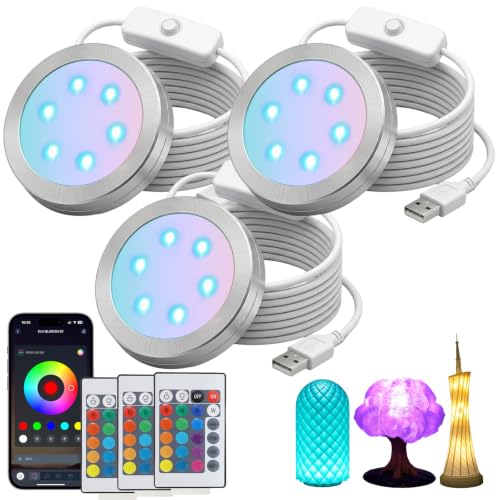
16 MILLION COLORS AND ADJUSTABLE EFFECTS – Create more than 16 million RGB color combinations with stepless brightness adjustment and multiple gradient effects through the APP. The remote provides 16 preset colors, four gradient modes and 10 brightness levels for quick adjustments

(TAILORED FOR BAMBU LAB & MAKERWORLD) Specifically engineered as the ultimate LED Lamp Kit 001 (MH001) for 3D printing enthusiasts. It fits perfectly for Bambu Lab A1/P1S/X2D/H2D/P2S. Simply download ""LED Lamp"" models from MakerWorld, and this hardware kit becomes the heart of your creation, turning 5D prints into professional-grade smart lamps.
Anycubic Kobra S1 Combo Multi-Color 3D Printer
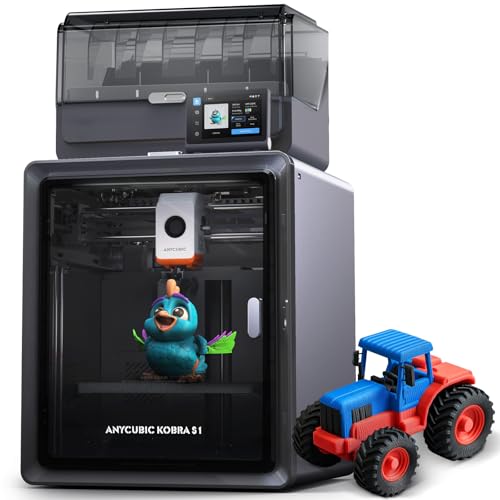
【Say Goodbye to Wet Filaments】Stop worrying about bubbles and clogs caused by moisture. S1C's built-in drying parameters for various materials keep filament in peak...
Want multi-color prints without the headache? I found the Anycubic Kobra S1 Combo, and honestly, it’s a relief.
What makes it stand out
This machine hits 600mm/s—that’s fast—thanks to its CoreXY structure. The fully enclosed chamber keeps ABS and other tricky materials stable, so I don’t get warping nightmares.
One-click auto-leveling means I spend less time tweaking and more time actually printing.
Multi-color that actually works
The S1C handles four colors right out of the box. I can connect two ACE Pro units for eight colors, though I’ll warn you: ACE Pro and ACE 2 Pro don’t play together.
The optimized algorithm cuts waste, which my wallet appreciates.
Features I love
Built-in filament drying saves my long prints. Quick-swap nozzles take seconds. I control everything remotely through the Anycubic App or LAN.
Verdict
For beginners ready to skip single-color frustration, this delivers speed, enclosure, and smart features without the usual chaos.
Best For: Beginners and hobbyists ready to move beyond single-color printing who want high-speed, multi-color capability with minimal setup hassle and reliable material handling.
Pros:
- 600mm/s CoreXY speed with fully enclosed chamber enables fast, stable printing of demanding materials like ABS without warping
- Built-in active filament drying and one-click auto-leveling reduce manual intervention and improve long print success rates
- Native 4-color printing expandable to 8 colors with dual ACE Pro units, plus quick-swap nozzles and smart app control for streamlined workflow
Cons:
- ACE Pro and ACE 2 Pro units cannot be used simultaneously, limiting upgrade flexibility
- Requires additional ACE Pro hardware purchase to unlock 8-color capability beyond the base 4-color setup
- CoreXY and enclosed design may present steeper learning curve for complete beginners compared to simpler Cartesian printers
Creality K2 SE 3D Printer with Multi-Color Support
Looking for a beginner printer that won’t leave you stuck in single-color boredom six months from now?
The Creality K2 SE checks that box, and then some. I love that you can grow into multicolor printing through the CFS system (sold separately), rather than paying upfront for features you might not need yet.
Speed and Build Quality
This machine hits 500 mm/s with 20,000 mm/s² acceleration. The CoreXY motion system uses vibration sensors and input shaping (think: automatic shake reduction) to keep prints clean even when it’s flying.
The die-cast aluminum frame with corner gussets and dual-side crossbeams means you’re not fighting frame flex during those rapid moves.
Practical Features for Beginners
Five-minute assembly. True out-of-the-box setup. Fully automatic bed leveling you trigger with one tap. The modular direct drive extruder and Quick-Swap nozzle minimize headaches when things go wrong, as they eventually do.
The CFS upgrade brings automatic filament switching, run-out detection, and tangle alerts. Creality Print handles multicolor slicing seamlessly; 40+ filament presets remove guesswork.
Verdict: Ideal if you want room to grow without outgrowing your first printer. Skip the CFS initially, add it later. That flexibility? Worth it.
Best For: Beginners who want a fast, easy-to-use printer that can grow with them into multicolor and multi-material printing without requiring immediate additional investment.
Pros:
- Blazing 500 mm/s print speed with CoreXY stability and automatic vibration compensation, delivering premium results
- True out-of-the-box experience with 5-minute assembly, one-tap auto bed leveling, and modular components that minimize maintenance headaches
- Future-proof CFS upgrade path lets you start simple and add multicolor capability later without replacing the entire printer
Cons:
- Multicolor capability requires separate CFS purchase, so advertised flexibility comes at additional cost
- High speeds and accelerations may still intimidate absolute beginners despite stabilization features
- Dependence on Creality ecosystem (Creality Print, Cloud, OS) limits flexibility for users preferring third-party software workflows
ELEGOO Mars 5 Resin 3D Printer with 4K LCD
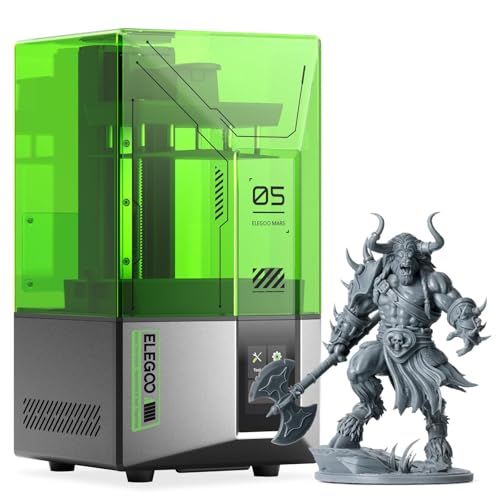
【Effortless Magic with One-Click Automatic Leveling】Effortless precision is just a click away. ELEGOO Mars 5 resin 3D printer offers advanced automatic leveling function...
The ELEGOO Mars 5 Resin 3D Printer is the top pick for beginners who want stunning detail without the usual hassle. I’m talking about that smooth, professional-grade surface finish that makes your miniatures look store-bought, not homemade.
Here’s why I’m impressed: the 4K Mono LCD paired with a COB light source delivers seriously sharp details.
The 5.65 × 3.53 × 5.91 inch build volume isn’t massive, but it’s perfect for jewelry, figurines, and detailed parts.
The automatic leveling, one-click and done. No more paper tests or swear words. The self-check routine runs before every print, so you’ll know immediately if something’s off.
Smart sensors monitor resin levels and catch leveling failures before they ruin your day. The residue detection protects that expensive LCD screen.
And if the LED overheats past 80°C, the printer shuts down automatically. Safety first, right?
Honestly, after my first resin printer nightmare, this workflow feels almost too easy. Unbox, power on, print. Reduced calibration means you’re creating within minutes, not hours.
The efficient cooling system keeps everything running smoothly long-term.
For beginners craving resin-quality results without the traditional headaches, I’ll recommend this every time.
Best For: Beginners seeking professional-quality resin prints with minimal setup hassle and automated safety features.
Pros:
- One-click automatic leveling and pre-print self-check eliminate tedious calibration
- Smart sensors detect resin shortages, leveling failures, and screen residue to prevent failed prints
- Overheat protection and efficient cooling ensure long-term reliability and component safety
Cons:
- Modest 5.65 × 3.53 × 5.91 inch build volume limits larger projects
- Green color may not appeal to all users
- No mention of wireless connectivity or remote monitoring capabilities
Creality HALOT R6 Resin 3D Printer for Kids & Beginners

Designed for Zero-Basic Newbies: Creality Halot R6, a resin 3d printer designed for newbies, is easy to operate, it has a built-in boot guide to help you complete the...
Who’s this little orange box really for?
Zero-basics newbies, that’s who. I love that the HALOT R6 holds your hand through networking and setup with its built-in boot guide. You literally unbox and print.
At 4.25 kg, this thing’s tiny. I mean, you could toss it in a backpack (though maybe don’t toss it, the alloy body resists impact, but still). The portability matters for apartment dwellers or anyone without a dedicated workspace.
Now, let’s talk safety. That orange hood isn’t just for show; it blocks 99.89% of UV rays. Resin printing used to mean squinting through tinted goggles, worried about your retinas. Creality solved that.
The 2K screen won’t wow resolution snobs. But paired with that >90% uniform light source and an optimized build platform, you get smooth, delicate surfaces. The Z-axis uses a single-line guide with a gap elimination nut, so there’s minimal wobble.
Want remote monitoring? Plug in a USB webcam. The HALOT BOX software offers one-click slicing, and Creality Cloud gives you model access without hunting Thingiverse. Plus, CHITUBOX Pro features come free, no season card nonsense.
Verdict: Perfect for nervous beginners, kids under supervision, and anyone prioritizing portability over massive build volume.
Best For: Zero-basics beginners, supervised kids, and anyone needing a portable, apartment-friendly resin printer who prioritizes ease of use and safety over large build volume.
Pros:
- Built-in boot guide enables true out-of-box printing with minimal setup frustration
- Exceptional safety features including 99.89% UV-blocking orange hood eliminate eye protection concerns
- Free CHITUBOX Pro access and integrated Creality Cloud ecosystem reduce ongoing costs and simplify workflow
Cons:
- 2K resolution falls short of industry standards for detailed miniatures and jewelry
- Compact size sacrifices build volume for users wanting larger prints
- USB webcam required for remote monitoring rather than built-in camera
Kidoodle 3D Printer for Kids with Wi-Fi & App Control
Want a printer that won’t overwhelm younger makers? I’ve got you covered.
What Makes It Kid-Friendly
The Kidoodle feels like a toy that actually works. It’s fully enclosed with a child-safe lock, and the nozzle cools down automatically if someone opens the door mid-print.
I appreciate that SUNLU thought about real kids, not ideal ones. The 5-inch HD touchscreen beats squinting at tiny displays, and auto-leveling means no one cries over failed first layers.
Speed That Surprises
At 600mm/s, this thing’s three times faster than typical small printers. I’m talking ten-minute prints at top speed. Sure, you won’t always max it out, but the option matters when patience runs thin.
Content and Connection
The 1,500+ model library (with weekly updates) keeps boredom away. Wi-Fi control through their kid-focused app works smoothly, though you can still use USB or Cura when needed.
My Take
This isn’t the cheapest starter option, but the included starter kit covers essentials. For families wanting safe, fast, genuinely educational printing without the headache, I’d call it worth the premium.
Best For: Families with children aged 6-14 who want a safe, easy-to-use 3D printer that prioritizes speed and educational value without requiring technical expertise.
Pros:
- Fully enclosed design with child-safe lock and automatic nozzle cooling provides genuine safety for unsupervised use
- 600mm/s printing speed delivers finished models in as little as 10 minutes, ideal for short attention spans
- Auto-leveling and intuitive 5-inch touchscreen eliminate common frustration points for beginners
Cons:
- 250g starter filament runs out quickly with active use
- Weekly library updates depend on continued manufacturer support long-term
Factors to Consider When Choosing a 3D Printer for Beginners
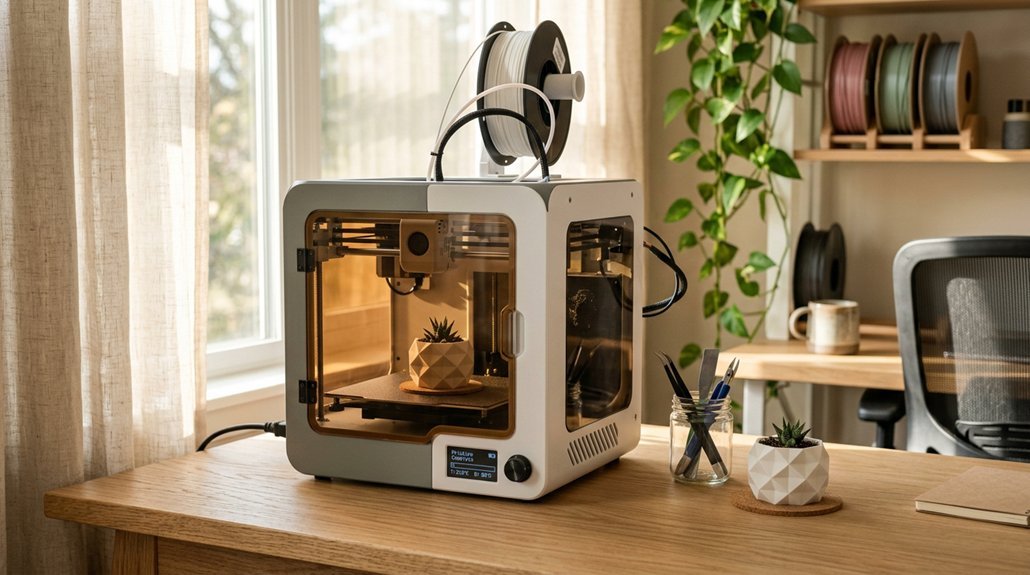
I’m about to walk you through what actually matters when you’re picking your first machine, because I’ve watched too many beginners get burned by specs that look impressive but mean nothing in practice. You’ll need to weigh print technology types (FDM’s your affordable workhorse, resin’s your detail king), ease of setup (trust me, you want something that doesn’t require a engineering degree), safety features (enclosed chambers, auto-shutoff, especially if kids are around), print quality factors (layer height, nozzle size, bed leveling), and budget considerations that go way beyond the sticker price.
I’ll break each down so you know where to splurge and where to save.
Print Technology Types
So you’re staring at the specs sheet and wondering what on earth FDM and MSLA actually mean for your kitchen table?
Let me break this down. FDM printers melt plastic filament and squirt it out layer by layer. Think of it like a glorified hot glue gun. You get bigger build areas, cheaper plastic, and frankly, less mess.
For a first printer? This is usually where I’d start.
MSLA resin printers use UV light to harden liquid goo. Sounds cool, and the detail is gorgeous: teeth on miniatures, silky curves on jewelry. But you deal with smelly chemicals, gloves, washing parts in alcohol, and finding your cat’s knocked over a $40 bottle of resin.
DLP works similarly but flashes whole layers at once, so it’s faster. Same mess, different speed.
Hybrids exist, combining both techs. Skip them for now. You want simple.
Ease of Setup
How much friction are you willing to tolerate before that first print?
I prefer machines that respect my time. Fully assembled, plug-and-play printers let me unbox and print within minutes. Kits demand patience I rarely have.
Auto-leveling is non-negotiable for beginners. Manual bed calibration, where you twist knobs and slide paper under the nozzle, wastes hours. One-click or automatic bed leveling eliminates this headache entirely.
Guided setup workflows through companion apps transform confusion into confidence. On-screen instructions walk you through each step, and remote monitoring lets you check progress from the couch.
Clear interfaces matter too. Simple menus, preloaded models, and straightforward filament loading reduce early frustration. Power-loss recovery saves prints when interruptions strike, because nothing stings like a failed first attempt.
Choose convenience. You’ll actually use the printer.
Safety Features
Once you’ve got the printer out of the box and running, you need to think about what happens next. Safety features matter more than flashy specs, especially when you’re learning at home.
I look for enclosed enclosures first. They trap fumes and keep fingers away from moving parts. Low-noise operation helps too: your ears will thank you during overnight prints.
Auto-leveling and auto-resume are game-changers. They stop you from babysitting the machine and reduce rookie mistakes that waste filament.
Don’t overlook nozzle design. Quick-swap or detachable nozzles mean less burning yourself during maintenance. Power-loss recovery and level-check alerts catch problems before they become disasters.
Finally, check for LED indicators, child-friendly modes, and protective covers. These aren’t gimmicks, they’re peace of mind for beginners.
Print Quality Factors
What actually separates a decent print from one that makes you groan? It comes down to a few hardware choices that beginners often overlook.
Layer Resolution and Nozzles
Smaller nozzle diameters, like 0.25 mm, give you finer details than chunky 0.8 mm nozzles. I always recommend starting with a standard 0.4 mm and experimenting later.
Resin Printer Screens
Monochrome LCDs cure faster and sharper than older color screens. The difference in edge definition is immediately noticeable.
Speed vs. Stability
Fast printing sounds great until vibrations wreck your dimensional accuracy. A rigid frame matters more than raw speed.
Bed Leveling and Extrusion
Auto-leveling saves you from first-layer nightmares. Pair that with a direct drive extrusion system, and you will see far fewer under-extrusion issues on complex prints.
Budget Considerations
Where do you even start when everything seems to cost money you haven’t spent yet? I’ve learned the hard way that your budget needs to stretch past the printer itself. Filaments and resins add up fast, and they’ll eventually cost more than the machine.
Entry-level models save you cash upfront but trade away conveniences. You’ll get slower speeds and manual bed leveling, which means more fiddling, more failed prints, more wasted material. I always tell beginners: spring for auto-leveling if you can. It pays for itself.
Don’t ignore the hidden costs. Nozzles wear out. Build plates scratch. You might want an enclosure later. Check the warranty too, because dead air from customer support burns through your patience and your wallet.