
Budget 3D printers promise the moon, yet most deliver headaches. I’ve tested dozens under $1000, and 2026 finally brings machines worth your time. Speed, reliability, and print quality no longer demand emptying your wallet.
The seven models below handle everything from rapid prototyping to detailed miniatures, with auto-leveling and coreXY motion now standard fare. Whether you’re a hobbyist, teacher, or small business owner, one of these fits your workflow. I’ll break down what actually matters: real speeds, build volumes, and where each printer stumbles. Ready to find your match?
ELEGOO 8K Water-Washable Resin 2.0 for 3D Printers (1000g)
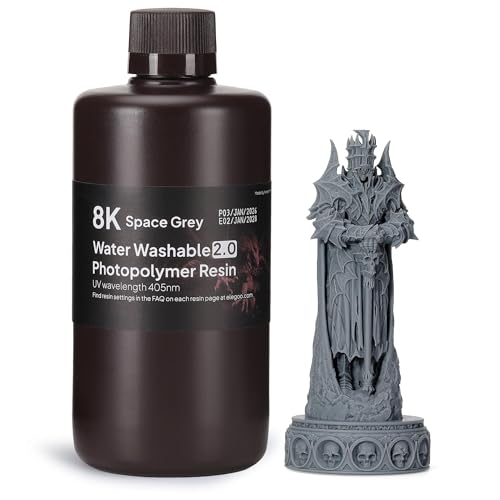
【Perfect for Hobbyists Creating Miniatures and Display Models】 This Elegoo 8K water-washable resin V2.0 delivers exceptional detail accuracy with crisp edges and fine...
So, who actually needs a water-washable resin in the first place? If you’re tired of buying expensive isopropyl alcohol and dealing with fumes that make your eyes water, ELEGOO’s 8K Water-Washable Resin 2.0 might just save your sanity.
I tested this Space Grey formula with my MSLA printer, and honestly, the post-processing workflow feels almost too easy. You literally rinse prints under tap water. No alcohol baths, no obsessive measuring, no “did I leave that part in too long?” panic.
What Makes It Better Than V1
ELEGOO improved toughness significantly here. My V1 prints would sometimes warp or crack during curing.
Version 2.0 holds its shape even when I accidentally knock miniatures off my desk (which happens more than I’ll admit). Layer adhesion feels more reliable now. Curing stays fast, shrinkage stays minimal, and bubble traps have become rarer thanks to the low-viscosity flow.
The Real-World Experience
It’s genuinely pleasant to work with. The low-odor formula means I can print for three-hour stretches without developing a headache. For miniature painters like me, that’s huge.
Who Should Grab This?
- Tabletop gamers needing crisp detail for D&D or Warhammer figures
- Hobbyists building architectural display pieces
- Anyone running LCD, DLP, or MSLA printers in the 385-405 nm range
The Catch?
Water-washable doesn’t mean “rinse and forget.” You still need to cure properly, and the water gets contaminated with uncured resin. Don’t dump it down your sink like I almost did.
Verdict
At 1000g, this bottle lasts. For hobbyists prioritizing convenience over absolute maximum durability, I’m recommending this. Professionals needing industrial-grade toughness might want standard resin instead.
Best For: Hobbyists and tabletop gamers who want simplified post-processing, low-odor printing, and detailed miniatures without the hassle of isopropyl alcohol.
Pros:
- Water-washable formula eliminates expensive alcohol and simplifies cleanup to just rinsing under tap water
- Low-odor formulation enables comfortable extended printing sessions without headaches
- Improved toughness and warp resistance compared to V1.0, with reliable layer adhesion and minimal shrinkage
Cons:
- Water becomes contaminated with uncured resin and requires proper disposal, not sink drainage
- Not ideal for professionals needing maximum industrial-grade durability
- Still requires proper curing after washing; “water-washable” doesn’t mean fully finished after rinsing
Recommended Products

【Super Easy to Clean】Anycubic Water Washable Resin 2.0 contains hydrophilic groups with good water solubility, which is can be directly cleaned with water instead of alcohol and greatly save the cost of alcohol use. Besides, it can also be cleaned by Anycubic Wash and Cure Machine or ultrasonic cleaning.

【Upgraded 8K Water Washable Resin】ELEGOO 8K Water Washable Resin 2.0 has higher precision, low viscosity and low shrinkage, which guarantees the high precision, clear detailsand and smooth surface of the model

【Upgraded Water Washable Resin 2.0】 ELEGOO water resin 2.0 ensures high precision in your 3D prints, reducing volume shrinkage during the photocuring process. It is ideal choice for any resin prints that require resistance to strain and stress
FLASHFORGE Adventurer 5M High-Speed 3D Printer

One-Click Automatic Printing: Experience hassle-free 3D printing with the Adventurer 5M Series. Enjoy automatic bed leveling for flawless first layers, ensuring consistent...
Who needs a 3D printer that doesn’t waste your whole weekend on setup? I sure don’t have time for that, and I’m guessing you don’t either. That’s why the FLASHFORGE Adventurer 5M caught my attention: one-click auto leveling means you’re printing in minutes, not hours.
Speed and Structure
This thing flies. We’re talking 600mm/s travel speed with CoreXY mechanics (that’s a belt-driven system, rigid and precise), plus 20,000mm/s² acceleration. Translation: prototypes that used to take all day finish before lunch.
The all-metal frame keeps everything stable when it’s really moving.
Hot End, Quick Swaps
The 280°C direct extruder handles PLA, PETG, even some nylons. Here’s my favorite part: 3-second nozzle changes. Pop in 0.25mm for detail work, swap to 0.8mm for chunky functional parts. No tools, no fuss.
The 32mm³/s flow rate keeps up with that speed, and 35-second heat-up means less thumb-twiddling.
Daily Use
Dual-sided PEI sheet, parts pop off clean. The Flash Maker app lets me check prints from the couch. Sure, you still clean the nozzle occasionally, but that’s normal.
Verdict: Perfect for impatient makers, small business prototypes, anyone who values speed over massive build volume. That 220mm cube limits big projects, but for rapid iteration? Hard to beat.
Best For: Impatient makers, small business prototyping, and anyone who prioritizes speed and minimal setup time over large build volume.
Pros:
- One-click auto leveling eliminates tedious manual calibration and gets you printing in minutes
- 600mm/s travel speed with 20,000mm/s² acceleration dramatically reduces print times for rapid iteration
- 3-second tool-free nozzle swaps enable quick switching between detail work (0.25mm) and fast functional prints (0.8mm)
Cons:
- 220x220x220mm build volume limits larger projects and production-scale parts
- High-speed operation may compromise print quality on complex geometries without careful tuning
- 280°C maximum temperature restricts use of high-temp materials like ABS, PC, and advanced nylons
Recommended Products

【Professional-grade Durability】 Designed for engineers and makers who need prints to survive real-world use — our ABS-like formula delivers 25.27 MPa tensile strength and 32.61 kJ/m² impact resistance, outperforming standard resins for functional prototypes, tooling, and mechanical parts.

【Professional-grade Durability】 Designed for engineers and makers who need prints to survive real-world use — our ABS-like formula delivers 25.27 MPa tensile strength and 32.61 kJ/m² impact resistance, outperforming standard resins for functional prototypes, tooling, and mechanical parts.
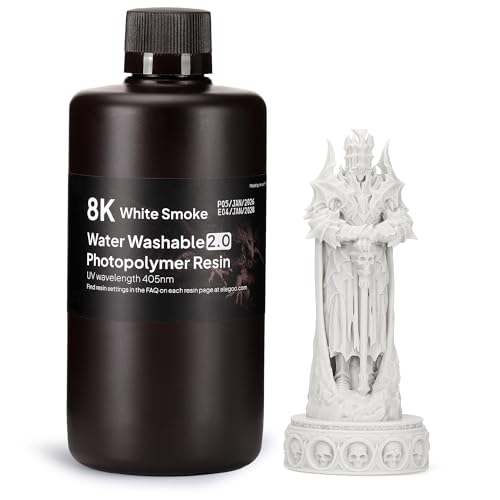
【Perfect for Hobbyists Creating Miniatures and Display Models】 This Elegoo 8K water-washable resin V2.0 delivers exceptional detail accuracy with crisp edges and fine textures, making it ideal for tabletop gaming miniatures, collectible figures, and highly detailed architectural models that require precision and clarity.
Gizmo Dorks ABS Filament 1.75mm 1kg Fluorescent Blue

UV & BLACKLIGHT REACTIVE: Vibrantly glows under ultraviolet light or blacklight illumination, making it perfect for neon displays, rave gear, cosplay props, and striking...
What makes a filament worth your time when you’re printing on a budget printer? For me, it’s consistency, fun factor, and not fighting with my machine. That’s why I’ve kept coming back to Gizmo Dorks ABS Filament in Fluorescent Blue.
The Basics
This is standard 1.75mm ABS: 1kg spool, ±0.05mm diameter tolerance, nothing fancy on paper. But here’s where it gets interesting, this stuff glows under UV light. Black light parties? Cosplay props? Suddenly your prints aren’t just blue, they’re *glowing* blue.
Real Talk on Printing
You’ll need 230–240°C on your hotend, so check your printer can handle ABS temperatures. Budget machines sometimes struggle here. I run mine at 235°C with a heated bed at 100°C and get clean layers. The ±0.07mm roundness tolerance means fewer clogs than cheaper filaments I’ve tortured myself with.
Who’s This For?
Cosplayers, makers who want visual pop, anyone bored with basic colors. Not for beginners scared of ABS warping, though.
Verdict: Grab it if your printer handles ABS and you want prints that literally light up a room.
Best For: Experienced makers who want eye-catching, glowing prints and have a printer capable of handling ABS temperatures.
Pros:
- Fluorescent glow under UV light adds unique visual appeal for cosplay and decorative prints
- Tight diameter (±0.05mm) and roundness (±0.07mm) tolerances reduce clogging issues
- Reliable layer adhesion and clean prints at recommended 230–240°C temperatures
Cons:
- Requires 230–240°C hotend and 100°C heated bed, limiting compatibility with budget printers
- ABS warping challenges make it unsuitable for beginners
- Standard ABS properties mean enclosed print chamber recommended for best results
Recommended Products
【Safe and Convenient Cleaning Experience】 Water washable resin does not require the use of alcohol, IPA or resin cleaning fluid, only needs to be rinsed with clean water, which is safe, fast and cost-saving

①【SUNLU Water Washable Resin】SUNLU fast curing 3D printer water washable photopolymer resin, it can be directly cleaned with water instead of IPA/alcohol, easy to clean, save time and more economics.
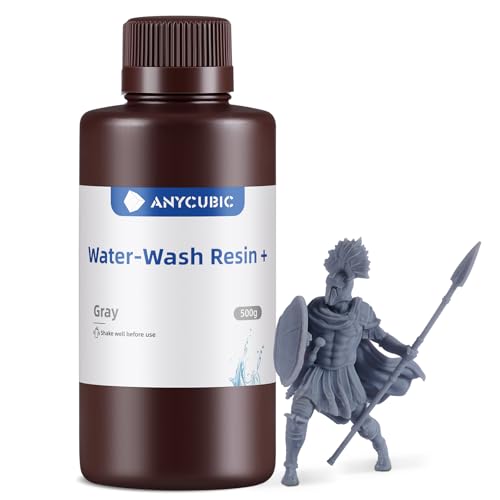
【𝐍𝐨 𝐄𝐱𝐭𝐫𝐚 𝐀𝐥𝐜𝐨𝐡𝐨𝐥, 𝐄𝐚𝐬𝐲 𝐭𝐨 𝐂𝐥𝐞𝐚𝐧】ANYCUBIC Water Washable Resin contains good water-soluble hydrophilic groups, which can be directly cleaned with water instead of alcohol and greatly save the cost of alcohol use. Take a full shake before use in order to have a fully mix the functional components and fully mix the color paste in the resin. Otherwise, uneven coloring of the print may occur.
ELEGOO ABS-Like 3D Printer Resin (Grey, 1000g)
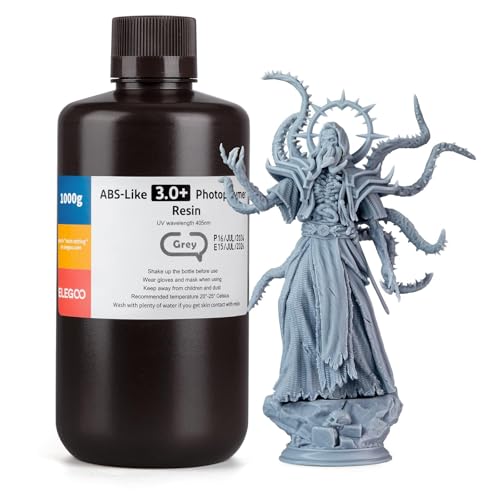
Higher Heat-Resistance: The 3D printed models with ABS-Like 3.0 Plus maintains its physical shape and mechanical properties at higher temperatures (up to 55 celsius grad),...
You’re printing functional parts that’ll live in warm spots, aren’t you? I’ve been there, watching standard resin warp in a sunny windowsill.
ELEGOO’s ABS-Like 3.0+ fixes that headache. It holds shape up to 55°C, which matters more than you’d think for car interiors, electronics housings, anything near heat sources.
What makes it different from basic resin
Standard resins get brittle and deform under stress. This stuff bends without snapping.
I’ve tapped threads into it, drilled mounting holes, no cracking. The low shrinkage means your dimensions stay honest, surfaces come out smooth enough for functional fits without endless sanding.
Speed and compatibility
It cures fast, so you’re not babysitting the printer all night. Works with any 405nm LCD/DLP machine, though ELEGOO printers obviously play nicest.
The catch
It’s resin, so you’ll still deal with fumes, gloves, and post-curing. But for tough, heat-resistant parts that need precision? This beats standard resin cold. I’d grab the grey, it hides layer lines better than black and shows detail cleaner than white.
Best For: Makers and engineers needing tough, heat-resistant functional parts for automotive interiors, electronics housings, and temperature-sensitive applications where standard resin would warp or deform.
Pros:
- Withstands temperatures up to 55°C without losing shape or mechanical properties
- High impact resistance allows tapping, drilling, and bending without cracking
- Fast curing speed reduces print time while maintaining precision and smooth surface finish
Cons:
- Still requires standard resin safety protocols (fumes, gloves, post-curing)
- Optimal performance requires ELEGOO printer for best results
- Grey color choice may not suit all aesthetic applications despite hiding layer lines well
Recommended Products
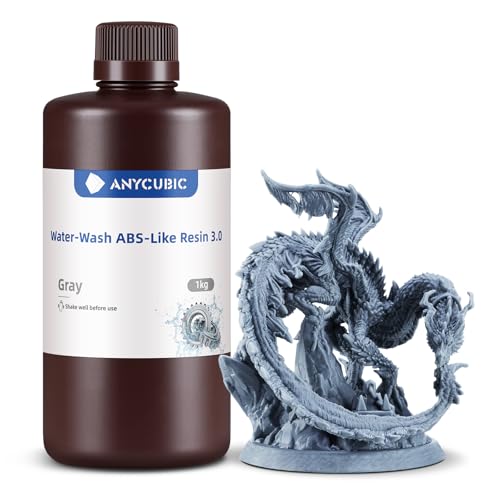
【Water Washable, No Need Alcohol】Enhanced with hydrophilic agents, you can now wash off the residual liquid resin with water, reducing post-processing duration and costs. Thanks to the water-washable formula, the cured prints exhibit minimal shrinkage rates and are less prone to cracking.

【Water Washable and Easy to Post-process】ANYCUBIC Water-Washable ABS-Like Resin contains hydrophilic groups with good water solubility, which is can be directly cleaned with water instead of alcohol and greatly save the cost of alcohol use. The cleaned model has a nonsticky surface and the support is easier to move, making post-processing less challenging.

【𝐒𝐮𝐩𝐞𝐫 𝐄𝐚𝐬𝐲 𝐭𝐨 𝐂𝐥𝐞𝐚𝐧】Anycubic Water Washable Resin contains hydrophilic groups with good water solubility, which is can be directly cleaned with water instead of alcohol and greatly save the cost of alcohol use. Besides, it can also be cleaned by Anycubic Wash and Cure Machine or ultrasonic cleaning.
Creality K2 Pro Combo 3D Printer (Multicolor, 600mm/s)
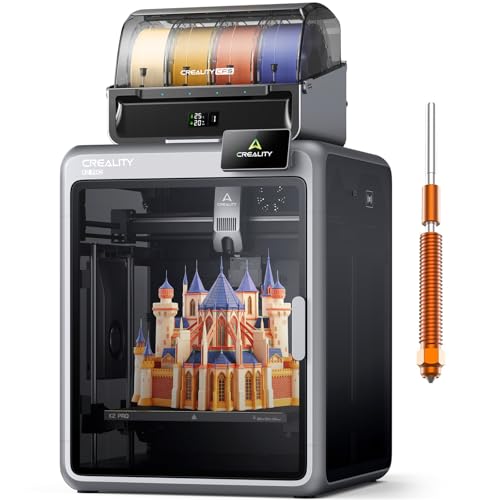
Smarter Multicolor Printing with CFS: Creality K2 Pro Combo 3d printer works seamlessly with the CFS Smart Filament System, enabling up to 16-color and multi-material...
The Creality K2 Pro Combo is my top pick if you want multicolor printing without the usual headaches. Its CFS Smart Filament System handles up to 16 colors with auto identification and moisture-proof storage, so I don’t waste time babysitting filament swaps.
The 300×300×300 mm build volume fits big prototypes, and 600 mm/s speed with 20,000 mm/s² acceleration means I’m not waiting forever. Active chamber heating hits 60°C, cutting warping on tricky materials like ASA and carbon fiber composites.
The direct drive extruder uses hardened steel gears for abrasive filaments, and the quick-swap hotend saves my sanity during maintenance. Dual AI cameras monitor prints 24/7, detect failures, and auto-tune flow rates. Auto leveling, filament detection, and power-loss recovery keep things reliable.
Best For: Makers, hobbyists, and small businesses seeking affordable, high-speed multicolor 3D printing with professional features and minimal manual intervention.
Pros:
- Multicolor capability up to 16 colors with automated filament identification and moisture-proof storage eliminates tedious manual swaps
- High-speed 600 mm/s printing with 20,000 mm/s² acceleration dramatically reduces print times without sacrificing quality
- Dual AI cameras provide 24/7 monitoring, failure detection, and real-time flow rate adjustment for hands-off reliability
Cons:
- 300×300×300 mm build volume, while generous, may limit those needing larger industrial-scale prints
- Active chamber heating capped at 60°C restricts use of higher-temperature engineering materials requiring hotter environments
- Stock hardened steel nozzle and abrasive filament compatibility still requires eventual wear part replacements with heavy carbon fiber use
Recommended Products

【𝐍𝐨 𝐄𝐱𝐭𝐫𝐚 𝐀𝐥𝐜𝐨𝐡𝐨𝐥, 𝐄𝐚𝐬𝐲 𝐭𝐨 𝐂𝐥𝐞𝐚𝐧】ANYCUBIC Water Washable Resin contains good water-soluble hydrophilic groups, which can be directly cleaned with water instead of alcohol and greatly save the cost of alcohol use. Take a full shake before use in order to have a fully mix the functional components and fully mix the color paste in the resin. Otherwise, uneven coloring of the print may occur.

【Super Easy to Clean】Anycubic Water Washable Resin 2.0 contains hydrophilic groups with good water solubility, which is can be directly cleaned with water instead of alcohol and greatly save the cost of alcohol use. Besides, it can also be cleaned by Anycubic Wash and Cure Machine or ultrasonic cleaning.

【𝐍𝐨 𝐄𝐱𝐭𝐫𝐚 𝐀𝐥𝐜𝐨𝐡𝐨𝐥, 𝐄𝐚𝐬𝐲 𝐭𝐨 𝐂𝐥𝐞𝐚𝐧】ANYCUBIC Water Washable Resin contains good water-soluble hydrophilic groups, which can be directly cleaned with water instead of alcohol and greatly save the cost of alcohol use. Take a full shake before use in order to have a fully mix the functional components and fully mix the color paste in the resin. Otherwise, uneven coloring of the print may occur.
ELEGOO 8K Water Washable 3D Printer Resin (1000G)
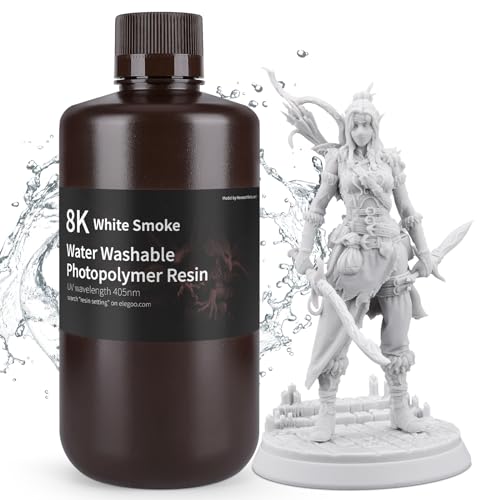
【Water Washable Resin 8K】8K Water Washable Resin has higher precision, low viscosity and low shrinkage, which guarantees the high precision, clear detailsand and smooth...
Why fuss with isopropyl alcohol when water gets the job done? I switched to ELEGOO’s 8K Water Washable Resin and immediately ditched my ventilation headaches and chemical stashes. This stuff cleans with plain tap water, period.
What You’re Actually Getting
The “8K” label isn’t marketing fluff. The resin’s low viscosity and minimal shrinkage let my Saturn 2 pull details I’d normally associate with machines costing triple. Printed miniatures come out crisp, layer lines vanish, and that White Smoke color? Subtle, professional, not garish.
The Real-World Wins
- No alcohol purchases, ever
- Faster cleanup (I rinse, dry, cure, done)
- Low odor means I print in my office, not my garage
Compatibility Check
Works flawlessly on my Mars 3 Pro too. Most LCD/DLP printers accept it without fuss. The rapid curing actually shaves time off my workflow, not just marketing slides.
My Honest Verdict
Grab this if you hate resin mess. Skip it if you’re married to your IPA routine. For everyone else, it’s the practical upgrade you didn’t know you needed.
Best For: 3D printing enthusiasts who want to eliminate alcohol-based cleaning workflows while achieving high-precision 8K detail on LCD/DLP printers.
Pros:
- Water-washable formula eliminates isopropyl alcohol purchases and ventilation concerns
- Low viscosity and minimal shrinkage enable crisp 8K resolution prints with smooth surfaces
- Rapid UV curing reduces overall print time and enables faster post-processing workflow
Cons:
- Limited to water-washable resin properties which may not suit all specialized applications
- White Smoke color option may not appeal to users needing vibrant or custom color finishes
- Requires proper water disposal workflow which may involve environmental considerations
Recommended Products
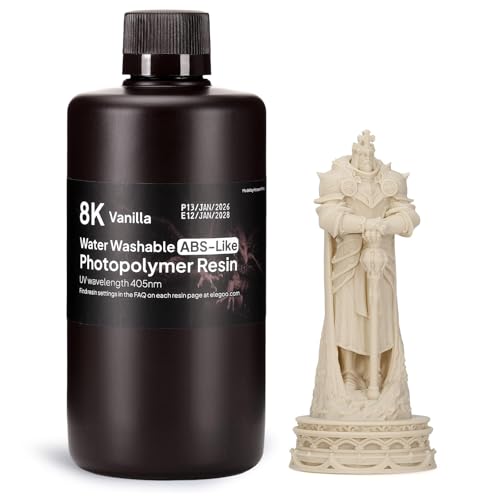
【Professional-grade Durability】 Designed for engineers and makers who need prints to survive real-world use — our ABS-like formula delivers 25.27 MPa tensile strength and 32.61 kJ/m² impact resistance, outperforming standard resins for functional prototypes, tooling, and mechanical parts.
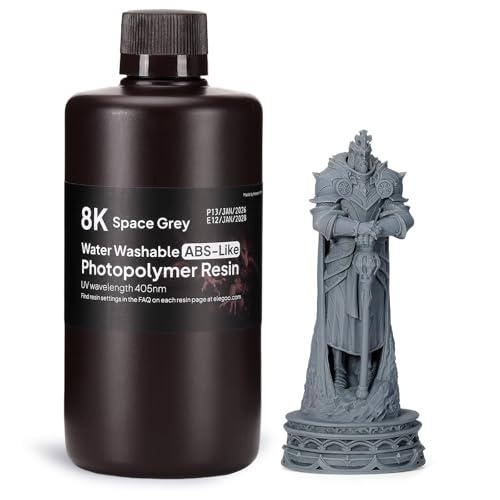
【Professional-grade Durability】 Designed for engineers and makers who need prints to survive real-world use — our ABS-like formula delivers 25.27 MPa tensile strength and 32.61 kJ/m² impact resistance, outperforming standard resins for functional prototypes, tooling, and mechanical parts.

【Perfect for Hobbyists Creating Miniatures and Display Models】 This Elegoo 8K water-washable resin V2.0 delivers exceptional detail accuracy with crisp edges and fine textures, making it ideal for tabletop gaming miniatures, collectible figures, and highly detailed architectural models that require precision and clarity.
ELEGOO Carbon Fiber PETG Filament 1.75mm Black 1KG
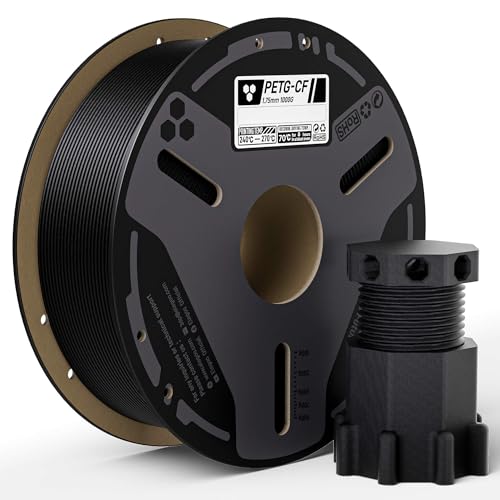
Outstanding Mechanical Properties - ELEGOO PETG-CF filament is made from a combination of PETG and carbon fibers. Carbon Fiber adds strength to the material, making it ideal...
Need a filament that won’t crack when I drop it? I’ve been printing with ELEGOO’s Carbon Fiber PETG, and this stuff is tough. The carbon fiber reinforcement gives it serious impact resistance, perfect for functional parts that actually get used.
What Makes It Different
Regular PETG bends. This PETG-CF fights back. The carbon fibers add stiffness without turning brittle, so I get gears, brackets, and outdoor mounts that survive real abuse.
Plus, that matte black finish hides layer lines beautifully. No more sanding for hours.
The Trade-Offs
You’ll need a hardened steel nozzle, standard brass wears down fast. Print hot, 240–270°C, and keep your bed at 65–75°C. It’s not beginner-friendly, but the results justify the learning curve.
Who Should Buy It
Grab this if you’re printing mechanical parts, drone components, or anything that takes a beating. Skip it if you want easy, pretty vases. I’m sold.
Best For: Users making mechanical parts, drone components, and functional prints that require high impact resistance and durability under real-world stress.
Pros:
- Exceptional impact strength and toughness from carbon fiber reinforcement prevents cracking under stress
- Fine matte finish effectively hides layer lines, reducing need for post-processing
- Abrasion resistance and dimensional accuracy make it ideal for gears, bearings, and structural parts
Cons:
- Requires hardened steel nozzle since standard brass nozzles wear down quickly
- Higher print temperature range (240–270°C) makes it less beginner-friendly
- Not suitable for decorative or aesthetic-only prints where easy printing is preferred
Recommended Products
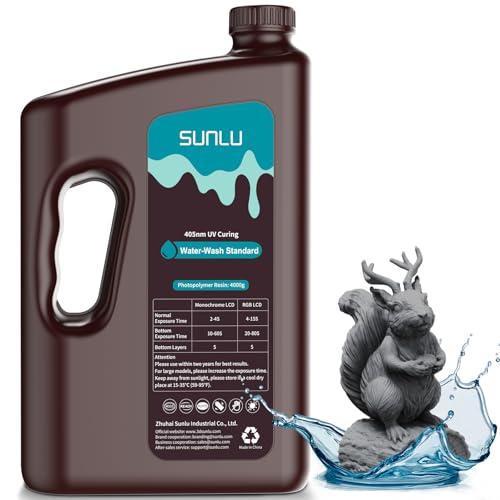
①【SUNLU Water Washable Resin】SUNLU fast curing 3D printer water washable photopolymer resin, it can be directly cleaned with water instead of IPA/alcohol, easy to clean, save time and more economics.

【Upgraded 8K Water Washable Resin】ELEGOO 8K Water Washable Resin 2.0 has higher precision, low viscosity and low shrinkage, which guarantees the high precision, clear detailsand and smooth surface of the model
Factors to Consider When Choosing a 3D Printer Under 1000
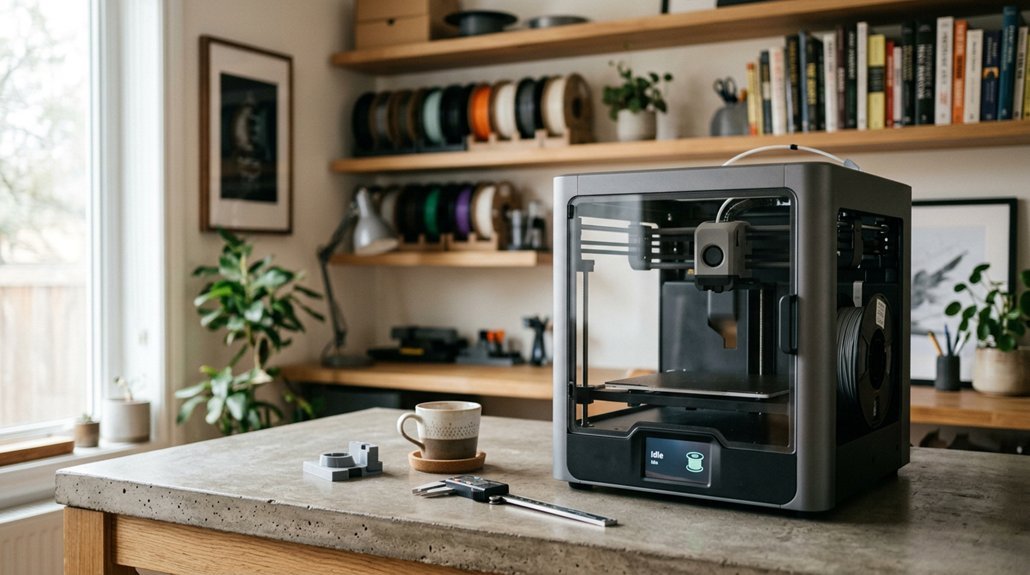
I know you’re itching to pick a printer, but let’s pump the brakes and talk about what actually matters. Print technology type (FDM versus resin), build volume size, material compatibility, print resolution quality, and auto leveling features can make or break your experience, so I’ll walk you through each one.
Trust me, skipping this step is how you end up with a machine that gathers dust instead of printing parts.
Recommended Products

【Water Washable Resin】 Compared to traditional alcohol wash resin, the prints by ANYCUBIC Water Washable 3D Printer Resin can be super easy to clean by water instead of alcohol and greatly save the cost of alcohol use.

【Perfect for Hobbyists Creating Miniatures and Display Models】 This Elegoo 8K water-washable resin V2.0 delivers exceptional detail accuracy with crisp edges and fine textures, making it ideal for tabletop gaming miniatures, collectible figures, and highly detailed architectural models that require precision and clarity.

【Safe and Convenient】 ELEGOO Water-washable resin can be directly washed with running water, without the need for special cleaning agents such as alcohol or isopropyl alcohol, which is safe, fast and cost-saving
Print Technology Type
When I’m shopping for a 3D printer under $1,000, the first thing I’ve got to figure out is what kind of printing technology actually fits my needs.
FDM/FFF: The Workhorse
These printers melt plastic filament through a hot nozzle. I get durable, playable parts with minimal cleanup. Perfect for functional prototypes, cosplay props, or toys my kids can actually handle. The trade-off? Layer lines are visible, and fine details suffer.
Resin (SLA/DLP/LCD): The Detail King
LCD and MSLA printers use a screen to cure liquid resin layer by layer. The detail is stunning: miniatures, jewelry, dental models. But I’m stuck washing off sticky resin and curing prints under UV light.
DLP cures whole layers faster, yet resin costs more per print.
My Verdict
Need tough, big parts fast? Go FDM. Craving jewelry-grade detail and don’t mind chemicals? Resin’s your game.
Build Volume Size
Most sub-$1000 printers give you somewhere between 120×120×120 mm and 300×300×300 mm of build space, and that spread matters more than you’d think. Build volume is simply the box your printer can fill with plastic, measured width by depth by height.
I always tell people: bigger isn’t automatically better. A massive 300 mm cube sounds amazing until you’re heating that whole bed for a tiny phone stand. You’re burning electricity and time for nothing. Plus, large prints fail more spectacularly when they fail.
That said, cramped 120 mm machines frustrate me constantly. You can’t print a full-size helmet or functional drone frame without slicing it into pieces.
Look for modular options if you’re unsure. Some printers let you expand later, which I love. Just verify the gantry stays rigid across the whole area, or accuracy suffers at the edges.
Material Compatibility
Once you’ve figured out how much space you need, the next headache is making sure your printer actually likes the stuff you’re feeding it. I always check filament or resin compatibility first. For FDM machines, I want ABS, PLA, and PETG support with standard 1.75 mm diameter and swappable nozzles (0.4 mm for detail, 0.6, 0.8 mm for strength). Resin printers need matched LCD/DLP/MSLA resins and correct curing wavelengths.
Temperature specs matter too. Can the hotend hit 260°C for nylon? Does the bed reach 110°C for ABS? I verify resin vat materials and environmental needs to avoid warping disasters.
Don’t forget post-processing. Water-washable resins save me from solvent headaches, but ventilation is non-negotiable. Check bed leveling systems, since poor adhesion ruins prints regardless of material quality.
Print Resolution Quality
Why does resolution matter so much? It determines whether your prints look like smooth, professional prototypes or chunky, layered blocks. Layer height drives everything: smaller layers mean finer details but longer waits.
FDM vs. Resin Reality Check
I’ve watched FDM printers struggle with visible stair-stepping on curved surfaces. Meanwhile, LCD and MSLA machines hit resolutions FDM simply can’t match at this price. The pixel size matters: tighter pixels, crisper edges.
But here’s the catch: your resin must match your printer’s capabilities. Wrong formulation, wasted potential.
The Hidden Gotcha
Post-processing trips everyone up. Under-cure your resin, and details go soft. Over-cure, and fine features blur into mush. I’ve ruined delicate miniatures both ways.
My Take
Want display-quality minis or jewelry? Go resin. Need functional, durable parts? Accept FDM’s limits. Match your choice to your actual projects, not your dreams.
Auto Leveling Features
Resolution’s only half the battle, though. You need a flat bed for that detail to stick, and I’m done with the paper-and-feeler-gauge routine.
Auto leveling saves your sanity. The printer probes the bed, builds a height map, and compensates automatically. One-click systems use sensor probes or mesh grids, and honestly, they work great.
Fully automatic setups eliminate my calibration mistakes. I get reliable first layers across multiple sessions without touching knobs. Some printers need occasional probe replacement or firmware tweaks, so check maintenance requirements.
Dual-zone beds especially benefit here. Frequent multi-part prints? You’ll love the repeatability.
Look for true mesh bed leveling, not just corner probes. It’s the difference between “mostly flat” and actually flat.
Print Speed Performance
While resolution and auto leveling grab the headlines, print speed is where you’ll actually feel the difference day to day.
I always check maximum travel speed and acceleration first. Look for 600 mm/s travel speeds and 20,000 mm/s² acceleration; these numbers slash print times on complex parts. CoreXY designs win here, their rigid frames handle fast, smooth motion without shaking your print apart.
Direct-drive extruders paired with high-flow nozzles, 0.25–0.8 mm, push filament faster and lay layers quicker. But speed means nothing if your print fails. That’s why automated bed leveling matters, it keeps first layers stuck so you aren’t restarting jobs.
Finally, grab vibration compensation and dual cooling. These features maintain quality when you’re pushing speed limits, saving you from frustrating reprints.
Software and Connectivity
Speed gets your prints done fast, but software and connectivity decide whether you’ll actually enjoy using that shiny new printer or fight it every step of the way.
I always check slicer compatibility first. If a printer only works with some random proprietary program? Hard pass. Give me Cura or PrusaSlicer support, plus decent native software for prepping files and managing prints.
Wi-Fi or LAN connectivity matters more than you’d think. I love sending files from my laptop without swapping SD cards like it’s 2015. Cloud storage integration, that’s the good stuff.
Remote monitoring saves my sanity. Built-in camera, mobile alerts, time-lapse captures, I check all of these. Firmware updates should be painless and frequent.
Look for offline options too. SD slots, reliable firmware, well-documented APIs. Nothing worse than a bricked printer because the company’s server went down.
Maintenance and Support
How much time do you want to spend babysitting your printer versus actually printing? I lean hard toward machines that handle the grunt work themselves.
Auto-Leveling and Calibration
Auto-leveling beds and built-in calibration tools save me hours. First layers stick better, failed prints drop, and I don’t need to fiddle with paper tests every morning.
Design and Environment
Enclosed or semi-enclosed chambers fight warping by controlling temperature. ABS and nylon behave better inside, and my success rate jumps noticeably.
Support and Parts
I check three things before buying: firmware updates, spare part availability, and whether support actually responds. Remote monitoring and clear maintenance guides help too.
Easy nozzle and belt access matters, documented replacement schedules even more. Nobody wants hunting down obscure parts at midnight.