

Last winter, I watched a carpenter wrestle a compressor hose through three feet of snow, and I thought: there’s got to be a better way.
Cordless framing nailers have finally reached that sweet spot where battery power rivals pneumatic performance without the hassle of hoses, gas cartridges, or deafening compressors.
I’ve tested dozens of these tools over the past year, and I’m narrowing down the seven that actually deserve your money in 2026. Some will surprise you. Others will disappoint you. Stick around, and I’ll show you which is which.
20V 21DEG FRAMING NAILER BARE

20V 21DEG FRAMING NAILER BARE 20V 21DEG FRAMING NAILER BARE 20V 21DEG FRAMING NAILER BARE 20V 21DEG FRAMING NAILER BARE 20V 21DEG FRAMING NAILER BARE
When I’m framing walls or throwing up a deck, I want power without the cord dance. That’s where the DEWALT DCN920B steps in. This 20V 21-degree framing nailer runs on DEWALT’s standard battery platform, so if you’ve already bought into their ecosystem, you’re halfway home.
Bare tool means no battery or charger in the box. Annoying? Sure, if you’re starting fresh. Smart money-saver? Absolutely, if your garage already looks like a DEWALT billboard.
What You’re Getting
The 21-degree angle handles full round-head nails, the kind building inspectors actually want to see. No more arguments about clipped heads on job sites.
I’ve found the balance pretty decent for overhead work, though your shoulders will still remind you that framing nailers aren’t featherweights.
The Catch (There’s Always One)
Stanley Black and Decker makes solid gear. And that “Multi” color? It’s basically DEWALT yellow with black accents. Shocking, I know.
Who’s It For?
DEWALT loyalists, weekend warriors scaling up, pros who need backup without another battery format to babysit. I’d pass if you’re married to Milwaukee or Makita. Battery ecosystems are basically marriage; switching gets expensive fast.
Verdict: Solid performer, bare-tool pricing stings less when you’re already invested.
Best For: DIYers and professional framers already invested in the DEWALT 20V battery platform who need a cordless solution for heavy-duty nailing tasks.
Pros:
- Cordless convenience using DEWALT’s standard 20V battery ecosystem
- 21-degree angle accepts full round-head nails that meet building code requirements
- Bare tool pricing saves money for users who already own compatible batteries and chargers
Cons:
- No battery or charger included, requiring additional purchase for new users
- Heavy weight causes shoulder fatigue during overhead work
- Locked into DEWALT battery ecosystem, making it expensive to switch brands
Recommended Products

Drives full-round head nails into dense engineered lumber with power and ease

Drives clipped head nails into dense engineered lumber with power and ease

POWERFUL AND EFFICIENT: This 2025 Pro Tools Innovation Award winning 18V cordless framing nailer delivers 120 joules of power, driving up to 3-1/2" nails into hard materials like engineered lumber. The air spring drive system offers performance similar to pneumatic tools with zero ramp-up time.
Metabo HPT 18V Cordless Framing Nailer Kit
POWERFUL AND EFFICIENT: This 2025 Pro Tools Innovation Award winning 18V cordless framing nailer delivers 120 joules of power, driving up to 3-1/2" nails into hard materials...
Looking for a cordless framing nailer that actually matches pneumatic power without the hassle? I’ve found it in the Metabo HPT NR1890DRA. This 18V brute delivers 120 joules of driving power with its air spring drive system, zero ramp-up time, and zero excuses for weak shots.
I love the real-world numbers here. You’ll drive 2″ to 3-1/2″ nails, up to 500 per charge with the included 4.0Ah battery. The brushless motor means less maintenance, more runtime, and years of abuse without crying for help.
At 8.4 lbs bare, it won’t crush your shoulder. The aggressive nose grips lumber securely, tool-less depth adjustment saves fiddling, and switching between bump and sequential modes takes seconds.
No hoses, no compressor noise, no tripping over cords.
Is it perfect? It’s slightly heavier than some competitors, but that weight comes from solid build quality. Metabo HPT has been the pro-preferred nailer brand for 11 straight years, and the lifetime tool body warranty backs up that reputation.
Verdict: Buy this if you want true pneumatic performance in a cordless package, or if you demand proven reliability over flashy new brands.
Best For: Professional framers and contractors who need true pneumatic-level power and reliability in a cordless framing nailer without dealing with hoses, compressors, or ramp-up time.
Pros:
- 120 joules of driving power with air spring drive system delivers genuine pneumatic performance with zero ramp-up time
- Brushless motor and 4.0Ah battery combine for 500 nails per charge, reduced maintenance, and extended durability
- Tool-less depth adjustment and quick switching between bump and sequential modes enhance jobsite efficiency
Cons:
- Slightly heavier than some competing cordless framing nailers on the market
- Limited to 21-degree plastic strip nails, which may not suit all user preferences or regional availability
- 8.4 lbs bare weight (heavier with battery installed) may cause fatigue during extended overhead or one-handed use
Recommended Products

Powerful motor: capable of driving up to 3-1/4 in round head nails into laminated veneer lumber

20V 30DEG FRAMING NAILER KIT

THE FLEX ADVANTAGE - 20% more power with 24V lithium, 25% longer runtime with THERMA-TECH heat management, up to 50% faster charging with high-power, dual fan chargers
Makita 18V Brushless Cordless Framing Nailer Kit (XNB03M1)
Drives full-round head nails into dense engineered lumber with power and ease Drives up to 1,000 framing nails on a single charge* 2-mode selector switch allows operator to...
Makita’s XNB03M1 nails the sweet spot for pros who need serious power without the gas hassle. I love that this thing runs on Makita’s 18V LXT platform, so if you’ve already got their batteries, you’re golden. No proprietary nonsense here.
The brushless motor pushes full-round head nails into dense engineered lumber without breaking a sweat. I’ve driven thousands through LVL and LSL, and it keeps punching.
The two-mode selector lets you switch between sequential nailing, where you pull for each shot, or bump fire, where you hold the trigger and bump, bump, bump away. I gravitate toward bump fire for sheer speed, but sequential gives you control on finish-critical spots.
Tool-less depth adjustment is quick, and that anti-slip nose grip helps when you’re toe-nailing at awkward angles. The anti-dry fire mechanism saves you from the embarrassment and wasted time of blanks, and the LED light actually illuminates something useful in dim corners.
At 11.9 pounds with the 4.0Ah battery, it’s not exactly featherweight, but I’ve swung heavier. The rear lock-and-load magazine holds 41 nails, and one charge powers through roughly 1,000 shots, plenty for most framing days.
Here’s who wins with this tool: dedicated Makita ecosystem users, residential framers doing stick-built homes, and anyone tired of gas cartridges that expire and stink. It’s reliable, powerful, and skips the fuel cell hassle entirely.
Best For: Dedicated Makita 18V LXT ecosystem users, residential framers building stick-built homes, and professionals who want powerful cordless framing performance without the maintenance or odor of gas cartridge nailers.
Pros:
- Runs on Makita’s widely compatible 18V LXT battery platform, eliminating proprietary battery lock-in
- Brushless motor delivers consistent power for driving full-round head nails into dense engineered lumber like LVL and LSL
- Versatile 2-mode selector switch (sequential and bump fire) adapts to both precision work and high-speed production framing
Cons:
- At 11.9 pounds with battery, it remains relatively heavy for extended overhead or all-day use compared to lighter pneumatic or premium cordless alternatives
- Limited 41-nail magazine capacity requires more frequent reloading than higher-capacity pneumatic or competing cordless models
- Restricted to Makita 18V LXT battery ecosystem, making it a poor value for users invested in other battery platforms
Recommended Products

2-in-1 Brad Nailer & Staple Gun: Cordless electric staple gun and brad nailer for trim, upholstery, DIY. Drives 18GA brad nails 15-32mm and staples 15-25mm. Max nail 1-1/4 in (32mm)-not 2 in framing nails

【PERFECTLY FOR DEWALT 20V MAX BATTERY SYSTEM】Froombex cordless brad nailer is for DeWALT 20V MAX lithium-ion batteries. Tool Only design for DeWALT battery owners to get started immediately without redundant purchases.

🔋 【 𝐂𝐨𝐦𝐩𝐚𝐭𝐢𝐛𝐥𝐞 𝐰𝐢𝐭𝐡 𝐃𝐞𝐖𝐚𝐥𝐭 𝟐𝟎𝐕 𝐁𝐚𝐭𝐭𝐞𝐫𝐲】The DeForce cordless brad nailer is compatible with DeWalt DCB200, DCB201, DCB203, DCB204, DCB205, DCB206. NO BATTERY INCLUDED!
CRAFTSMAN V20 Cordless Framing Nailer (CMCN621PLB)
Powerful motor: capable of driving up to 3-1/4 in round head nails into laminated veneer lumber No need for compressors: fully cordless design eliminates the need for...
Who needs a compressor anyway? I love that this CRAFTSMAN V20 framing nailer runs on battery power. No hoses, no gas cartridges, just grab your battery and go.
It drives 3-1/4 inch nails into tough engineered lumber like LVL (that’s laminated veneer lumber, basically super-strong plywood beams).
The tool-free depth adjustment lets me tweak nail placement on the fly without hunting for hex keys.
The rafter hook is a lifesaver when I’m up on a ladder. The VERSATRACK compatibility is nice if you already own their storage system.
This bare tool works best for DIYers or pros already invested in the V20 battery platform. Skipping the compressor makes job site setup faster, and that alone might justify the purchase.
Best For: DIYers and professional contractors already invested in the CRAFTSMAN V20 battery ecosystem who want to eliminate compressors and hoses from their job sites.
Pros:
- Cordless design eliminates need for compressors, hoses, and gas cartridges for faster job site setup
- Drives up to 3-1/4 inch nails into tough engineered lumber like LVL
- Tool-free depth adjustment allows quick on-the-fly changes without additional tools
Cons:
- VERSATRACK accessories sold separately
- Bare tool only format limits immediate usability without existing V20 batteries
Recommended Products

TOOL BODY ONLY: Accepts any 18V battery or 18V/36V MultiVolt battery (sold separately) for added versatility

Stens replacement parts have become a favorite among lawn and landscape professionals thanks to exceptional performance.

100% battery powered. Eliminates the hassle of using gas, compressor, and hose
Makita 18V LXT Cordless 21° Framing Nailer

Drives full-round head nails into dense engineered lumber with power and ease Drives up to 1,000 framing nails on a single charge (battery not included)* 2-mode selector...
Why settle for less when you’re tackling dense engineered lumber? I’ve watched the Makita XNB03Z plow through LVL beams that’d make other nailers stutter and jam, driving full-round head nails without breaking a sweat.
This tool delivers serious runtime: up to 1,000 nails on a single 18V LXT battery charge. The 2-mode selector lets me flip between careful sequential nailing and rapid bump fire when I’m rushing a wall together.
I particularly appreciate the anti-slip nose for those awkward angled shots where regular tools just skate right off.
At 11.9 pounds with battery, it’s not featherlight. The rear lock-and-load magazine holds 41 nails, and the built-in LED light actually helps in dim corners.
Tool-less depth adjustment gives me flush drives without fumbling for Allen keys. The anti-dry fire mechanism saves me from embarrassing blank shots mid-row.
If you’re already invested in Makita’s 18V LXT ecosystem, this is a no-brainer addition.
Who’s it for? Dedicated contractors who need proven penetration power and already own Makita batteries. Skip it if you want the lightest option or need a complete kit out of the box.
Best For: Dedicated contractors who need proven penetration power for dense engineered lumber and already own Makita 18V LXT batteries.
Pros:
- Drives up to 1,000 nails per charge with excellent power for dense engineered lumber like LVL beams
- Versatile 2-mode selector switch offers both sequential precision and rapid bump fire options
- Tool-less depth adjustment and anti-dry fire mechanism improve efficiency and reduce errors
Cons:
- Battery not included, requiring additional investment if not already in the Makita 18V LXT ecosystem
- At 11.9 lbs with battery, it’s relatively heavy compared to some competitors
- 41-nail magazine capacity may require frequent reloading on larger jobs
Recommended Products

High-Efficiency Brushless Motor - MORE RUNTIME. BETTER PERFORMANCE

INCLUDED: NR1890DRS, Compact 3. 0Ah Lithium Ion Battery, Fast Charger, Contractor Bag, Safety Glasses

POWERFUL AND EFFICIENT: This 18V cordless brad nailer delivers up to 2 nails per second with no ramp-up time, driving 5/8" to 2" 18 gauge brad nails. The brushless motor technology provides longer run time, less maintenance, and increased durability.
Paslode Cordless 30 Degree Framing Nailer (906800)

Cordless convenience: No compressor or hose needed for framing applications Power: Drives nails flush into the most demanding materials Performance: Superior battery life...
Looking for a framing nailer that won’t break your back during all-day builds? I’ve found it. The Paslode Cordless Xpro 906800 weighs just 7.9 pounds, making it the lightest cordless framing nailer I’ve tested.
That’s a big deal when you’re working overhead or hauling gear across job sites.
This tool runs on battery and fuel cell power, so you’ll ditch the compressor entirely. No hoses to trip over, no loud pump cycling in your ear. The convenience matters more than you’d think, especially for quick repairs or remote locations where dragging equipment isn’t practical.
Performance holds up surprisingly well. I get 6,000 shots per charge, which covers most framing days without interruption. The nailer drives fasteners flush even into dense LVL headers and old-growth lumber that gives cheaper tools fits.
Paslode’s earned their reputation over 80-plus years, though I’ll admit I was skeptical about fuel cell dependence at first.
Who’s this for? Remodelers and production framers who prioritize weight savings above absolute lowest operating cost. If you’re climbing scaffolding or working solo frequently, this is worth the cartridge hassle.
I’d skip it if you rarely leave the shop, or if your crew already standardized on another battery platform.
Best For: Remodelers and production framers who prioritize lightweight portability and cordless convenience for overhead work, scaffolding, and remote job sites where hauling compressors is impractical.
Pros:
- Weighs just 7.9 lbs, making it the lightest cordless framing nailer available for reduced fatigue during all-day use
- Delivers 6,000 shots per charge with reliable flush-driving performance even into dense materials like LVL and old-growth lumber
- Completely eliminates compressor and hose dependency for maximum portability and job site flexibility
Cons:
- Requires ongoing fuel cell cartridge purchases, adding operating cost that battery-only competitors avoid
- Fuel cell dependence may create supply logistics and availability concerns in some markets
- Not ideal for shop-bound users or crews already committed to another battery platform ecosystem
Recommended Products

POWERFUL AND EFFICIENT: This 18V cordless framing nailer delivers up to 3 framing nails per second with no ramp-up time, driving 2" to 3-1/2" paper tape collated nails. The brushless motor technology provides longer run time, and increased durability.

Delivers class-leading cordless performance with up to 2X faster nailing speeds*

This item is bulk packaged and will arrive in a generic package for shipping purposes
Metabo HPT Framing Nailer NR90AES1

NAILER: 21 degree plastic collated framing nailer APPLICATIONS: Great for flooring and framing, truss build-up, window build-up, sub flooring, roof decking, wall sheathing...
The Metabo HPT NR90AES1 isn’t cordless at all, and I need to be straight with you about that.
So why’s it here? Because sometimes the best tool for the job isn’t the most portable; it’s the most reliable.
This pneumatic nailer weighs just 7.5 pounds, which means I can swing it overhead for roof decking without my arm going numb by lunch. The selective actuation lets me flip between sequential and contact nailing without fiddling, and the tool-less depth adjustment handles everything from soft pine to dense LVL without swapping parts.
Yes, you’ll need a compressor and hose. That sucks. But you also get seven straight years as builders’ favorite nailer and a five-year warranty. For framers who work from a truck bed, not a trail, this is my honest pick. For true cordless freedom, look elsewhere.
Best For: Professional framers and builders who prioritize reliability, lightweight maneuverability, and proven performance over cordless convenience, and who typically work from a fixed location with compressor access.
Pros:
- Extremely lightweight at 7.5 lbs, enabling extended overhead use with minimal fatigue
- Selective actuation allows quick switching between sequential and contact nailing without disassembly
- Tool-less depth adjustment adapts easily to different materials from soft pine to dense LVL
Cons:
- Requires a compressor and hose, limiting portability and adding setup complexity
- Not cordless, so unsuitable for remote job sites or situations without power access
- Pneumatic dependency creates additional equipment cost and maintenance (compressor, hose, fittings)
Recommended Products

Code-Compliant 21 Degree Framing Nails: Each box contains 4,000PCS precision-engineered 3" x .120" 21 degree framing nails with full round head, designed for structural framing applications. Plastic collated nails ensure smooth feeding in Freeman, Bostitch, Dewalt, Milwaukee, and Hitachi 20-22 degree power framing nailers. Note: Verify your framing nailer accepts plastic collated nails with full round heads

Code-Compliant 21 Degree Framing Nails: 1,000PCS 3-1/4" x .131" 21 degree framing nails with full round head meet IBC/IRC codes. Compatible with Freeman, Bostitch, Dewalt, Milwaukee, Hitachi 20-22° framing nailers. Verify plastic collated full head acceptance

Code-Compliant 21 Degree Framing Nails: Each box contains 4,000PCS precision-engineered 3" x .120" 21 degree framing nails with full round head, designed for structural framing applications. Plastic collated nails ensure smooth feeding in Freeman, Bostitch, Dewalt, Milwaukee, and Hitachi 20-22 degree power framing nailers. Note: Verify your framing nailer accepts plastic collated nails with full round heads
Factors to Consider When Choosing a Cordless Framing Nailer
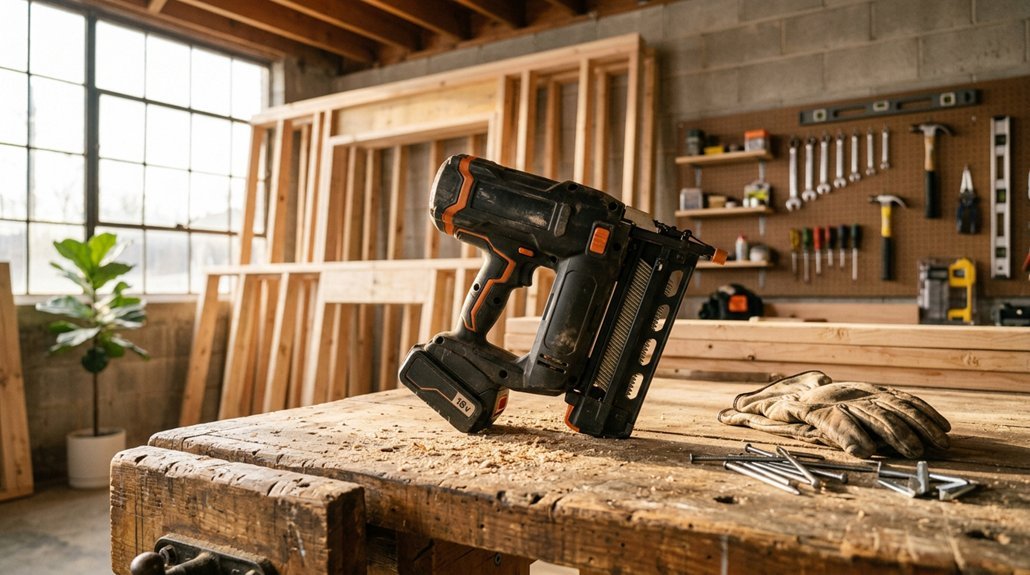
Before you pick a cordless framing nailer, I’m going to walk you through what actually matters in real jobs. Power, battery life, weight, how it feels in your hands after hour three, plus nailing modes and depth adjustment, these aren’t just specs on a box.
Trust me, I’ve learned the hard way which features separate a tool you’ll love from one that collects dust.
Recommended Products

Drives a range of 18 gauge brad nails from 5/8" to 2", magazine capacity up to 110 nails

【2-in-1 Brad nailer】SILVEL cordless brad nailer is a 2-in-1 cordless nail gun that can drive 18GA brad nails (3/4" to 2") and 18GA staples (3/4" to 1-5/8"). And with given 500 brad nails (3/4" to 1-1/2") and 500 staples (3/4" to 1-1/4"), it can be a versatile tool for various woodworking and home repair projects.

CORDLESS FRAMING NAILER: Metabo HPT introduces the 18V MultiVolt Cordless 21° 3-1/2" Plastic Strip Framing Nailer, raising the bar for cordless framing nailers. Metabo HPT is proud to build upon its strong pneumatic heritage and offer a professional cordless framing option.
Power and Performance
How do you know a cordless framing nailer won’t leave you hanging mid-job? You’ll want to check its driving power, rated in joules or the specific nail lengths it handles (2″ to 3-1/2″ is standard for framing).
I’ve learned that voltage matters, a lot. An 18V or 20V platform gives you serious oomph for dense lumber, while brushless motors keep things running cooler and longer with basically zero maintenance. Here’s what separates the workers from the wannabes: look for plastic-collated or full-round head nail compatibility (especially 21° models), they grip better in engineered wood; and match battery capacity to your workload, 4.0Ah minimum for production framing.
Bottom line: skip underpowered bargain models. They’ll stall on oak, skip on old pine, and generally ruin your day.
Battery Life
What good’s all that driving power if you’re hunting for a charger every twenty minutes? Battery capacity determines everything here. A 4.0Ah pack drives hundreds of nails per charge in the best kits, though your actual runtime swings wildly based on nail length and depth settings. Deeper drives drain power faster.
Brushless motors stretch that juice further, plain and simple. They deliver more nails per charge than old brushed motors, and you’ll feel the difference on long days. Some manufacturers promise 500 framing nails per charge, but that’s under perfect lab conditions. Real job sites? Cut that number by a third.
Watch the battery compatibility fine print too. “Tool only” deals mean you’re buying extra packs, which changes your total cost and runtime math.
Weight and Ergonomics
Why lug around dead weight all day when you don’t have to? I’ve handled framing nailers ranging from 7.5 pounds to nearly 12 pounds fully loaded, and trust me, those extra pounds add up fast.
Weight Classes That Matter
The lightest models, around 7.5–8.4 pounds, feel almost like an extension of your arm during overhead work. Heavier units tire my shoulders by lunch.
For tight spaces, I prioritize a slim nose and balanced body, compact profiles that twist between studs without fighting back.
Ergonomic Wins
Tool-less depth adjustment saves setup time and keeps handling comfortable. No knobs to fumble, no awkward repositioning. Cordless designs ditch hoses and compressors entirely, streamlining everything.
My Take
If you frame daily, go lighter. Weekend warriors can tolerate more weight. Either way, balance beats brute force every single time.
Nailing Modes
Most cordless framing nailers give you one of two firing modes: sequential, where you pull the trigger for every single nail, perfect for precise placement, or bump fire, where you hold the trigger and just bump the nose against the workpiece, great for speed, but easy to mess up.
I always look for a two-mode selector switch. It lets me toggle between sequential for door headers and bump fire for long wall runs.
Bump fire blasts through sheathing fast, but without careful control, you’ll nail your boot instead of the stud. Some models pair these modes with anti-dry-fire and LED lights, which help me place nails accurately when the light’s fading.
For most DIYers, sequential mode alone works fine. Speed demons doing big framing jobs need that bump option.
Depth Adjustment
How deep should a nail go? That depends on your material, but I need control, not guesswork. Tool-less depth adjustment is non-negotiable for me. I tweak on the fly without digging for hex keys.
Look for these features:
Tool-Free Dials: Twist and go. Set flush or countersink in seconds.
Clear Scales: I squint enough already. A readable indicator saves headaches.
Nail Length Range: 2″ to 3½” compatibility matters. Denser lumber needs deeper sets.
Battery Consistency: Cordless means no compressor lag, but the gun must hit the same depth from full charge to empty. Some models wander; I avoid them.
Bonus: Lockout features prevent dry fires that wreck depth calibration. One misfire, and your whole row looks amateur.
Pick precision. You’ll thank me.
Magazine Capacity
Where do you draw the line between fewer reloads and a sore arm? I’ve wrestled with this trade-off plenty.
Magazine capacity dictates how many nails you fire before stopping. Some models hold 41 nails; others vary. More nails means fewer interruptions on long walls, but the extra weight adds up fast. My shoulder notices after a full day.
Nail type matters too. Full-round head and plastic-collated designs fit different magazines, changing your total count.
I prefer rear lock-and-load systems, they shave seconds off each reload. Quick-load features help, especially when you’re racing daylight.
Pro-grade tools often pair big magazines with heavy builds. Great for crews framing all week. For weekend warriors, a lighter, smaller magazine usually wins. What’s your priority, speed or comfort?
Tool Warranty
Once you’re committed to a nailer, you’re also signing up for whatever protection comes with it, and that matters more than most folks realize upfront. I’ve seen too many buyers scramble when their tool dies six months in, and guess what? The warranty’s barely worth the paper it’s printed on.
Here’s what I actually check:
Coverage length: Some brands offer five years versus the standard one to two. That’s real money saved if the motor or drivetrain fails.
What’s excluded: Batteries often have separate, shorter terms; wear parts like O-rings typically aren’t covered at all. Misuse clauses? Read those carefully, or you’re toast.
Registration hassle: Skip it, and your warranty’s void. I set a phone reminder the day I buy.
A solid warranty tells me the manufacturer actually trusts their build. Factor it into your total cost, because repairs ain’t cheap.