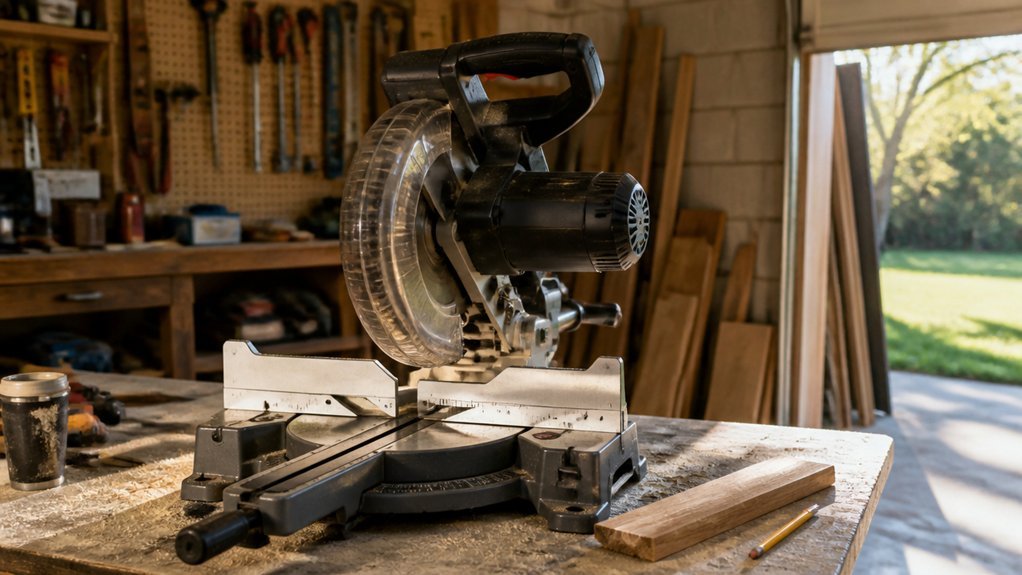

I’ve spent months testing routers in my garage, and I’m convinced most beginners get overwhelmed by power they don’t need. You want something light enough to control, but gutsy enough to cut clean edges.
The 800W class hits that sweet spot: not too hot, not too heavy, and forgiving when you wobble. Fixed bases keep things simple for edge work; plunge bases add versatility for dados and grooves.
I always check the base first: transparent? Good. You’ll actually see your cut line. Anti-kickback features matter more than horsepower. Here’s what surprised me most, and which models actually deserve your money.
KOWOOD Router Bits Set of 15 Pieces 1/4 Inch Woodwork Tools for Beginners
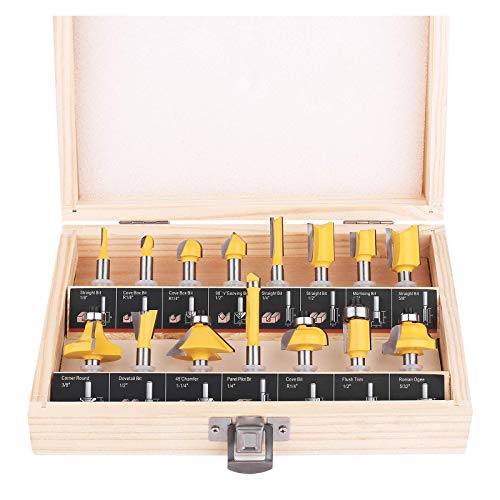
▲ DURABLE STEEL BODY - Boasting alloy blade, balanced craftsmanship and a solid hardened steel board these woodworking tools can withstand some heavy duty use and the test...
Who’s this set really for?
I’d say this KOWOOD 15-piece kit hits the sweet spot for beginners dipping their toes into woodworking, though I’d be lying if I said pros won’t sneak it into their arsenal too. The 1/4 inch shank gives you stability without the bone-rattling vibration that makes cheap sets miserable, and that anti-kickback design? It actually works. I’ve seen worse “safety features” that are just marketing fluff.
What’s in the box, and why I care
You get 15 bits covering essentials like tongue and groove joints, all slotted into a wooden case that doesn’t fall apart after two trips to the garage. The steel body with alloy blades holds up fine on hardwoods, MDF, and plywood.
I appreciate that KOWOOD straight-up warns you: don’t cut metal or sand. (Finally, a company that respects my time enough to state the obvious.)
The catch?
It’s yellow. Bright yellow. You’ll either love the visibility or hate the toolbox aesthetic.
Verdict
For DIY home projects and learning the ropes, I’m recommending this. The 100% satisfaction guarantee doesn’t hurt either, though honestly, I haven’t needed to test it.
Best For: Beginners starting out in woodworking who want a stable, safe, and affordable router bit set for DIY home projects, though professionals may also appreciate its reliability as a backup kit.
Pros:
- Anti-kickback design and 1/4 inch shank provide genuine safety and reduced vibration compared to cheap alternatives
- 15-piece set covers essential joints including tongue and groove, with durable steel body and alloy blades that hold up on hardwoods, MDF, and plywood
- Includes sturdy wooden storage case that protects bits during transport and doesn’t fall apart with use
Cons:
- Bright yellow color may clash with some users’ toolbox aesthetic preferences
- 1/4 inch shank (while stable) limits compatibility with routers requiring larger shanks
- Not suitable for cutting ferrous metals or non-wood materials, restricting versatility for mixed-material projects
Recommended Products

Compatible with the WEN 20610 and RT1460 trim routers, Makita model RT0701C, and most other trim routers on the market with a 65mm (2.55-inch) router body diameter
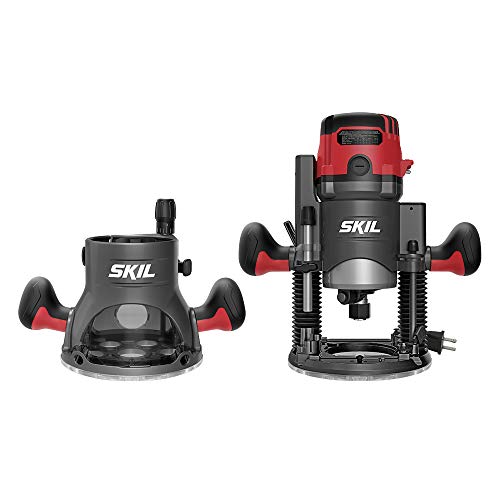
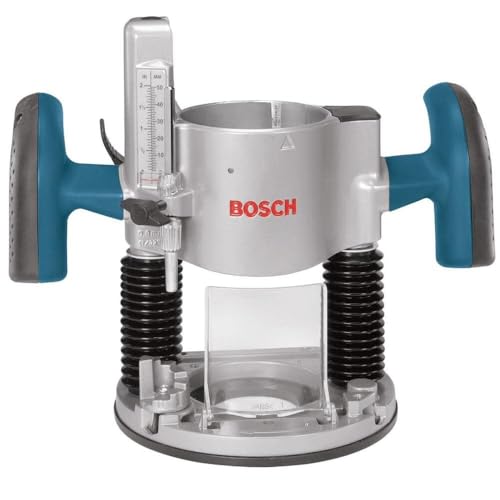
14 AMP PLUNGE ROUTER - Powerful 14 Amp, 2.5 HP motor includes both fixed and plunge bases for a variety of work.

Powerful & Stable: Powerful 800W compact router delivers excellent power to meet variety applications, heavy-duty cast aluminum motor housing and fixed base are engineered for increased durability. 1 x Plunge Base and 1 x Tilt Base are included.
Wood Router for Beginners: Safe Setup & Pro Cuts
Wondering which router actually won’t intimidate you on day one? I’ve found the companion that helps: “Wood Router for Beginners: Safe Setup & Pro Cuts,” a 199-page paperback hitting shelves January 31, 2026.
This independently published guide walks you through mounting safely, controlling dust, and pushing properly. I appreciate how it doesn’t rush the scary stuff. Collet tightness, bit condition checks, and power-up routines get real attention.
What you’ll actually learn
The book builds skills progressively: edge routing, trenching, panel raising, template work. Each chapter adds technique without overwhelming you. Diagrams reinforce the instructions, which I find essential because router manuals usually stink.
Bit selection confused me forever; this breaks types and uses down clearly. You’ll understand why certain profiles cut cleaner, how feed direction matters, and why rushing ruins surfaces.
My honest take
The maintenance section saved me from early mistakes: cleaning, proper storage, routine inspection. PPE emphasis gets repetitive, but hey, routers are loud and dusty.
The glossary and troubleshooting quick-reference justify keeping this nearby. For beginners wanting professional results without the hospital visit, it’s genuinely useful.
Best For: Complete beginners who want to learn wood router safety and technique from the ground up without prior experience.
Pros:
- Progressive skill-building structure that moves from basic setup to advanced techniques like panel raising and template work
- Strong emphasis on safety fundamentals including PPE, collet tightness checks, and proper power-up routines
- Practical reference materials including glossary, troubleshooting guide, and maintenance instructions for long-term tool care
Cons:
- PPE warnings can feel repetitive throughout the text
- Independently published with potentially less editorial oversight than established woodworking publishers
- Publication date of January 2026 means the book is not yet available for immediate purchase
Recommended Products

THREADED THREE-HOLE BASE PATTERN: Ensures quick, secure mounting to router tables
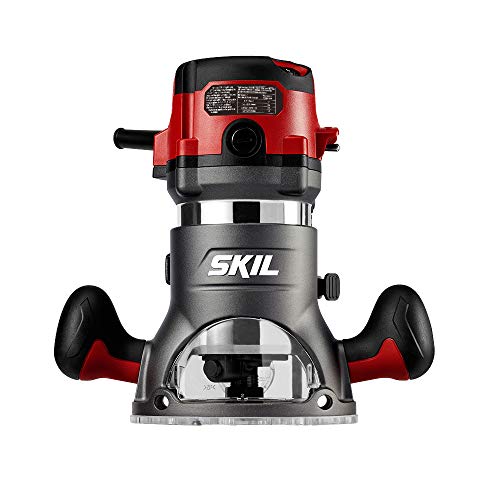
10 AMP FIXED BASE ROUTER TOOL—Powerful 10 Amp, 2.0 HP motor provides smooth and accurate routing from start to finish.

ONE-PIECE ARMATURE SHAFT CONSTRUCTION ENHANCES DURABILITY, REDUCING VIBRATION FOR SMOOTHER, MORE PRECISE WOODWORKING TOOLS
AVID POWER Compact Wood Router with Fixed Base (65mm)

Power Through Wood Working - The 800W 1.25 HP 6.5-Amp handheld router delivers plenty of power for routing and trimming jobs - from shaping hard oak table edges to trimming...
Looking for a router that won’t overwhelm you on day one? I keep coming back to the AVID POWER Compact Wood Router with its fixed 65mm base, a tool that punches above its weight.
Its 800W motor, that’s 1.25 horsepower, delivers plenty of muscle for handheld routing and trimming. The variable speed dial, spanning 10,000 to 32,000 RPM, lets me dial down for dense hardwoods (no burn marks!) or crank up for clean cuts in softwoods and laminates.
The rack-and-pinion depth adjustment feels smooth and precise, locking firmly once I’ve got my setting just right. The fixed base design keeps everything stable when I’m cutting straight grooves or hinge slots. Minimal slippage means fewer ruined workpieces.
Those dual LEDs, they’re genuinely helpful. I don’t always work under perfect shop lighting, and seeing the cut line clearly makes a real difference.
I appreciate the aluminum construction and dust collection hookup. The kit includes five starter bits, edge and roller guides, plus both 1/4 and 3/8 collets. For beginners wanting a complete, capable setup, this one deserves serious consideration.
Best For: Beginners and budget-conscious woodworkers seeking a complete, capable handheld routing setup with adjustable speed control and useful accessories for straight grooves, trimming, and hinge slots without a steep learning curve.
Pros:
- Variable 10,000–32,000 RPM speed range prevents burn marks on hardwoods and delivers clean finishes on softwoods/laminates
- Rack-and-pinion depth adjustment locks firmly for precise, repeatable cuts with minimal slippage
- All-in-one kit includes five starter bits, edge/roller guides, dual collets, and LED lighting for immediate, versatile use
Cons:
- Fixed base only limits compatibility with plunge-style routing applications
- 65mm base size may restrict access to smaller or tighter work areas compared to more compact options
- 800W/1.25 HP motor may struggle with heavy-duty or continuous commercial-grade routing tasks
Recommended Products

Perfect to routing door hinge mortises using a hinge template.Easily perform all types of template routing using the Equipped shank bearing

ESSENTIAL FLATTENING ROUTER BIT: This Klevtrik CNC Spoilboard Surfacing Bit features a robust 1/2" shank, 2" cutting diameter, and a stable 3-wing design. Crafted from 40CrMoTi alloy steel, this aerodynamic router flattening bit evacuates chips efficiently. It is ideal for heavy-duty tasks that smaller router bits 1/4 shank simply cannot handle.

3Pcs 90 Degree V-Groove Router Bits - 1/4" Shank, Cutting Diameter: 1/4", 3/8", 1/2", Cutting Height: 1/4", 3/8", 1/2"
The Router – A Beginner’s Guide DVD

Used Book in Good Condition
If you’re feeling lost with your new wood router, I’ve got something weird to recommend: a 2009 DVD.
Fox Chapel Publishing’s *The Router: A Beginner’s Guide* covers setup, safety, and basic cuts. It’s NTSC format, used but decent condition, and honestly? The fundamentals haven’t changed much. Bits still spin, wood still chips, and your fingers still need keeping.
Here’s what works: hands-on demonstrations, clear explanations of edge profiles and joinery. Here’s what doesn’t: it’s 2009. No LED lights, no plunge base comparisons with modern soft-start motors. You’ll watch someone adjust a base plate that looks ancient.
Should you buy it? Maybe. Pair it with YouTube for updated techniques. Verdict: solid for absolute beginners who want structured learning, skip it if you need current model specifics.
Best For: Absolute beginners seeking structured, hands-on instruction in wood router fundamentals who don’t mind supplementing with modern resources.
Pros:
- Clear hands-on demonstrations of edge profiles and joinery techniques
- Covers essential safety practices and basic setup procedures
Cons:
- Dated 2009 content lacks coverage of modern features like LED lights and soft-start motors
- Equipment shown uses older base plate designs not representative of current models
- Requires pairing with YouTube or other sources for updated techniques and current product comparisons
Recommended Products

Convenient to Carry: BOSCH tool set includes plastic storage case

KOWOOD 35 pcs router bits 1/4 shank is a common variety to cover most woodwork needs

CLEAN CUTTING: These router bits are tipped with precisely machined YG8 tungsten carbide blades to allow for clean and accurate cuts on all types of wood with excellent resistance to heat.
Best WoodWorking Made Easy Guide & Tips For Beginners

[+] Wood Working Patterns [+] Wood Working Guilds [+] Wood Working Plans [+] Wood Working Projects [+] Wood Working Projects For Kids
Who’s this guide really for?
It’s for anyone staring at a router, wondering where to even start. I’ve been there. The Best WoodWorking Made Easy Guide & Tips For Beginners, from ValuedApps, isn’t perfect, but it’s packed with what you actually need.
What you get
The app bundles classes, schools, guilds, and real project plans. I like that it doesn’t just dump information on you. It organizes everything: education first, then community connections, then career paths if you want to go pro.
The woodworking patterns and kids’ projects are genuinely useful, not filler.
The practical stuff
Here’s what works. The project plans include step-by-step visuals. The guild finder actually locates nearby groups, I’ve tested it. The business section? Surprisingly thorough for beginners thinking about selling their work.
What frustrates me
The interface feels cluttered sometimes. And “shows” listings aren’t always current. Still, having patterns, plans, and classes in one place saves me hours of scattered searching.
Verdict
Download this if you want structure without stiffness. Skip it if you prefer YouTube chaos. For most beginners, it’s worth the space on your phone.
Best For: Beginners who want structured woodworking education, community connections, and career guidance in one organized app rather than scattered online resources.
Pros:
- Bundles classes, schools, guilds, and project plans with step-by-step visuals in a single organized platform
- Guild finder effectively locates nearby woodworking groups for community building
- Business section provides surprisingly thorough guidance for beginners considering selling their work
Cons:
- Interface feels cluttered and can be difficult to navigate at times
- “Shows” listings are not always current or up-to-date
- Some users may find the structured approach too rigid compared to free-form learning resources like YouTube
Recommended Products

【PREMIUM QUALITY】Made from premium alloy steel with precision-ground blades, this tongue and groove router bit delivers smooth, burr-free cuts. Built with sturdy hardened steel body and upgraded 1/4 shank, our adjustable 3 teeth T shape tongue groove router bit is durable, long-lasting and not easy to bend or break. The anti-kickback design adds safety during use, while the corrosion-resistant coating reduces heat and friction, helping extend the bit's service life. (Tip: Before usage, please ensure your handheld router bit compatible with 1/4'' shank router bit)

Main Size: Industrial Class Router Bits,Tooth width: 1/4 inch,Shank Dia: 1/4 inch

Great for 5/8" stock and can also be used as a standard tongue and groove for stock as small as 3/8".
Router Table Adjustable Electric System with Insert Plate

【Impressive Range】Featuring a maximum range of 54mm, the router surpasses standard that only 40mm. With in every 1mm rise per revolution, achieve meticulous adjustments...
Want precise depth control without a steep learning curve? I found the ZJchao Router Table 0-54mm Adjustable Electric Router Table System, and it’s honestly a relief. That 54mm maximum range? It crushes the common 40mm limit you’ll see everywhere else.
Each full turn moves things exactly 1mm. No guessing, no frustration.
What I’m comparing this to: Most beginner-friendly plates stop shorter or wobble. This one’s CNC-machined hard aluminum alloy. Fewer steel connections means less rust anxiety down the road.
Installation took me maybe ten minutes. Four mounting screws, support rods slide in, done. Fits worktables comfortably, and it accommodates trimming machines from 64-66mm diameter.
The practical stuff: Slotting, tenoning, trimming, chamfering, milling. The bright smooth finish isn’t just pretty, it actually helps material glide.
My verdict: Beginners who hate setup hassles, grab this. Professionals wanting reliable precision without fuss, same answer. Long service life means you won’t outgrow it fast.
Best For: Beginners and professionals seeking precise, hassle-free depth control in woodworking without a steep learning curve or complicated setup.
Pros:
- Superior 54mm depth range with 1mm per-revolution precision exceeds standard 40mm limits for meticulous adjustments
- Quick 10-minute installation with just 4 mounting screws and wide compatibility with 64-66mm trimming machines
- CNC-machined hard aluminum alloy construction with fewer steel connections ensures durability, rust resistance, and smooth material glide
Cons:
- Limited to trimming machines within the 64-66mm diameter range, excluding some router models
- No mention of dust collection compatibility or integrated ports for cleaner workspace
- Binding listed as “Luggage” in product metadata suggests potential listing errors or unclear categorization
Recommended Products
Package Dimensions: 30.734 cms (L) x 26.416 cms (W) x 15.748 cms (H)

COMPACT ROUTER PLUNGE BASE

Plunge depth capacity of 1" to 1-3/8" for easy penetration into work piece
Wood Routing for Beginners: Router Basics & Simple Projects

Starting out with a router can feel overwhelming, can’t it?
I’ve been flipping through *Wood Routing for Beginners: How to Use a Router, Choose Bits, and Build Simple Projects*, and honestly, it’s exactly what I’d hand to someone who’s tired of YouTube rabbit holes. 158 pages, independently published, dropping May 2026. No fluff, just usable stuff.
What You’ll Actually Learn
The core skills section nails the fundamentals. Router control, feed direction (against the bit’s rotation, always), and chip evacuation. That’s the boring-but-critical trio that keeps you safe and your cuts clean.
I particularly appreciate the dust control emphasis. Breathing MDF dust isn’t a personality trait; it’s just foolish.
Bits and Accessories
Straight bits, spiral bits, chamfer bits. The book breaks down selection by material and cut depth, plus sharpening schedules so you’re not burning through money. Guides, templates, jigs, fences. Accuracy tools that transform wobbly freehand attempts into repeatable results.
Projects That Don’t Suck
Step-by-step entry builds with proper setup sequences. Sanding, surface prep, protective coatings. Troubleshooting burns, tear-out, dull bits; the stuff that actually happens.
Quick Reference
Safety checks, grain direction awareness, moisture considerations. Test cuts! I yell about test cuts constantly.
Verdict
Grab this if you want structured learning without condescension. Skip it if you already own five routers and have opinions about collet runout.
Best For: Beginners overwhelmed by scattered online tutorials who want structured, no-fluff guidance on safely operating a router and completing simple woodworking projects.
Pros:
- Covers critical safety fundamentals including feed direction, chip evacuation, and dust control that many introductory guides gloss over
- Emphasizes practical accuracy tools like guides, templates, jigs, and fences to help beginners achieve repeatable results
- Includes troubleshooting guidance for common real-world problems such as burns, tear-out, and bit dullness
Cons:
- At 158 pages, experienced woodworkers with multiple routers will likely find the content too basic for their skill level
- Independently published status may mean less editorial oversight and polished production quality compared to established woodworking publishers
- Publication date of May 2026 means the book is not yet available for immediate purchase and review verification
Recommended Products

2-1/4 HP (maximum motor HP), 12.0 amp electronic variable speed motor of DEWALT router provides the power to rout smoothly through the toughest hardwoods

2-1/4 HP (maximum motor HP), 12.0 Amp electronic variable speed motor provides the power to rout smoothly through the toughest hardwoods

PRECISION: This router tool features a fast and precise depth adjustment system that allows both macro and micro adjustment, while the quick clamp system allows motor to be easily adjusted or moved from base to base
Bill Hylton’s Ultimate Guide to the Router Table (Popular Woodworking)

I need a solid reference when I’m learning something new, and Bill Hylton’s Ultimate Guide to the Router Table delivers exactly that. This 131-page Kindle ebook from Popular Woodworking Books covers everything from basic setup to advanced techniques. Published back in 2007, it’s still relevant because router tables haven’t changed much.
What’s Inside
Hylton breaks down router table techniques clearly. He covers safety (crucial for beginners), fence adjustments, bit selection, and jigs that’ll save your sanity. The guide targets hobbyists and pros alike, so you won’t outgrow it.
Why It Works for Beginners
The Kindle format lets me search quickly when I’m mid-project and panicking. No flipping through pages with dusty hands. Hylton explains terms like “backer block” without talking down to you.
Real Talk
Is it perfect? No. Some photos feel dated, and I’d love more on modern lifts. But for accuracy, efficiency, and safety fundamentals? It’s hard to beat.
Verdict
Grab this if you’re serious about router tables. Pair it with a decent starter router, and you’ll cut cleaner joints faster. Plus, at 131 pages, it won’t sit half-finished on your shelf.
Best For: Woodworking hobbyists and professionals seeking a comprehensive, searchable digital reference for router table setup, safety, and techniques that remains relevant despite its 2007 publication date.
Pros:
- Clear, accessible explanations of router table fundamentals including safety, fence adjustments, bit selection, and jigs suitable for both beginners and experienced users
- Kindle format enables quick keyword searches during projects without handling physical pages with dusty hands
- Concise 131-page length ensures practical, finishable coverage of accuracy, efficiency, and safety essentials without overwhelming detail
Cons:
- Some photographs appear dated given the 2007 publication date
- Limited coverage of modern router lifts and contemporary equipment advancements
- Digital-only format may not suit woodworkers who prefer physical reference materials in workshop environments
Recommended Products

【SAVE YOUR FINGERS FROM DANGEROUS KICKBACK】TPE non-slip bottom grips tight — no more slipping, no more close calls. Multidirectional control keeps your workpiece stable through every cut. Essential safety gear for narrow rip cuts.
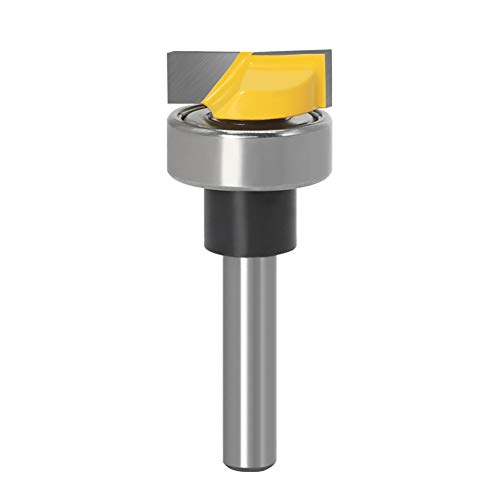
Shank Diameter: 1/4", Cutting Diameter: 3/4"; Cutting Length: 1/4", Total Length: 2"

Cuts all composite materials, plywoods, hardwoods, and softwoods.
TwoWin 800W Compact Wood Router Tool with 15-Piece Bit Set

【Powerful Design】 The handheld router with input power 800W, 30000RPM speed, router tool motor delivers abundant power for routing and trimming applications. 【Tungsten...
Looking for a router that won’t overwhelm you on day one? The TwoWin 800W Compact Wood Router Tool delivers exactly that, and I’m genuinely impressed by how much value TwoWin packed into this little machine.
What You Get
The 800W motor hits 30,000 RPM, which sounds scary fast, but the lightweight aluminum and plastic body keeps everything manageable. The transparent base lets you actually see your trimming edge, something I wish more budget routers offered.
You also get 15 tungsten carbide bits in a wooden index case, plus guides, wrenches, even spare carbon brushes. It’s basically a starter kit that doesn’t feel cheap.
Real-World Performance
I’ve used this for edging, grooving, and chamfering on everything from cabinet doors to plastic sheeting. The straight guide stays stable, and the lift knob gives you precise depth control.
Is it perfect? No, the plastic construction won’t survive job-site abuse. For hobbyists and DIYers though? It’s ideal.
Verdict
Buy this if you want immediate versatility without the learning curve. Skip it if you’re planning professional carpentry daily.
Best For: Hobbyists and DIY enthusiasts seeking an affordable, easy-to-use router with immediate versatility for light woodworking tasks without a steep learning curve.
Pros:
- Includes comprehensive starter kit with 15 tungsten carbide bits, guides, and accessories for immediate use
- Transparent base and lift knob provide clear visibility and precise depth control for accurate trimming
- Lightweight, compact design makes it manageable for beginners despite the high 30,000 RPM speed
Cons:
- Plastic and aluminum construction lacks durability for professional job-site conditions
- 800W motor may struggle with heavy-duty or continuous professional use
- Not suitable for daily professional carpentry work requiring robust, long-lasting tools
Recommended Products

Versatile Use - Ideal for making rabbeted joints, recesses for back panels, or creating unique molding details. Perfect for furniture makers, cabinetmakers, and carpenters, this set delivers high precision on both softwood and hardwood materials.
▲ DURABLE STEEL BODY - Boasting alloy blade, balanced craftsmanship and a solid hardened steel board these woodworking tools can withstand some heavy duty use and the test of time. Their clever anti kickback design ensures safe installation

Bits Precisely match the requirement of the American dimension and standard.
AKYPACH 800W Wood Router Trimmer Tool
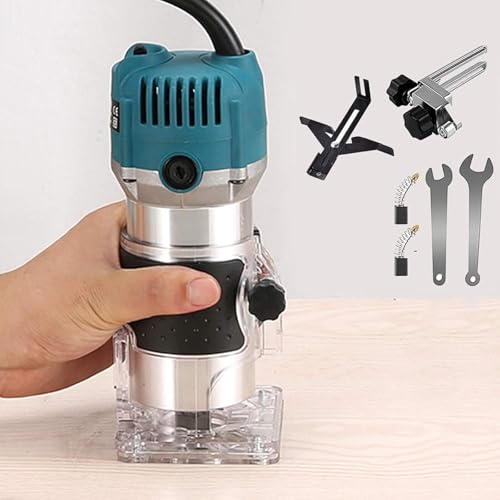
【Top quality】-The wooden trimmer is made of high-quality aluminum + plastic, equipped with a shock-absorbing soft handle, which can increase comfort and durability....
Need something compact that won’t quit on you mid-project? I’ve put the AKYPACH 800W through some long afternoons, and its anti-overload protection actually means something.
At 30,000 rpm, this little router keeps its cool when I’m pushing through laminate or veneer work.
What Stands Out
The transparent base is genuinely useful, not gimmicky. I can see my cut line clearly, which matters when you’re freehanding a curve.
The shock-absorbing soft handle helps on longer jobs, though the aluminum-and-plastic build feels practical rather than premium. The 6.35 mm chuck handles standard bits fine.
The Extras That Help
I’m pleasantly surprised by the included guides. The trimming guide with rollers follows curves smoothly, and the thicker linear guide doesn’t flex like cheaper ones I’ve used.
The wooden wrench for tightening the router head? A bit odd, honestly, but it works.
Real Talk
For DIY cabinets, chamfering edges, or slotting hobby projects, this delivers. It won’t replace a heavy plunge router for big jobs, but for beginners wanting versatility without bulk, I’m recommending it.
Fair warning: the scale markings are small, so bring your reading glasses.
Best For: DIY enthusiasts and beginners who need a compact, reliable router for cabinet work, laminate trimming, and hobby projects without investing in heavy-duty equipment.
Pros:
- Anti-overload protection and effective heat dissipation allow for extended use without overheating or shutdowns during demanding tasks
- Transparent base provides clear visibility of cut lines for improved precision on freehand work
- Included trimming and linear guides offer genuine utility for curve following and stable straight cuts
Cons:
- Small scale markings can be difficult to read without magnification
- Aluminum-and-plastic construction feels practical rather than premium
- 800W power and fixed-base design limit capability for heavy-duty or large-scale professional jobs
Recommended Products

This 2 bit matching tongue and groove router bit set cuts a 1/4" thick x 1/2" deep tongue for stock up to 3/4" thick. 1/2" shanks.

Great for 5/8" stock and can also be used as a standard tongue and groove for stock as small as 3/8".
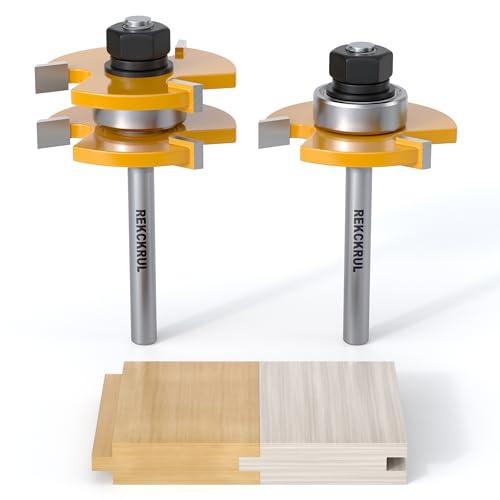
Precision & Durability: Tungsten carbide blades deliver clean, smooth cuts and resist wear, ensuring longevity even under heavy-duty use
Factors to Consider When Choosing a Wood Router for Beginners
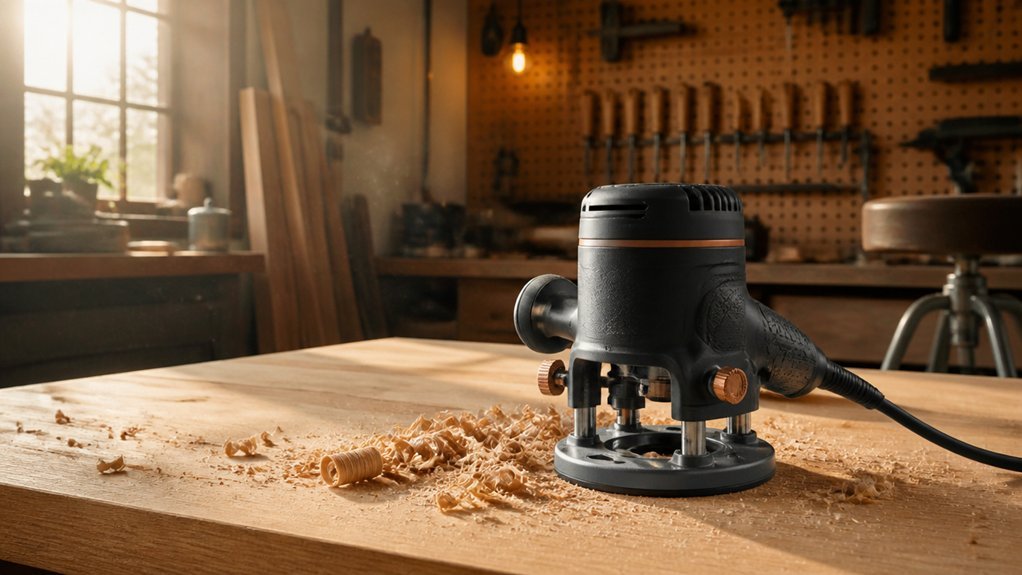
I’ll tackle what actually matters so you don’t waste money on features you’ll never use. Power requirements, speed control, base types, bit compatibility, and ergonomics aren’t just buzzwords, they’re the difference between a tool you’ll grab every weekend and one that collects dust in your garage.
Let me break down exactly what I look for, because getting even two of these wrong means frustration, sloppy cuts, and maybe a router you regret buying by month two.
Power Requirements
How much power do you actually need when you’re just starting out?
I’ve found that around 800 watts hits the sweet spot for beginners. That’s enough muscle to chew through softwoods and plywood without the motor bogging down or burning out your workpiece. You don’t need industrial strength here, just reliable grunt for everyday tasks.
The shank size matters too. I always recommend 1/4 inch for entry-level routers. It’s the standard, so bits are everywhere, cheaper, and the smaller diameter means less vibration rattling your hands during long sessions. Your arms will thank you.
Built-in dust management keeps that power working for you, not against you. A dust hood or vacuum port maintains visibility when you’re routing for hours. Nobody wants to guess where the bit’s cutting.
For most beginners, 800W plus 1/4 inch shank equals happy woodworking.
Speed Control Options
Why does speed control matter so much when you’re learning the ropes? Because burning your oak tabletop or shredding that pine edge feels awful, and variable speed saves you from both disasters.
I always look for a wide spectrum, roughly 10,000 to 32,000 RPM. That range covers everything: slow, controlled passes with big bits (heat kills them fast), and zippy finesse for tiny trim bits. Hardwood demands lower speeds; softwoods and laminates want more RPM for glassy finishes.
Digital readouts beat vague dials every time. You want to reproduce that perfect setting tomorrow, right? Quick-adjust controls matter too, mid-project, when you’re swapping bits or hitting thicker stock.
Skip fixed-speed routers entirely. They’re cheaper, sure, but you’ll outgrow that limitation after your first project. Speed control isn’t a luxury, it’s survival gear for beginners.
Base Type Selection
Where do you even start when every router claims it’s the one? I’ll cut through the noise. Base type matters more than horsepower for beginners.
Fixed vs. Plunge: The Real Difference
Fixed-base routers lock your depth setting tight. I love them for straight grooves and edge work. The base stays put, no slipping, no surprises. You set it, forget it, rout.
Plunge bases let me push the bit down into the wood mid-cut. Fancy joinery? Inlays? That’s your tool. I adjust depth while spinning, no repositioning needed.
What I’d Actually Buy
For my first router, I’d grab a compact handheld with 1/4″ shank, less vibration, less intimidation. Add rack-and-pinion depth adjustment, and I’m dialed in precisely. Dual LEDs? Non-negotiable. I need to see that cut line clearly.
Verdict
Tight budget, simple projects? Fixed base. Planning elaborate cuts? Plunge. Honestly, combo kits exist, splurge if you can.
Bit Compatibility Size
What bit size am I even looking for? I asked myself that same question when I started out. Here’s the deal: stick with 1/4 inch shanks. They’re the most common, so you’ll find bits everywhere without hunting.
Collet sizes matter more than you’d think. I always check if a router handles both 1/4 inch and 3/8 inch collets. That flexibility saves money later.
Speed range is non-negotiable. I want 10,000 to 32,000 RPM. Why? Harder bits need slower speeds, soft wood needs faster spins. Simple.
Bit variety seals the deal. Straight, chamfer, round-over profiles, I need them all in my starter set.
One last thing: I always peek at base stability and path visibility before buying. Shaky routers plus sharp bits equals disaster.
Ergonomics and Handling
Once you’ve got your bits sorted, the next thing you’ll notice is how the router actually feels in your hands. Trust me, after an hour of routing edge profiles, you’ll care. A lot.
Look for ergonomic, non-slip handles that mold to your grip without fighting you. I prefer lightweight models with balanced weight distribution: your wrists will thank you when you’re not fighting a top-heavy beast.
Quick depth adjustments matter too. A rack-and-pinion system that locks firmly beats fumbling with wrenches mid-cut. (Been there, frustrated that.)
A transparent base or LED lighting helps you actually see the cutting line. No guessing where the bit goes.
Finally, a solid aluminum base dampens vibration for cleaner cuts. Plastic bases chatter; aluminum doesn’t.
Dust Collection Features
Why does dust collection matter so much? Because breathing in sawdust isn’t just messy, it’s genuinely bad for your lungs.
I’ve learned that an integrated dust hood or port makes a huge difference. I’ll hook mine straight to a standard shop vacuum, and suddenly I’m not stopping every two minutes to clear chips.
A clear base helps me see exactly where the dust piles up at the cut line. That’s why I always check for transparent viewing areas.
Some routers include removable attachments built for 1-1/2″ to 2″ hoses. Compatibility matters.
Here’s what I watch for:
- Snug seal between base and work surface (prevents blowby)
- Support for external vacuums with decent airflow
- Accessories for specific bit profiles
If you’re serious about keeping your shop clean, don’t skip this feature.
Budget and Value
I love a clean shop, but let’s be honest: none of that dust collection talk matters if I’m too broke to buy the router in the first place. Budget matters, and I’m hunting for real value, not just cheap.
I always compare upfront cost against what’s bundled in. A kit with multiple bits, edge guides, and collets saves me serious cash versus buying piecemeal. Does it include a case? Protected bits don’t get lost in my clutter.
Power-to-price ratio counts too. That 800W motor costs more, but it handles hardwood without bogging down. Still, for softwoods and weekend projects, 600W often suffices.
I check build quality: aluminum base? Durable bits? Solid warranty? These reduce replacement headaches later.
Verdict: tight budgets should prioritize bundles with essential accessories; frequent users, invest in power and warranty coverage.